Whatsapp

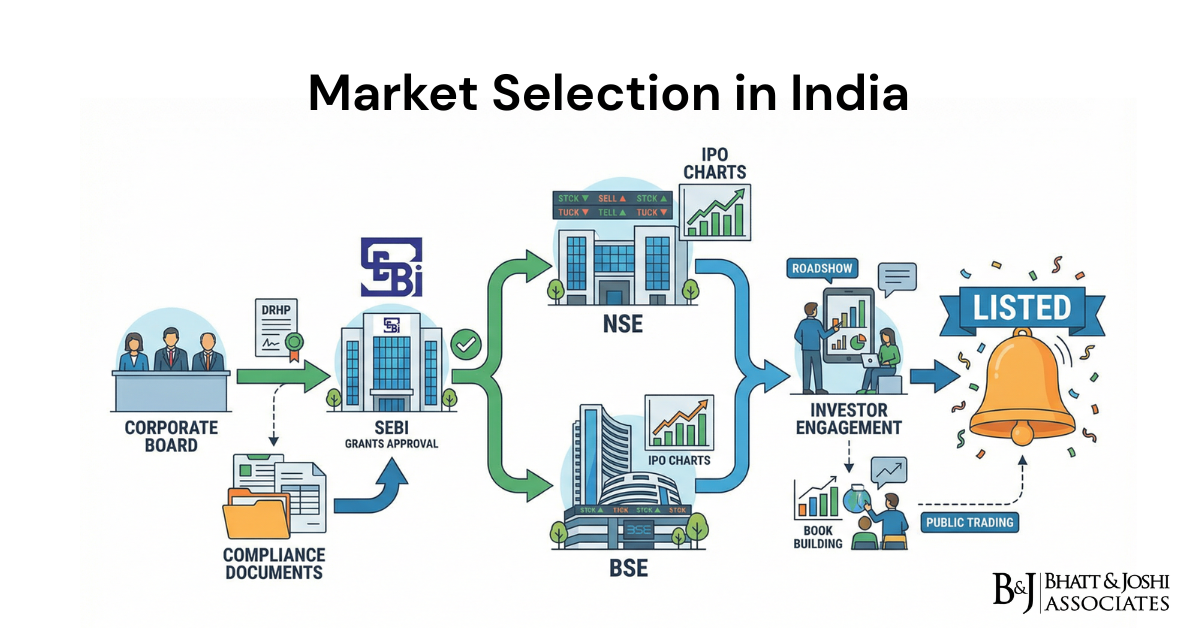
Market Selection in India: Legal and Regulatory Framework
Introduction
Market selection in India represents a critical juncture where companies decide to access public capital markets through listing on recognized stock exchanges. This process involves navigating a sophisticated regulatory landscape designed to protect investor interests while promoting market development. The Indian securities market operates under a multi-layered regulatory framework primarily governed by the Securities and Exchange Board of India Act, 1992, the Securities Contracts (Regulation) Act, 1956, and various regulations issued thereunder. Understanding these legal requirements is essential for companies seeking to raise capital through public offerings and for maintaining transparency in the securities market.
Regulatory Framework Governing Market Selection in India
The Securities and Exchange Board of India Act, 1992
The cornerstone of securities market regulation in India is the Securities and Exchange Board of India Act, 1992, which established SEBI as the principal regulatory authority [1]. The preamble of the SEBI Act clearly articulates its purpose: “to protect the interests of investors in securities and to promote the development of, and to regulate the securities market and for matters connected therewith or incidental thereto.” SEBI functions with quasi-legislative, quasi-judicial, and quasi-executive powers, enabling it to draft regulations, conduct investigations, and pass rulings to maintain market integrity.
Section 11 of the SEBI Act, 1992 outlines the extensive powers and responsibilities vested in SEBI [2]. This provision mandates that SEBI shall protect investor interests, promote market development, and regulate the securities market through appropriate measures. The section empowers SEBI to regulate intermediaries including stock brokers, merchant bankers, portfolio managers, and other market participants. Furthermore, SEBI possesses powers similar to those of a civil court under the Code of Civil Procedure, 1908, particularly for discovery and production of documents during investigations.
Section 11B of the SEBI Act grants the Board the authority to issue directions and levy penalties when it deems necessary for investor protection or orderly market development [3]. This provision has been instrumental in SEBI’s enforcement actions against market participants who violate securities laws. The power extends to directing disgorgement of wrongful gains made through contraventions of the Act or regulations.
Section 11C, introduced through an amendment effective from October 29, 2002, provides SEBI with wide-ranging investigative powers [4]. SEBI can appoint any person as an investigating authority to examine the affairs of intermediaries or persons associated with the securities market. This provision does not prescribe specific qualifications for investigating authorities, giving SEBI flexibility in conducting thorough investigations into market irregularities.
The Securities Contracts (Regulation) Act, 1956
The Securities Contracts (Regulation) Act, 1956 represents India’s first all-India legislation standardizing stock exchange practices across the country [5]. Enacted on September 4, 1956, and coming into force on February 20, 1957, this Act regulates contracts in securities and establishes the framework for stock exchange operations. The Act defines fundamental concepts including contracts for purchase or sale of securities, recognized stock exchanges, and the regulatory requirements for listing securities.
Section 3 of the SCRA establishes the procedure for recognition of stock exchanges. Any stock exchange desirous of recognition must apply to the Central Government (now SEBI) in the prescribed manner, providing particulars about its bye-laws and constitutional rules. Recognition can be granted subject to conditions ensuring fair dealing and investor protection.
Section 21 of the SCRA addresses the listing of securities by public companies [6]. This provision, read together with Section 21A concerning delisting, forms the foundation for companies’ access to capital markets. Public companies seeking to list their securities must comply with conditions prescribed by SEBI regarding disclosure requirements, corporate governance standards, and ongoing obligations post-listing.
Section 22 and Section 22A of the SCRA provide companies with an appellate mechanism when stock exchanges refuse to list their securities [7]. If a recognized stock exchange refuses to list a company’s securities, the company is entitled to receive reasons for such refusal and may appeal to the Securities Appellate Tribunal within fifteen days. This provision ensures procedural fairness in the listing process and prevents arbitrary rejection of listing applications.
SEBI (Issue of Capital and Disclosure Requirements) Regulations, 2018
The SEBI (Issue of Capital and Disclosure Requirements) Regulations, 2018, commonly referred to as ICDR Regulations, replaced the earlier 2009 regulations and constitute the primary regulatory framework governing capital raising activities in India [8]. These regulations came into force sixty days from their publication in the Official Gazette on September 11, 2018.
Regulation 6 of the ICDR Regulations prescribes eligibility criteria for companies making initial public offerings. An unlisted issuer may make an IPO if it has net tangible assets of at least three crore rupees in each of the preceding three years, of which not more than fifty percent are held in monetary assets. Additionally, the issuer must demonstrate a track record of distributable profits for at least three years out of the immediately preceding five years, with each year having distributable profits.
The regulations also prescribe detailed disclosure requirements through the Draft Red Herring Prospectus and Red Herring Prospectus. These documents must contain all material information that investors would reasonably require for making informed investment decisions. The duty to disclose extends beyond mere accuracy to ensuring adequacy and completeness of information.
Chapter IX of the ICDR Regulations specifically addresses Small and Medium Enterprises, providing a more flexible framework for SMEs to access capital markets. An issuer is eligible for SME IPO if its post-issue paid-up capital does not exceed ten crore rupees. The SME framework recognizes that smaller companies may not meet the stringent requirements applicable to mainboard listings while still deserving access to public capital.
SEBI (Listing Obligations and Disclosure Requirements) Regulations, 2015
The SEBI (Listing Obligations and Disclosure Requirements) Regulations, 2015, commonly known as LODR Regulations, govern the continuing obligations of companies post-listing [9]. These regulations unified and strengthened the regulatory framework for listed companies, replacing the erstwhile listing agreements. The LODR Regulations mandate timely disclosure of financial results, material events, and corporate actions. They also prescribe corporate governance norms including board composition requirements, with at least fifty percent non-executive directors and specified proportions of independent directors depending on whether the chairman is executive or non-executive.
Eligibility Criteria for Market Selection in India
Financial Requirements
The financial prerequisites for listing on Indian stock exchanges vary between the mainboard and SME platforms, and these criteria play a decisive role in market selection in India for companies seeking public capital. For mainboard listing on NSE, companies must have minimum paid-up equity capital of ten crore rupees, net worth of at least three crore rupees, and demonstrate profitability for three consecutive years. The minimum public issue size must be at least ten crore rupees. For BSE mainboard, the minimum market capitalization requirement stands at twenty-five crore rupees.
For SME platforms, the eligibility criteria are more relaxed to encourage smaller companies. The post-issue paid-up capital must range between one crore and twenty-five crore rupees. A minimum net worth of three crore rupees is required, calculated as the sum of paid-up capital and reserves. Unlike mainboard IPOs, SME listings do not mandate specific minimum turnover or profitability requirements, providing flexibility for growth-oriented companies.
Track Record and Operational Requirements
Companies seeking listing must demonstrate an operating track record of minimum three years. This requirement ensures that only sustainable business models with proven operations approach the capital markets, protecting investors from premature or untested ventures. The track record requirement applies to both mainboard and SME listings, though the specific financial performance criteria differ.
In cases of name changes within the preceding year, the company must demonstrate that at least fifty percent of revenue for the preceding full financial year was earned from activities indicated by the new name. This provision prevents companies from misleading investors through cosmetic name changes that do not reflect actual business operations.
Promoter and Director Qualifications
The regulatory framework imposes strict requirements on promoters and directors of companies seeking listing. No promoter or director should be a wilful defaulter or fraudulent borrower. Any promoter or director who is a fugitive economic offender is prohibited from accessing capital markets. Directors must not be disqualified or debarred by any regulatory authority, including SEBI, the Reserve Bank of India, or the Ministry of Corporate Affairs.
Promoters must not have been associated with companies that were compulsorily delisted, unless the consequences of such delisting have been addressed. This provision ensures that individuals with a history of regulatory violations or corporate failures face appropriate restrictions in accessing capital markets again.
Corporate Governance and Compliance Standards
Listed companies must maintain robust corporate governance structures. The board of directors must have an optimum combination of executive and non-executive directors, with at least fifty percent being non-executive directors. Where the Chairman is non-executive, at least one-third of the board should comprise independent directors. If the Chairman is executive or a promoter, at least fifty percent of the board must be independent directors.
Companies must establish board committees including an audit committee with specific composition and terms of reference. The audit committee must have at least three directors with the majority being independent directors, and all members must be financially literate with at least one member having accounting or financial management expertise.
Case Law Developments
DLF Ltd. v. SEBI
The landmark case of DLF Ltd. v. SEBI significantly shaped the interpretation of disclosure requirements under securities regulations. DLF, India’s largest real estate company at the time, was penalized by SEBI for failing to disclose material information in its IPO prospectus regarding transactions transferring ownership of subsidiaries to related parties and outstanding litigation. The Securities Appellate Tribunal initially overturned SEBI’s order, but the Supreme Court ultimately upheld SEBI’s position. The Court established that the duty of an issuer while filing a prospectus extends beyond making true and correct disclosures to ensuring such disclosures are adequate. This judgment emphasized that materiality of information should be assessed from the perspective of a reasonable investor, and companies cannot unilaterally decide what information is material enough to disclose.
MCX Stock Exchange Limited v. Securities & Exchange Board of India
This case before the Gujarat High Court involved challenges to the legality and validity of certain SEBI circulars and the Securities Contracts (Regulation) (Stock Exchange and Clearing Corporations) Regulations, 2012. The petitioner argued that these circulars and regulations were inconsistent with the provisions of the Indian Constitution, the Securities Contracts (Regulation) Act, 1956, and the Companies Act, 1956. The Gujarat High Court dismissed the petition and upheld the validity of all challenged circulars and regulations, affirming SEBI’s regulatory authority and the legal framework governing stock exchanges and clearing corporations.
Vishal Tiwari v. Union of India
This recent Supreme Court case dealt with the fall in share prices of the Adani Group following the Hindenburg Research report. Among the reliefs sought was the transfer of investigation from SEBI to the Central Bureau of Investigation or a special investigation team. The Supreme Court reaffirmed SEBI’s investigative authority and declined to transfer the investigation, holding that SEBI possessed adequate powers and expertise to investigate securities market matters. The Court noted its consistent approach of not entertaining petitions questioning the legality of show-cause notices or investigations, as such interference would stall investigative processes.
Market Infrastructure and Exchange Selection
National Stock Exchange of India (NSE)
Bombay Stock Exchange (BSE)
The Bombay Stock Exchange, established in 1875, is Asia’s oldest stock exchange and plays a crucial role in India’s capital markets. BSE offers both mainboard and SME platform listing opportunities. The BSE SME platform specifically caters to small and medium enterprises with modified eligibility criteria, providing these companies with access to capital while maintaining appropriate investor protection mechanisms.
Regulatory Oversight and Enforcement
Investigation and Enforcement Powers
SEBI’s enforcement framework demonstrates its commitment to maintaining market integrity. According to recent data, more than ninety percent of SEBI investigations pertain to market abuse issues including insider trading and market manipulation. In fiscal year 2022-2023, of 144 investigations initiated, 59 percent involved insider trading cases while 37.5 percent concerned market manipulation and price rigging.
The prohibition of insider trading is governed by SEBI (Prohibition of Insider Trading) Regulations, 2015, which prohibit trading while in possession of unpublished price-sensitive information. Market manipulation is addressed through SEBI (Prohibition of Fraudulent and Unfair Trade Practices) Regulations, 2003, which aim to prevent fraudulent, deceptive, and unfair trading practices.
Penalties and Consequences
The regulatory framework provides for significant penalties for violations. Section 15A to 15HB of the SEBI Act prescribe various penalties that can be imposed through adjudication proceedings. For insider trading violations, penalties can extend up to twenty-five crore rupees or three times the profit made, whichever is higher. Violations of disclosure requirements, listing obligations, and other regulatory provisions attract penalties proportionate to the severity of the violation.
Conclusion
Market selection in India operates within a robust legal framework designed to balance capital formation needs with investor protection imperatives. The multi-tiered regulatory structure comprising the SEBI Act, Securities Contracts Regulation Act, and various SEBI regulations provides clarity on eligibility criteria, disclosure obligations, and ongoing compliance requirements. Recent judicial pronouncements have reinforced the importance of adequate disclosure and upheld SEBI’s regulatory authority. As India’s capital markets continue to evolve, this regulatory framework adapts to accommodate new financial instruments and market practices while maintaining its core commitment to transparency, fairness, and investor protection. Companies contemplating market access must navigate these requirements carefully, recognizing that regulatory compliance extends beyond initial listing to encompass continuous obligations throughout their tenure as public companies.
References
[1] Law.asia. (2025). The SEBI and its legislative framework. Available at: https://law.asia/sebi-regulations-capital-markets-india/
[2] The Legal School. (n.d.). Section 11 of SEBI Act: An Overview of Functions of the Board. Available at: https://thelegalschool.in/blog/section-11-sebi-act
[3] India Code. (n.d.). Securities and Exchange Board of India Act, 1992. Available at: https://www.indiacode.nic.in/bitstream/123456789/1890/1/AA1992__15secu.pdf
[4] SCC Times. (2024). SEBI’s Powers to Investigate: A Primer on Section 11-C of the SEBI Act, 1992. Available at: https://www.scconline.com/blog/post/2024/07/22/sebi-power-to-investigate-primer-on-section-11-c-sebi-act-1992-experts-corner/
[5] The Securities Blawg. (2024). Historical Underpinnings II – Path to the Securities Contracts (Regulation) Act, 1956. Available at: https://www.thesecuritiesblawg.in/post/historical-underpinnings-ii-path-to-the-securities-contracts-regulation-act-1956
[6] PW. (n.d.). Securities Contracts Regulation Act, 1956 Provision and Significance. Available at: https://www.pw.live/cs/exams/securities-contracts-regulation
[7] Asian Laws. (2020). A guide to the Securities Contracts (Regulation) Act, 1956. Available at: https://www.asianlaws.org/blog/a-guide-to-the-securities-contracts-regulation-act-1956/
[8] TaxGuru. (2025). Applicability of SEBI ICDR Regulations, 2018. Available at: https://taxguru.in/sebi/applicability-sebi-icdr-regulations-2018.html
[9] MUDS. (2025). What Makes a Business Eligible for BSE SME Listing in India? Available at: https://muds.co.in/what-makes-a-business-eligible-for-bse-sme-listing-in-india/