Whatsapp

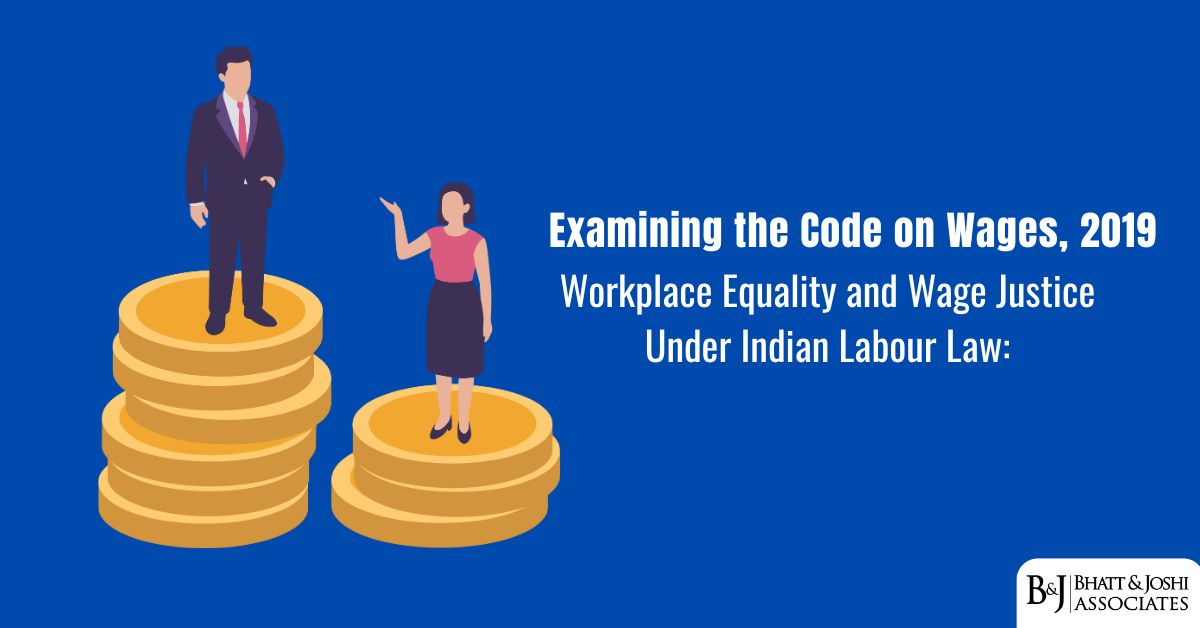
Code on Wages 2019: Ensuring Workplace Equality and Wage Justice in India
Introduction
India’s journey toward establishing wage equality has been marked by progressive legislative reforms aimed at eliminating discrimination in the workplace. The enactment of the Code on Wages, 2019 represents a watershed moment in Indian labour law, consolidating four separate enactments into a unified framework that addresses wage-related matters for all workers across organized and unorganized sectors. This consolidation demonstrates the government’s commitment to simplifying the complex web of labour regulations while strengthening protections against wage discrimination.
The Code on Wages received Presidential assent on August 8, 2019, and was published in the Official Gazette the same day [1]. This landmark legislation repealed and replaced the Payment of Wages Act, 1936, the Minimum Wages Act, 1948, the Payment of Bonus Act, 1965, and the Equal Remuneration Act, 1976, bringing these diverse provisions under one comprehensive statute. The Code extends its protective umbrella to all employees in India, irrespective of their sector of employment or wage ceiling, thereby universalizing the right to minimum wages and timely payment. By replacing the gender-specific terminology of “men and women” with the inclusive term “gender,” the Code takes a progressive stance that recognizes the rights of transgender persons and other gender identities within its ambit.
Constitutional Foundations of Wage Equality
The principle of equal remuneration finds its constitutional moorings in Article 39(d) of the Indian Constitution, which is enshrined within Part IV containing the Directive Principles of State Policy. Article 39(d) explicitly states that “the State shall, in particular, direct its policy towards securing that there is equal pay for equal work for both men and women” [2]. Though Directive Principles are not directly enforceable in courts, they serve as fundamental guidelines for governance and policy formulation, representing the constitutional vision of establishing social and economic justice for all citizens.
The transformative judicial interpretation of this principle began with the landmark judgment in Randhir Singh v. Union of India delivered on February 22, 1982 [3]. In this seminal case, the Supreme Court held that while equal pay for equal work is not expressly declared as a fundamental right, it is certainly a constitutional goal capable of enforcement through constitutional remedies. Justice Chinnappa Reddy, speaking for the Court, observed that the principle is not a mere abstract doctrine but one of substantial importance. The Court established that Directive Principles must be read into fundamental rights as a matter of interpretation, thereby deriving the principle of equal pay from Articles 14 and 16 when read in conjunction with Article 39(d). The judgment emphasized that the Preamble to the Constitution declares India to be a Socialist Democratic Republic, and the word “Socialist” must mean at minimum “equal pay for equal work.”
This constitutional interpretation was further strengthened in subsequent judicial pronouncements. The Supreme Court has consistently reinforced that persons performing identical work under the same employer cannot be treated differentially merely because they belong to different departments or hold different employment statuses, provided all relevant considerations remain the same.
Legislative Framework: From Fragmented Laws to Unified Code
Prior to the Code on Wages, India’s legislative framework for wage regulation was scattered across multiple statutes. The Equal Remuneration Act, 1976 was enacted to provide for payment of equal remuneration to men and women workers and to prevent discrimination on the ground of sex against women in matters relating to employment. However, this Act suffered from several limitations that hampered its effectiveness in achieving true wage equality.
The Equal Remuneration Act adopted a narrow interpretation of “same work or work of a similar nature,” focusing primarily on identical job functions rather than recognizing the intrinsic value of different types of work [4]. This restrictive approach failed to account for the systematic undervaluation of female-dominated occupations such as caregiving, domestic labor, and other service-oriented roles. The Act also contained provisions under Section 16 that permitted the government to declare certain pay differences as non-discriminatory if based on factors other than sex, creating ambiguities that could be exploited to maintain wage disparities. Furthermore, the binary terminology of “men and women” excluded transgender persons and other gender identities from the Act’s protective scope.
The Code on Wages addresses these shortcomings through a more inclusive and robust framework. Section 3 of the Code prohibits discrimination in establishments among employees on the ground of gender in matters relating to wages for the same work or work of similar nature. The provision explicitly states that “there shall be no discrimination in an establishment or any unit thereof among employees on the ground of gender in matters relating to wages by the same employer, in respect of the same work or work of a similar nature done by any employee” [1]. The Code defines “same work or work of a similar nature” in Section 2(v) as work requiring the same skill, effort, experience, and responsibility when performed under similar working conditions, with any differences not being of practical importance in relation to terms and conditions of employment.
Substantive Provisions Ensuring Wage Equality
The Code on Wages, 2019 establishes multiple layers of protection against wage discrimination. Section 3(1) creates an affirmative obligation on employers, mandating that they must not differentiate between employees based on gender when paying wages for identical or similar work. This provision applies uniformly across all establishments regardless of size or sector, marking a significant departure from earlier legislation that often contained exemptions based on establishment size or industry classification.
Section 3(2) contains two critical prohibitions that strengthen the equal pay mandate. First, it prevents employers from reducing the wage rate of any employee for the purpose of complying with equal remuneration provisions, ensuring that wage parity is achieved by raising lower wages rather than lowering higher ones. Second, it prohibits gender-based discrimination in recruitment for the same work or work of similar nature, extending protection beyond wage payment to the initial hiring process itself. This recruitment protection applies to all terms and conditions of employment, with the sole exception being situations where employment of women in such work is prohibited or restricted by law.
The Code addresses potential disputes through Section 4, which empowers the appropriate government to notify authorities for deciding disputes regarding whether particular work constitutes the same or similar nature of work. This dispute resolution mechanism provides a formal channel for employees to challenge discriminatory classifications of their work without resorting immediately to litigation.
Minimum Wage Provisions and Universal Coverage
The Code on Wages, 2019 introduces a revolutionary concept of floor wage under Section 9, which requires the Central Government to fix a floor wage taking into account minimum living standards of workers. This floor wage serves as a baseline below which no State Government can fix minimum wages in their jurisdiction. The provision allows for different floor wages for different geographical areas, recognizing regional variations in cost of living and economic conditions [1].
Section 6 empowers the appropriate government to fix minimum rates of wages for time work or piece work, with specific provisions for ensuring that piece workers receive at least the minimum time-based wage. The Code mandates that minimum wages must be reviewed and revised at intervals not exceeding five years, ensuring regular updates to reflect changing economic realities. In fixing minimum wages, governments must primarily consider the skill levels of workers, categorizing them as unskilled, skilled, semi-skilled, or highly-skilled, and may additionally account for geographical areas and arduousness of work including factors like temperature, humidity, or hazardous conditions.
The universal applicability of minimum wage provisions represents a fundamental shift from earlier legislation. Previously, the Minimum Wages Act, 1948 covered only certain scheduled employments, leaving vast segments of the workforce without statutory wage protection. The Code extends minimum wage coverage to all employees across organized and unorganized sectors, eliminating arbitrary exclusions and ensuring comprehensive protection for India’s diverse workforce.
Judicial Interpretation and Case Law Development
Indian courts have played a pivotal role in developing the jurisprudence around equal pay for equal work, progressively expanding its scope and application. Beyond the foundational Randhir Singh judgment, the principle has been applied and refined through numerous subsequent decisions that have addressed various dimensions of wage discrimination.
The Supreme Court in State of Punjab v. Jagjit Singh, decided on October 26, 2016, addressed the critical issue of wage parity between temporary and permanent employees [5]. The Court held that the principle of equal pay for equal work constitutes a clear and unambiguous right vested in every employee, whether engaged on a regular or temporary basis. The judgment emphasized that in a welfare state, an employee engaged for the same work cannot be paid less than another performing identical duties and responsibilities, as such action strikes at the foundation of human dignity. The Court ruled that temporary employees performing similar duties and functions as permanent employees are entitled to draw wages at par with similarly placed permanent employees at the minimum of the pay scale, though not necessarily entitled to all allowances. This decision has had far-reaching implications for millions of contract and temporary workers across India.
However, the courts have also recognized that the equal pay principle is not a mechanical formula applicable in all situations. The Supreme Court has clarified that for the principle to apply, there must be complete identity of work, qualifications, responsibilities, and conditions of service. The judiciary has maintained that equation of posts and determination of pay scales primarily falls within the executive domain, and courts will interfere only when discrimination is clearly established and lacks rational basis.
Implementation Mechanisms and Enforcement
The Code on Wages, 2019 establishes robust implementation mechanisms to ensure compliance with its provisions. Central and State Advisory Boards are constituted under Section 42, with one-third of members required to be women. These boards advise governments on fixation and revision of minimum wages, increasing employment opportunities for women, and other matters related to the Code. The mandatory inclusion of women in these advisory bodies ensures that gender perspectives are incorporated into wage policy formulation.
Section 45 creates a comprehensive claims mechanism by empowering governments to appoint authorities not below the rank of Gazetted Officer to hear and determine claims arising under the Code. These authorities possess powers equivalent to civil courts for taking evidence and enforcing attendance of witnesses. Significantly, applications can be filed not only by affected employees but also by trade unions or Inspector-cum-Facilitators, enabling collective action and official intervention when individual workers may hesitate to approach authorities independently. The limitation period for filing claims is three years, providing reasonable time for workers to seek redress while maintaining administrative efficiency.
Inspector-cum-Facilitators appointed under Section 51 serve dual functions of ensuring compliance and providing guidance to employers and workers. They possess extensive powers to inspect establishments, examine workers, require production of documents, and even search and seize relevant records when violations are suspected. The Code emphasizes a facilitative approach, requiring Inspector-cum-Facilitators to first provide employers with written direction and reasonable time to comply before initiating prosecution for non-maintenance or improper maintenance of records.
Penalties and Deterrence Framework
The Code prescribes stringent penalties for violations to ensure effective deterrence. Section 54 establishes a graduated penalty structure that distinguishes between different types of violations and repeat offenses. An employer paying less than the amount due to employees faces a fine extending to fifty thousand rupees for the first offense. For subsequent similar offenses within five years, the penalty escalates to imprisonment for up to three months or fine extending to one lakh rupees, or both. This escalating penalty structure reflects the serious view taken of persistent violations.
Interestingly, the Code provides for compounding of offenses under Section 56, allowing first-time offenders to resolve violations by paying fifty percent of the maximum fine prescribed for the offense. However, this compounding facility is not available for repeat offenders within five years, ensuring that habitual violators cannot simply treat penalties as a cost of doing business. The burden of proof in cases alleging non-payment or underpayment of wages rests on the employer under Section 59, shifting the evidentiary burden in favor of workers who typically have limited access to relevant records.
Persistent Challenges in Achieving Wage Equality
Despite the comprehensive legislative framework and supportive judicial pronouncements, significant challenges persist in achieving genuine wage equality in India. Occupational segregation remains a fundamental barrier, with women concentrated in lower-paying sectors and occupations. Cultural attitudes that undervalue women’s work, particularly in caregiving and domestic roles, perpetuate wage disparities even when formal discrimination is prohibited.
The Code on Wages, 2019 is limited to addressing “same work or work of a similar nature” rather than adopting the broader principle of “work of equal value,” a point criticized by commentators [6]. The concept of equal value, recognized in international instruments like the ILO Equal Remuneration Convention, 1951, holds that different types of work requiring comparable skill, effort, and responsibility should receive similar remuneration, even if the specific tasks differ. By not embracing this principle, the Code on Wages, 2019 may fail to address the systematic undervaluation of female-dominated occupations that require equivalent qualifications and effort as male-dominated roles but command lower wages.
Implementation challenges also persist, including limited awareness of legal rights among workers, inadequate resources for enforcement agencies, and social pressures that discourage women from asserting their rights. The informal sector, where the majority of women workers are employed, presents particular difficulties for enforcement despite the Code’s theoretical universal coverage.
Comparative Perspectives and International Standards
India’s approach to wage equality can be contextualized within international frameworks and comparative experiences. The ILO Equal Remuneration Convention, 1951, which India ratified in 1958, promotes the principle of equal remuneration for work of equal value. This principle extends beyond identical work to encompass different jobs that are nevertheless of equal value when assessed on criteria of skill, effort, responsibility, and working conditions.
The United Kingdom’s Equality Act, 2010 provides a more expansive framework, distinguishing between like work, work rated as equivalent, and work of equal value. Under this framework, courts have found professions as diverse as clerical assistants and warehouse operatives, or nursery nurses and architectural technicians, to be of equal value despite their different nature [6]. Such comparative examples illustrate possibilities for more comprehensive approaches to addressing wage discrimination that accounts for systematic undervaluation of certain types of work.
Conclusion and Future Directions
The Code on Wages, 2019 represents significant progress in India’s journey toward eliminating wage discrimination and establishing comprehensive protections for all workers. By consolidating disparate legislation, adopting gender-neutral terminology, introducing universal minimum wage coverage, and establishing robust enforcement mechanisms, the Code on Wages, 2019 creates a strong foundation for wage equality.
However, legislative reform alone cannot eliminate deeply entrenched wage disparities. The Code’s effectiveness will depend on vigorous implementation, adequate resource allocation to enforcement agencies, sustained awareness campaigns to educate workers about their rights, and continued judicial vigilance in interpreting provisions broadly to advance substantive equality. Future reforms might consider adopting the principle of work of equal value, strengthening provisions addressing indirect discrimination, and developing more nuanced approaches to addressing occupational segregation and undervaluation of female-dominated work.
The constitutional vision articulated in Article 39(d) remains aspirational rather than fully realized. Achieving genuine wage equality requires not merely formal legal equality but transformation of social attitudes, workplace cultures, and economic structures that perpetuate discrimination. The Code on Wages provides essential legal tools, but their effectiveness depends on sustained commitment from government, employers, workers’ organizations, and society at large to translate legal mandates into lived reality for India’s diverse workforce.