Whatsapp

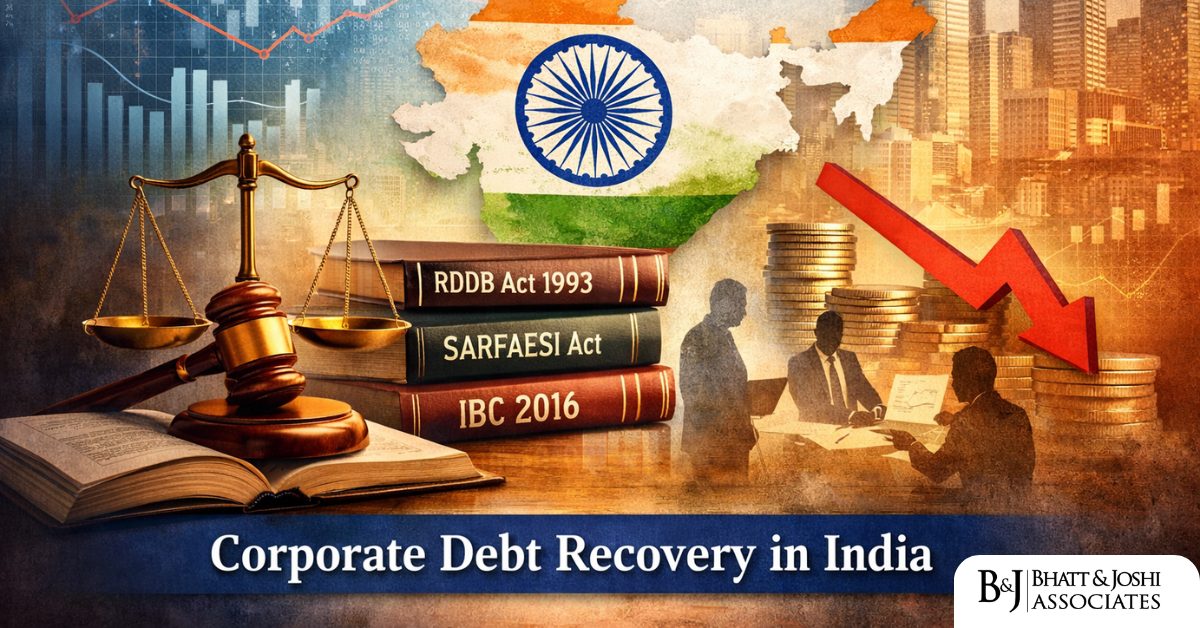
Corporate Debt Recovery in India: Regulatory Framework and Judicial Developments
Introduction
Corporate debt recovery in India has undergone significant transformation over the past three decades, evolving from a fragmented system of civil court litigation to a specialized regulatory framework designed to address the mounting challenge of non-performing assets. The Indian banking sector, which plays a pivotal role in financing economic growth, has historically grappled with delayed debt recovery mechanisms that undermined financial stability and credit availability. Before the introduction of dedicated recovery legislation, financial institutions faced protracted civil court proceedings that often stretched across years, if not decades, resulting in substantial value erosion and creating a culture of debtor impunity. This persistent challenge prompted the government to establish a specialized legal architecture comprising tribunal-based adjudication and creditor-friendly enforcement mechanisms that fundamentally altered the landscape of debt recovery in India.
The Recovery of Debts and Bankruptcy Act, 1993
The Recovery of Debts and Bankruptcy Act of 1993 marked the first systematic attempt to create an expedited forum for debt recovery by banks and financial institutions. This legislation laid the institutional foundation for modern corporate debt recovery in India by establishing specialized tribunals dedicated exclusively to financial claims. The legislation emerged from recommendations of the Tiwari Committee constituted in 1981, which advocated for quasi-judicial mechanisms specifically designed to handle debt recovery matters [1]. This Act established Debt Recovery Tribunals across the country, empowering them with exclusive jurisdiction to adjudicate applications filed by banks and financial institutions seeking recovery of debts exceeding the prescribed monetary threshold. Currently, there are thirty-nine Debt Recovery Tribunals and five Debt Recovery Appellate Tribunals functioning throughout India, each headed by a Presiding Officer and Chairperson respectively, who possess qualifications equivalent to District Judges or High Court Judges [2].
The jurisdictional framework under the Act provides that Debt Recovery Tribunals may entertain applications where the debt amount exceeds twenty lakh rupees, a threshold raised from the original ten lakh rupees to reduce the burden on these specialized forums. The tribunals exercise powers akin to civil courts for purposes of evidence, witness examination, and document discovery, yet operate under principles of natural justice rather than the rigid procedural requirements of the Civil Procedure Code. This procedural flexibility was intended to facilitate speedier adjudication, though in practice, the tribunals have struggled with significant case backlogs and infrastructural constraints that have somewhat undermined their effectiveness.
The SARFAESI Act, 2002: Empowering Secured Creditors
The Securitisation and Reconstruction of Financial Assets and Enforcement of Security Interest Act enacted in 2002 represented a paradigm shift in corporate debt recovery by granting secured creditors the extraordinary power to enforce their security interests without court intervention. This legislation was born from the recognition that the Debt Recovery Tribunal mechanism, while an improvement over civil courts, remained insufficient to address the growing menace of non-performing assets that threatened the stability of India’s banking system [3]. The Act applies to secured loans exceeding one lakh rupees that have been classified as non-performing assets, with the notable exception that accounts where the outstanding amount represents less than twenty percent of the original principal and interest fall outside its purview.
Under the enforcement mechanism prescribed in the Act, when a borrower defaults and the account is classified as a non-performing asset, the secured creditor must issue a demand notice requiring payment within sixty days. If the borrower fails to comply, the creditor may take possession of the secured assets, transfer them through sale or lease, appoint a manager to operate the borrower’s business, or invoke guarantees. The 2016 amendment to the Act introduced significant changes, including empowering banks and Asset Reconstruction Companies to convert debt into equity shares of the defaulting company, thereby potentially becoming equity holders rather than merely creditors [4]. This mechanism allows financial institutions to restructure distressed assets more effectively and potentially participate in the upside of a successful turnaround.
The constitutional validity of this Act was challenged before the Supreme Court in the landmark case of Mardia Chemicals Limited versus Union of India, decided on April 8, 2004 [5]. The petitioners contended that the Act violated fundamental rights by granting banks unchecked powers to seize assets without judicial oversight and imposing an onerous requirement that borrowers deposit seventy-five percent of the disputed amount before filing an appeal with the Debt Recovery Tribunal. The Supreme Court upheld the constitutional validity of most provisions, recognizing that non-performing assets constituted a serious economic challenge requiring swift remedial action. However, the Court struck down the mandatory seventy-five percent pre-deposit requirement as arbitrary and violative of the right to equality and access to justice guaranteed under Articles 14 and 21 of the Constitution. This judicial intervention balanced the need for efficient debt recovery with constitutional safeguards protecting borrowers from potentially oppressive enforcement actions.
Asset Reconstruction Companies and Securitisation
The SARFAESI Act also provided the statutory framework for establishing Asset Reconstruction Companies, which acquire non-performing assets from banks and financial institutions with the objective of resolving them through various strategies including asset reconstruction, management takeover, or outright sale. The first such company, Asset Reconstruction Company India Limited, was established in 2002 by a consortium of four major banks including the State Bank of India, ICICI Bank, Punjab National Bank, and IDBI Bank. These entities are regulated by the Reserve Bank of India and operate by issuing security receipts to qualified institutional buyers, thereby allowing banks to transfer their distressed assets off their balance sheets while the Asset Reconstruction Companies work toward maximizing recovery through specialized expertise and dedicated focus.
The securitisation mechanism envisioned under the Act enables financial institutions to pool non-performing assets and convert them into marketable securities that can be sold to investors. This process provides banks with immediate liquidity while transferring the risk and recovery responsibility to investors who acquire these securities at a discount. The regulatory framework mandates that Asset Reconstruction Companies must possess asset sizes exceeding one hundred crore rupees to be eligible for coverage under the Act, ensuring that only entities with sufficient financial capacity undertake the complex task of asset reconstruction.
The Insolvency and Bankruptcy Code, 2016
The Insolvency and Bankruptcy Code of 2016 introduced a consolidated framework for insolvency resolution and represents the most transformative reform in corporate debt recovery in India. Prior to this enactment, insolvency proceedings were scattered across multiple legislations including the Companies Act, the Sick Industrial Companies Act, and the aforementioned recovery statutes, creating jurisdictional overlap and procedural confusion [6]. The Code established the Insolvency and Bankruptcy Board of India as the regulatory authority overseeing insolvency professionals, information utilities, and registered valuers who constitute the institutional infrastructure for the insolvency resolution process.
The Code’s most significant innovation lies in its time-bound Corporate Insolvency Resolution Process, which must ordinarily be completed within one hundred and eighty days from the date of admission, extendable by a further ninety days with creditor approval. This stringent timeline was designed to prevent the value erosion that occurs when insolvency proceedings drag on indefinitely. Under the process, either financial creditors, operational creditors, or the corporate debtor itself may initiate proceedings by filing an application with the National Company Law Tribunal [7]. Upon admission of the application, the Tribunal appoints an Insolvency Resolution Professional who assumes control of the corporate debtor’s management, displacing the existing board of directors and promoters.
The moratorium declared upon commencement of the Corporate Insolvency Resolution Process constitutes a critical protective mechanism that prohibits the institution of suits or continuation of pending proceedings against the corporate debtor, prevents execution of judgments, and bars actions to foreclose or enforce security interests including those under the SARFAESI Act. This standstill provision ensures that creditors cannot engage in a destructive race to seize assets, thereby preserving the corporate debtor as a going concern while the Committee of Creditors evaluates resolution proposals. The Code’s resolution-oriented approach prioritizes revival of the corporate debtor over mere liquidation, with liquidation serving as a last resort when no viable resolution plan emerges.
Interplay Between Recovery Mechanisms
The coexistence of multiple debt recovery frameworks has necessitated judicial interpretation to delineate their respective domains and resolve potential conflicts. The Supreme Court clarified in Committee of Creditors of Essar Steel India Limited versus Satish Kumar Gupta that once insolvency proceedings commence under the Insolvency and Bankruptcy Code, enforcement actions under the SARFAESI Act are suspended, establishing the primacy of the Code in corporate insolvency scenarios. This hierarchical relationship prevents creditors from simultaneously pursuing multiple remedies that might undermine the collective resolution process contemplated under the Code.
However, secured creditors retain the flexibility to pursue remedies under the SARFAESI Act and simultaneously approach Debt Recovery Tribunals for recovery of any balance amounts that remain outstanding after enforcement of security interests. This complementary relationship allows creditors to maximize recovery by utilizing whichever mechanism proves most effective for the particular circumstances of default. Financial institutions must strategically evaluate whether to pursue the swift but potentially incomplete recovery available under SARFAESI enforcement, the adjudicatory route through Debt Recovery Tribunals, or the holistic resolution process under the Insolvency and Bankruptcy Code.
Regulatory Oversight and Current Challenges
The Reserve Bank of India exercises comprehensive regulatory oversight over the corporate debt recovery framework through various policy guidelines and prudential norms. The central bank prescribes the criteria for classification of non-performing assets, mandates provisioning requirements for bad loans, and issues directions regarding the conduct of Asset Reconstruction Companies. Financial institutions must comply with these regulatory standards while pursuing recovery actions, ensuring that enforcement measures remain proportionate and procedurally sound [8].
Despite the sophisticated legal framework now in place, India’s debt recovery system continues to face significant operational challenges. Debt Recovery Tribunals and Debt Recovery Appellate Tribunals suffer from severe understaffing, with vacancy rates often exceeding fifty percent for presiding officers and supporting staff. The resultant case pendency has grown to alarming levels, with over one lakh cases pending across tribunals as of recent estimates. This backlog substantially undermines the intended expeditious resolution that these specialized forums were designed to achieve. Similarly, the National Company Law Tribunals administering the Insolvency and Bankruptcy Code face capacity constraints that have resulted in delays beyond the statutorily mandated timelines for insolvency resolution.
The effectiveness of recovery mechanisms also varies significantly based on the nature and location of secured assets. Assets such as specialized industrial machinery or properties in remote locations often attract limited interest during auctions, resulting in substantial haircuts for creditors. Recent data indicates that creditors have been forced to accept discounts averaging eighty percent in a significant proportion of insolvency cases, raising questions about whether the current framework adequately balances creditor recovery with debtor rehabilitation. These systemic challenges underscore the need for continued institutional strengthening, technological integration, and procedural reforms to realize the full potential of India’s debt recovery architecture.
Borrower Protections and Appellate Remedies
While the debt recovery framework empowers creditors with potent enforcement mechanisms, it also incorporates safeguards to protect borrowers from arbitrary or wrongful actions. Under the SARFAESI Act, borrowers retain the right to file representations against demand notices, which secured creditors must consider and respond to within prescribed timelines. If aggrieved by enforcement measures taken under the Act, borrowers may appeal to the Debt Recovery Tribunal within forty-five days of receiving notice of the measures, and subsequently to the Debt Recovery Appellate Tribunal if dissatisfied with the Tribunal’s order [9].
The Mardia Chemicals judgment established that civil courts retain residual jurisdiction in exceptional circumstances where the secured creditor’s actions are alleged to be fraudulent or patently absurd, though subsequent judicial pronouncements have interpreted this exception narrowly to prevent circumvention of the statutory scheme. Borrowers also possess the right of redemption, enabling them to reclaim their assets by clearing outstanding dues even after the secured creditor has taken possession, provided the sale has not yet been concluded. These procedural protections attempt to balance the imperative of efficient debt recovery against constitutional guarantees of due process and fair treatment.
Conclusion
India’s corporate debt recovery framework has evolved into a multifaceted system comprising specialized tribunals, creditor-in-possession enforcement mechanisms, and time-bound insolvency resolution processes. The legislative journey from the Recovery of Debts and Bankruptcy Act through the SARFAESI Act to the Insolvency and Bankruptcy Code reflects an increasingly sophisticated understanding of the delicate balance between creditor rights and debtor protections. While significant challenges remain in terms of institutional capacity and procedural delays, the fundamental architecture is now in place to address non-performing assets more effectively than at any previous point in India’s economic history. Continued reforms focusing on tribunal capacity, technological integration, and procedural streamlining will be essential to realize the promise of swift and effective corporate debt recovery that underpins a healthy financial system and supports sustained economic growth.
References
[1] Kanakkupillai. “Debt Recovery Tribunal (DRT) – Process, Powers & Jurisdiction.” Available at: https://www.kanakkupillai.com/learn/debt-recovery-tribunal-drt/
[2] Ministry of Finance, Department of Financial Services. “About Debt Recovery Tribunal.” Government of India. Available at: https://financialservices.gov.in/beta/en/page/debts-recovery-tribunals-debts-recovery-appellate-tribunals
[3] ClearTax. “SARFAESI ACT, 2002 – Applicability, Objectives, Process, Documentation.” Available at: https://cleartax.in/s/sarfaesi-act-2002
[4] IndiaFilings. “Sarfaesi Act – Sarfaesi Act 2002 Rules & Regulations Online.” Available at: https://www.indiafilings.com/learn/sarfaesi-act-india/
[5] Mardia Chemicals Ltd. v. Union of India, (2004) 4 SCC 311. Available at: https://indiankanoon.org/doc/1059476/
[6] Ministry of Corporate Affairs. “The Insolvency and Bankruptcy Code, 2016.” Government of India. Available at: https://www.mca.gov.in/Ministry/pdf/TheInsolvencyandBankruptcyofIndia.pdf
[7] ClearTax. “Insolvency and Bankruptcy Code, 2016.” Available at: https://cleartax.in/s/insolvency-and-bankruptcy-code-2016
[8] Fibe. “Debt Recovery Tribunal (DRT) in India: Role, Process & RBI Oversight.” Available at: https://www.fibe.in/blogs/debt-recovery-tribunal-drt/
[9] iPleaders. “Overview of the SARFAESI Act, 2002.” Available at: https://blog.ipleaders.in/overview-of-the-sarfaesi-axt-2002/