 Whatsapp

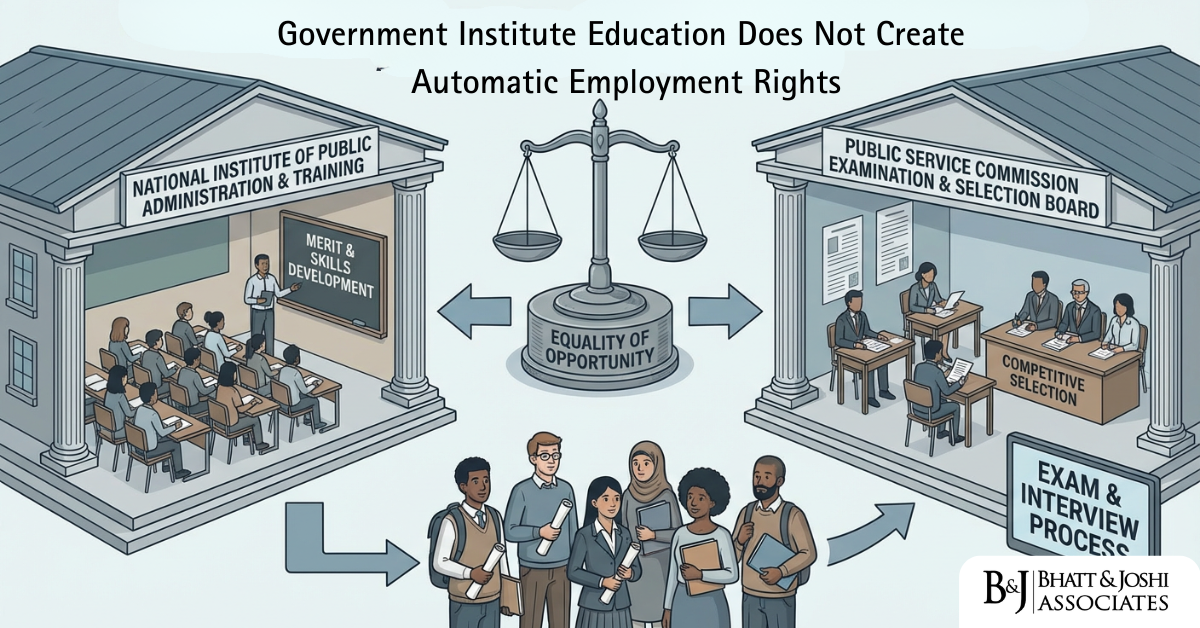
Government Institution Education Does Not Guarantee Government Jobs: Supreme Court on Legitimate Expectation in Government Jobs
Introduction
The Supreme Court of India recently delivered a significant judgment that clarifies the boundaries between education in government institutions and entitlement to public employment. In State of Uttar Pradesh and Others v. Bhawana Mishra [1], a Division Bench comprising Justice Rajesh Bindal and Justice Manmohan examined whether candidates who completed an Ayurvedic Nursing Training Course in a government college could claim an automatic right to appointment as Ayurvedic Staff Nurses based on past administrative practice and the doctrine of legitimate expectation. The judgment, pronounced on January 8, 2026, reversed the Allahabad High Court’s decision and established crucial principles governing the relationship between government-sponsored education and employment expectations in public service.
This ruling addresses a fundamental question that affects thousands of students across India who pursue vocational and professional courses in government institutions with the hope or assumption that their education will translate into guaranteed government employment. The Supreme Court analysis provides much-needed clarity on the limits of legitimate expectation in government jobs, the constitutional requirements for public employment, and the State’s authority to modify recruitment policies in response to changing circumstances.
Factual Background of the Case
Since the 1970s, the State of Uttar Pradesh had been conducting an Ayurvedic Nursing Training Course through the Government Ayurvedic College in Lucknow. This program operated with a limited intake of approximately 20 seats per batch. A Government Order dated November 12, 1986, prescribed the procedure for admission to this training course through written tests and interviews, though this order was explicitly confined to the admission process and contained no provisions regarding subsequent employment or appointment to government positions.
For several decades, the State followed an informal administrative practice whereby candidates who successfully completed the course in the government institution were generally appointed as Ayurvedic Staff Nurses in state service. This pattern emerged primarily because the number of available vacancies for Ayurvedic Staff Nurses substantially exceeded the limited number of trained candidates produced by the single government institution. The convergence of high demand and limited supply created a situation where virtually all graduates from the program could be absorbed into government service without the need for competitive selection processes.
However, this administrative landscape underwent significant transformation when the State government implemented two major policy changes. First, it authorized both government and private institutions to conduct the Ayurvedic Nursing Training Course, thereby dramatically expanding the pool of trained candidates. Second, and more fundamentally, the State transferred recruitment to the posts of Ayurvedic Staff Nurse to the jurisdiction of the Uttar Pradesh Subordinate Services Selection Commission (UPSSSC), mandating that all future appointments be made through regular competitive selection processes governed by statutory service rules that were formally notified in 2021.
The respondent candidates in this case had completed their training from the government college between 2011 and 2016. During this transitional period, the earlier practice of automatic appointment had already been discontinued. The last batch to receive appointments under the old system comprised candidates who were admitted up to the 2010–11 academic session, and even those appointments were made pursuant to court orders rather than through regular administrative channels. When the respondent candidates were not appointed following their course completion, they approached the Allahabad High Court asserting that the decades-long past practice had created a legitimate expectation in government jobs that could not be unilaterally withdrawn by the State without violating principles of fairness and natural justice.
The High Court’s Approach
The Allahabad High Court, in its judgment from the Lucknow Bench, accepted the respondents’ contentions and invoked the doctrine of legitimate expectation to direct the State to consider their cases for appointment. The High Court treated the earlier administrative practice as having crystallized into a binding norm that created enforceable expectations in the minds of candidates who had secured admission to the government college course based on the historical pattern of appointments. The High Court reasoned that the State’s longstanding practice had generated reasonable expectations among candidates that successful completion of the course would lead to employment, and that departing from this practice without adequate justification constituted arbitrary action violative of Article 14 of the Constitution of India.
The High Court’s decision reflected a particular interpretation of the legitimate expectation doctrine that emphasized continuity of administrative practice and the reliance interests of individuals who had made educational and career decisions based on observed patterns of government conduct. However, this approach did not adequately consider the changed factual matrix, including the proliferation of private training institutions and the consequent increase in the number of qualified candidates far exceeding available government positions.
The Supreme Court’s Constitutional Analysis
The Supreme Court comprehensively examined the constitutional and administrative law principles governing this dispute, ultimately reversing the High Court’s decision. The supreme Court’s analysis centered on several interconnected legal doctrines and constitutional provisions that collectively define the boundaries of legitimate expectation in the context of government jobs.
Article 14 and the Principle of Non-Arbitrariness
The Supreme Court grounded its analysis in Article 14 of the Constitution of India, which provides that “The State shall not deny to any person equality before the law or the equal protection of the laws within the territory of India” [2]. The Court emphasized that Article 14 operates as a fundamental constraint on arbitrary state action in all spheres, including employment and education. As established in the landmark case of E.P. Royappa v. State of Tamil Nadu [3], the principle of equality enshrined in Article 14 is inherently antithetical to arbitrariness, meaning that any state action characterized by unreasonableness or lack of rational basis violates this constitutional guarantee.
However, the Court also clarified that Article 14 does not prohibit reasonable classification or legitimate policy modifications. The constitutional requirement is that state actions must be non-arbitrary and should treat similarly situated persons equally. In the present case, the Court found no violation of Article 14 because the State had consistently refrained from making appointments under the old practice for all candidates admitted after the 2010-11 session. The respondents could not point to any batchmate or similarly situated candidate who had been preferentially treated through direct appointment, thereby rendering claims of discriminatory treatment factually unsustainable.
The Court observed that the essence of discrimination lies in the unequal treatment of equals, and since the State had uniformly applied the new recruitment policy to all candidates admitted after the transitional period, there was no constitutional infirmity in its actions. The transition from one recruitment system to another, motivated by legitimate policy considerations including the expansion of educational opportunities and the need for merit-based competitive selection, satisfied the test of reasonableness under Article 14.
Understanding the Doctrine of Legitimate Expectation
The Supreme Court provided detailed guidance on the proper application of the doctrine of legitimate expectation in Indian administrative law. This doctrine, which originated in English administrative law, has been progressively incorporated into Indian jurisprudence as a principle ensuring fairness and non-arbitrariness in governmental dealings with citizens. The Supreme Court in Food Corporation of India v. Kamdhenu Cattle Feed Industries [4] had articulated the foundational principle that Article 14 imposes a duty on the State to act fairly and adopt procedures that constitute “fair play in action,” thereby raising legitimate expectations in citizens to be treated fairly in their interactions with state authorities.
However, the Court emphasized that legitimate expectation is not an independent source of enforceable rights but rather operates as a component of the broader principle of non-arbitrariness. As stated in the judgment, the doctrine fills the space between having a legal right and having no right at all, providing a mechanism to hold public authorities accountable when their conduct has generated reasonable expectations. Nevertheless, such expectations must be grounded in clear promises or consistent practices that continue to operate despite policy changes and must withstand constitutional scrutiny.
The supreme Court distinguished between procedural and substantive legitimate expectations. Procedural legitimate expectation entitles an individual to a fair hearing before a decision affecting their interests is taken, whereas substantive legitimate expectation relates to the continuation of a particular benefit or treatment. Indian courts have been more receptive to procedural aspects of the doctrine while maintaining caution regarding substantive expectations, particularly when they conflict with broader policy objectives or constitutional requirements.
Requirements for Valid Legitimate Expectation
The Supreme Court identified several essential requirements that must be satisfied before legitimate expectation can be successfully invoked. First, there must be a clear and unambiguous representation or promise by the public authority, or alternatively, a consistent past practice that individuals could reasonably expect to continue. Mere coincidental patterns or sporadic actions do not suffice to create legitimate expectations.
Second, the expectation must be reasonable and legitimate in the specific context. An expectation cannot be deemed legitimate if it is contrary to law, public policy, or constitutional principles. The Court emphasized that reasonableness must be assessed not from the claimant’s subjective perception but from an objective standpoint considering larger public interest.
Third, the claimant must demonstrate actual reliance on the representation or practice, resulting in detriment if the expectation is frustrated. However, even when these elements are present, legitimate expectations can be overridden by overriding public interest considerations. The doctrine does not freeze administrative policies indefinitely or prevent necessary policy evolution. As the Court noted, the State’s obligation is not to fulfill every expectation but to consider it fairly in the decision-making process and to provide adequate justification if departing from established practice.
Critical Analysis of the Present Case
Applying these principles to the facts before it, the Supreme Court identified several reasons why the respondents’ claim of legitimate expectation could not be sustained. The Court conducted a meticulous examination of the admission advertisements, the 1986 Government Order, and the bond conditions that candidates were required to execute upon admission to the training course.
Absence of Express Promise
The Court found that none of these documents contained any explicit promise or assurance of automatic appointment upon successful completion of the training course. The 1986 Government Order dealt exclusively with the admission process and selection criteria for entry into the training program. It prescribed procedures for conducting written tests and interviews to select candidates for admission but was entirely silent on post-training employment or appointment procedures. The admission advertisements similarly did not guarantee or even mention future employment prospects.
The bond that candidates executed stated that if they were appointed to government service after completing the course, they would be required to serve the State for a specified period. The conditional language of this bond reinforced that appointment was not guaranteed but was a possible outcome that would trigger certain service obligations if it materialized. The Court contrasted this with admission advertisements for private colleges that explicitly disclaimed any employment expectations, noting that while the government college advertisements lacked such specific disclaimers, the absence of a disclaimer does not automatically imply the existence of a promise.
Changed Factual and Policy Context
The Court gave considerable weight to the dramatic change in factual circumstances that occurred between the period when the earlier practice was followed and the time when the respondent candidates completed their training. When the practice of appointing all trained candidates originated, there was only one government institution with a mere 20 seats, producing a limited number of qualified candidates annually. Simultaneously, there existed a substantial number of vacant positions for Ayurvedic Staff Nurses. In this context, appointing all available trained candidates served both efficiency and merit considerations.
However, once private institutions were permitted to conduct the same training course, the number of qualified candidates increased exponentially while the number of available government positions remained relatively constant or grew much more slowly. This fundamental transformation meant that continuing the earlier practice would have been neither feasible nor consistent with constitutional principles requiring merit-based selection for public employment. The Court noted that when circumstances change so dramatically, administrative authorities not only have the discretion but may have the duty to modify their practices to align with new realities and constitutional imperatives.
Statutory Framework and Constitutional Requirements
The Supreme Court emphasized that recruitment to public posts must conform to statutory service rules and constitutional requirements, particularly those relating to equality of opportunity enshrined in Article 14 and Article 16 of the Constitution. Article 16 specifically provides for equality of opportunity in matters of public employment and prohibits discrimination on specified grounds [5]. When the State formalized the recruitment process through the UPSSSC and notified statutory service rules in 2021, it aligned its practices with constitutional and administrative law requirements that mandate transparent, merit-based, and non-arbitrary selection processes for government positions.
The Court observed that the earlier informal practice, while it may have been administratively convenient when circumstances permitted, lacked the legal foundation and procedural safeguards that constitutional governance demands. The shift to a competitive selection process through a statutory body like UPSSSC enhanced transparency, ensured wider participation, and facilitated merit-based appointments consistent with constitutional values. This transition represented not arbitrary policy change but constitutional compliance and good governance.
Distinguishing Past Practice from Legal Right
A crucial aspect of the Supreme Court’s reasoning involved distinguishing between administrative convenience based on particular circumstances and the creation of legal entitlements. The Court noted that the earlier appointments were made not pursuant to a formal policy or rule but as a matter of administrative practice driven by the convergence of limited supply and high demand. Such circumstantial practices do not automatically ripen into legally enforceable rights merely through repetition over time. The case thus illustrates the limits of legitimate expectation in government jobs, showing that repeated administrative practices alone cannot create binding employment rights.
The Court referred to established precedent holding that past practice can give rise to legitimate expectation only when it is founded on the sanction of law, custom, or an established procedure followed in regular and natural sequence. Moreover, the legitimacy of expectation must be continuously evaluated in light of changing circumstances and overriding public interest. The Court emphasized that no appointments had been made under the old system for any candidate admitted after the 2010-11 session, demonstrating that the practice had already been discontinued well before the respondents completed their training.
The Legal Framework Governing Public Employment in India
The Supreme Court’s judgment reinforces fundamental principles that structure public employment law in India. These principles are derived from constitutional provisions, statutory enactments, and judicial interpretations that collectively ensure that government service operates in accordance with the rule of law and principles of equality.
Constitutional Provisions
Article 14 of the Constitution establishes the foundational principle of equality before law and equal protection of laws [2]. This provision applies to all persons, not merely citizens, and extends to all state actions, including those relating to employment. The Supreme Court has consistently interpreted Article 14 as embodying the principle of non-arbitrariness and requiring that all governmental action be reasonable, fair, and free from discrimination.
Article 16 specifically addresses equality of opportunity in matters of public employment, providing that there shall be equality of opportunity for all citizens in matters relating to employment or appointment to any office under the State [5]. This article permits reasonable classification and reservations for backward classes but prohibits arbitrary or discriminatory practices in recruitment and appointment. Together, Articles 14 and 16 establish a constitutional framework that prioritizes merit, transparency, and fairness in public employment while allowing for affirmative action to address historical disadvantages.
Administrative Law Principles
The doctrine of legitimate expectation, as applied in Indian administrative law, derives its force from the constitutional principles of fairness and non-arbitrariness embodied in Article 14. As articulated in Food Corporation of India v. Kamdhenu Cattle Feed Industries [4], the doctrine requires public authorities to consider legitimate expectations in their decision-making processes, though such expectations do not automatically translate into enforceable substantive rights. The doctrine serves as a check against arbitrary administrative action while preserving necessary flexibility for policy evolution in response to changing circumstances and public interest considerations.
The principle of natural justice, which includes the right to be heard and the rule against bias, also informs public employment law in India. However, these principles operate within the boundaries set by statutory provisions and do not override clear legislative or constitutional requirements. In the present case, the respondents were not denied procedural fairness, as they were aware of the changed recruitment framework and had the opportunity to participate in the competitive selection process conducted by UPSSSC.
Service Rules and Recruitment Regulations
Government employment in India is extensively regulated by service rules that define the terms and conditions of appointment, promotion, and termination. These rules, which have statutory force, typically specify the qualifications required for particular posts, the procedure for recruitment, and the authority competent to make appointments. The Uttar Pradesh Subordinate Services Selection Commission, established under state legislation, is vested with the authority to conduct recruitment for specified categories of subordinate service posts, ensuring uniformity, transparency, and merit-based selection.
The notification of formal service rules for Ayurvedic Staff Nurses in 2021 provided a clear statutory framework for recruitment, superseding any earlier informal practices. These rules specify educational qualifications, experience requirements, and the selection process to be followed, thereby ensuring that appointments are made on an objective and transparent basis. Once such rules are in force, appointments must conform to their requirements, and deviations would be vulnerable to legal challenge.
Implications for Education and Employment Policy
The Supreme Court’s judgment in State of Uttar Pradesh v. Bhawana Mishra [1] carries significant implications for education policy, vocational training programs, and public employment administration across India. The decision establishes clear principles that will guide both government institutions offering professional courses and students pursuing such education with employment aspirations.
Clarification for Educational Institutions
Government institutions offering professional and vocational courses must ensure that their admission materials and course information clearly communicate the relationship between course completion and employment prospects. While the absence of an explicit disclaimer does not create an implied promise of employment, institutions would be well-advised to provide clear information about career pathways, including whether completion of the course provides any preferential consideration for government employment or merely confers eligibility to participate in competitive selection processes.
This transparency obligation extends beyond admission advertisements to include counseling materials, orientation programs, and ongoing communication with students. Educational institutions serve not only an instructional function but also play a crucial role in setting appropriate expectations and preparing students for the realities of the employment market. Clear communication prevents misunderstandings and enables students to make informed decisions about their educational and career investments.
Protection of Government Policy Flexibility
The judgment affirms the government’s authority to modify recruitment policies in response to changing circumstances, technological developments, and evolving administrative needs. This flexibility is essential for effective governance and allows the State to adapt its human resource practices to contemporary requirements. However, such policy changes must satisfy constitutional requirements of reasonableness and non-arbitrariness, and significant policy shifts should ideally be accompanied by adequate publicity and transitional provisions that protect reasonable reliance interests.
The Court’s recognition that policy evolution is not only permissible but sometimes constitutionally required represents an important affirmation of administrative discretion. It prevents the crystallization of administrative practices into rigid entitlements that could hamper governance and policy innovation. At the same time, the judgment makes clear that policy changes cannot be arbitrary or motivated by improper considerations and must serve legitimate public purposes.
Balancing Individual Expectations and Public Interest
Perhaps the most significant contribution of this judgment is its nuanced approach to balancing individual expectations arising from government conduct with broader public interest considerations. The Court recognized that while individuals may form expectations based on observed patterns of government behavior, these expectations must be evaluated against competing considerations including constitutional requirements, fiscal constraints, efficiency concerns, and the legitimate interests of other potential candidates.
This balancing approach ensures that the doctrine of legitimate expectation serves its intended purpose of preventing arbitrary government action without becoming a mechanism for freezing outdated practices or conferring special advantages on particular groups at the expense of others. The judgment emphasizes that legitimate expectation operates within, not above or beyond, the constitutional framework governing public employment.
Comparative Perspective on Merit-Based Recruitment
The Supreme Court’s emphasis on competitive, merit-based selection for government positions aligns with evolving administrative law jurisprudence across democratic jurisdictions. The transition from patronage-based or practice-based appointment systems to formalized competitive selection represents a global trend toward professionalizing public services and ensuring that government employment decisions are based on objective merit criteria rather than historical accident or informal understandings.
Merit-based recruitment serves multiple important objectives. It enhances the quality and effectiveness of public administration by ensuring that positions are filled by candidates with the requisite knowledge, skills, and abilities. It promotes fairness and equal opportunity by opening government positions to all qualified candidates regardless of their educational institution or personal connections. It reduces opportunities for corruption and nepotism by making the selection process transparent and objective. Finally, it enhances public confidence in government institutions by demonstrating that public employment is accessible based on merit rather than privilege.
The present judgment reinforces these values by holding that even long-standing practices that deviate from merit principles cannot be sustained indefinitely based solely on repetition. The Court’s reasoning suggests that practices that may have been administratively convenient in particular circumstances should give way to constitutionally mandated merit-based selection when circumstances change or when formal institutional structures for competitive selection become available.
The Path Forward for Affected Candidates
While the Supreme Court’s judgment resolved the legal dispute by upholding the State’s decision to discontinue the earlier practice of automatic appointment, it also implicitly recognized the difficulties faced by candidates who had pursued education in government institutions with expectations informed by historical patterns and assumptions of legitimate expectation in government jobs. The decision does not prevent these candidates from participating in competitive selection processes conducted by the UPSSSC or other appropriate authorities, and their training and qualifications position them to compete effectively for available positions through constitutionally compliant recruitment mechanisms.
The Supreme Court’s judgment serves as an important reminder to prospective students that admission to educational programs, even in government institutions, should not be conflated with assured employment. Career planning must account for the reality that government positions are typically filled through competitive processes open to all qualified candidates, and that educational qualifications constitute eligibility criteria rather than guarantees of appointment. Students pursuing professional and vocational courses should focus on acquiring knowledge and skills that enhance their competitive position in the employment market rather than relying on assumptions about preferential treatment or automatic absorption.
Conclusion
The Supreme Court’s decision in State of Uttar Pradesh and Others v. Bhawana Mishra [1] represents a significant contribution to administrative law jurisprudence concerning the intersection of education policy, employment expectations, and constitutional governance. By clearly delineating the boundaries of the doctrine of legitimate expectation in government jobs and reaffirming the Supreme Court’s consistent emphasis on constitutional requirements for merit-based public employment, the judgment provides valuable guidance for government institutions, students, and administrative authorities.
The Supreme Court’s analysis demonstrates that legitimate expectation is not a standalone right but operates as an element of the constitutional requirement of non-arbitrary state action. While public authorities must give fair consideration to expectations generated by their conduct, such expectations cannot override statutory requirements, constitutional principles, or overriding public interest considerations. The doctrine serves to ensure fairness in governmental dealings with citizens but does not prevent necessary policy evolution or the implementation of improved administrative systems.
For students and educational institutions, the judgment underscores the importance of clear communication regarding the relationship between education and employment. For government authorities, it affirms the flexibility necessary for effective policy-making while emphasizing the continuing obligation to act reasonably and non-arbitrarily in all matters affecting citizens. For the legal community, it provides important clarification regarding the application of legitimate expectation principles in the specific context of public employment, contributing to the ongoing development of administrative law doctrine in India.
Ultimately, the judgment reinforces fundamental constitutional values of equality, merit, and fairness in public employment while recognizing the practical necessity for government policies to adapt to changing circumstances. This balance between stability and flexibility, between individual expectations and public interest, reflects the maturity of Indian constitutional jurisprudence and its capacity to address complex governance challenges within a framework of legal principles and democratic values.
References
[1] State of Uttar Pradesh and Others v. Bhawana Mishra, Civil Appeal No. 14250/2025, Supreme Court of India (2026). Available at: https://www.livelaw.in/pdf_upload/1773620252026-01-08-645454.pdf
[2] Constitution of India, Article 14. Available at: https://www.mea.gov.in/images/pdf1/part3.pdf
[3] E.P. Royappa v. State of Tamil Nadu, AIR 1974 SC 555. Available at: https://indiankanoon.org/doc/367586/
[4] Food Corporation of India v. Kamdhenu Cattle Feed Industries, (1993) 1 SCC 71. Available at: https://indiankanoon.org/doc/298443/
[5] Constitution of India, Article 16. Available at: https://www.mea.gov.in/images/pdf1/part3.pdf
[6] LiveLaw Report on Supreme Court Judgment (January 9, 2026). Available at: https://www.livelaw.in/supreme-court/studying-in-govt-institute-doesnt-give-automatic-right-to-govt-job-supreme-court-rejects-legitimate-expectation-claim-518265
[7] Legal Bites Analysis on Legitimate Expectation. Available at: https://www.legalbites.in/administrative-law/does-education-in-a-government-institute-give-rise-to-legitimate-expectation-of-a-government-job-1237799
[8] iPleaders Blog on Doctrine of Legitimate Expectation. Available at: https://blog.ipleaders.in/legitimate-expectaion/
[9] SCC Online Report on Eligibility Criteria in Government Jobs. Available at: https://www.scconline.com/blog/post/2024/11/07/supreme-court-eligibility-criteria-government-jobs-changed-midway/
Published and Authorized by Rutvik Desai
