Whatsapp

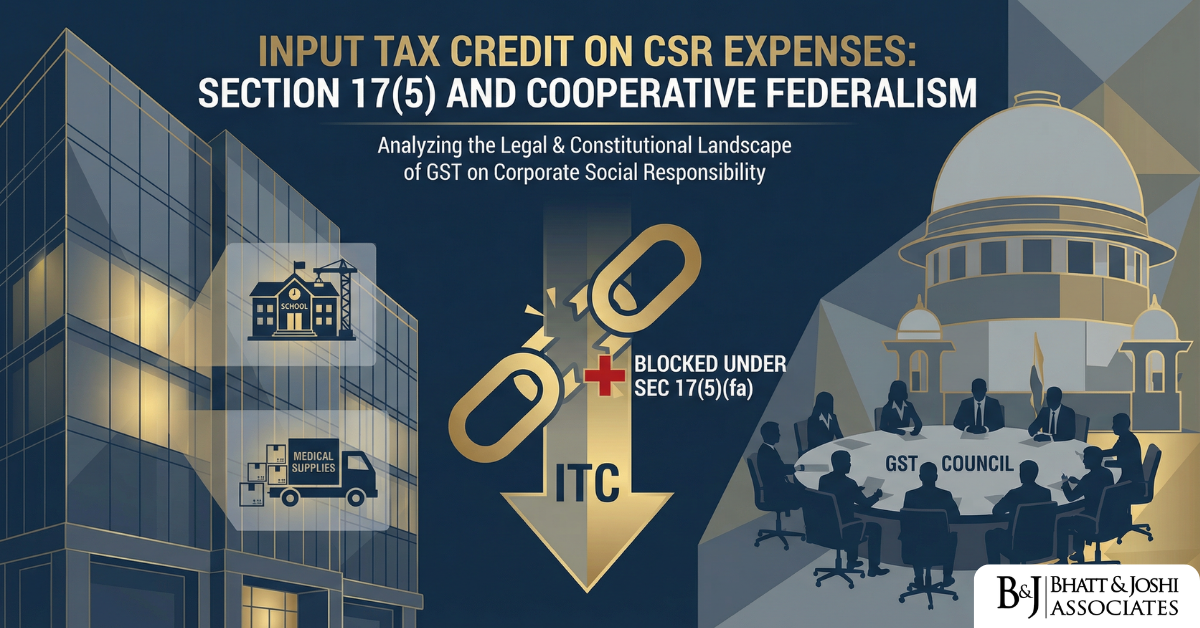
Input Tax Credit on CSR Expenses: Why the Statutory Exclusion Under Section 17(5) Contradicts Constitutional Cooperative Federalism
Introduction
India’s Goods and Services Tax framework rests on a foundational promise: that taxes paid on business inputs will be credited against output tax liability, thereby eliminating the cascading effect that plagued the pre-GST indirect tax regime. This mechanism, known as Input Tax Credit (ITC), is codified under Section 16(1) of the Central Goods and Services Tax Act, 2017 (CGST Act), which provides that “every registered person shall, subject to such conditions and restrictions as may be prescribed and in the manner specified in section 49, be entitled to take credit of input tax charged on any supply of goods or services or both to him which are used or intended to be used in the course or furtherance of his business.”[1]
Against this backdrop, the Finance Act, 2023 inserted clause (fa) into Section 17(5) of the CGST Act, expressly blocking ITC on CSR expenses, i.e., the goods or services used to discharge a company’s obligations under Corporate Social Responsibility (CSR) as mandated by Section 135 of the Companies Act, 2013. The amendment, brought into force from 1 October 2023 via Notification No. 28/2023-Central Tax dated 31 July 2023, has generated significant controversy in the legal and commercial world.[2]
The central tension is this: the very same Parliament that enacts the Companies Act compels certain companies to spend money on CSR under pain of statutory penalty—yet the GST law, also enacted by Parliament, refuses to allow those same companies a tax credit on the GST they pay while fulfilling that statutory duty. This article examines the regulatory architecture governing both CSR and ITC, traces the evolution of judicial thought before the 2023 amendment, analyses why the exclusion under Section 17(5)(fa) sits uncomfortably with the spirit of cooperative federalism enshrined in Article 246A of the Constitution of India, and considers the practical and policy consequences for Indian businesses.
The Regulatory Architecture: CSR as a Statutory Obligation
Corporate Social Responsibility in India is not a moral suggestion—it is a hard legal obligation for qualifying companies. Section 135(1) of the Companies Act, 2013 provides that every company having a net worth of rupees five hundred crore or more, or a turnover of rupees one thousand crore or more, or a net profit of rupees five crore or more during the immediately preceding financial year, must constitute a Corporate Social Responsibility Committee of the Board.[3]
Section 135(5) further mandates that the Board of every such company shall ensure that the company spends, in every financial year, at least 2% of the average net profits made during the three immediately preceding financial years in pursuance of its CSR policy. Non-compliance carries a penalty under Section 135(7) of twice the amount required to be transferred, or one crore rupees, whichever is less, and every officer in default is also personally liable to a penalty. The activities eligible for CSR spend are listed in Schedule VII of the Companies Act and include education, healthcare, sanitation, environmental sustainability, rural development, and promotion of sports and culture, among others.[3]
The Companies (CSR Policy) Rules, 2014 further operationalise these requirements, requiring companies to form a CSR Committee, formulate a CSR Policy aligned with Schedule VII activities, incur the mandated spend, and make detailed disclosures in their Annual Board Report. Any unspent amount must be transferred to an Unspent CSR Account or to specified funds under Schedule VII within 30 days of the end of the financial year, failing which penalties cascade further. In short, CSR is a statutory cost of doing business in India for companies meeting the financial thresholds—it is not a voluntary charitable act.
Section 17(5) of the CGST Act: The “Negative List” of ITC
Section 17 of the CGST Act deals with the apportionment of credit and blocked credits. While sub-sections (1) and (2) govern proportional credit where goods or services are used partly for business and partly for other purposes, sub-section (5) is a non-obstante provision that absolutely blocks ITC on specified categories of inward supplies regardless of their business connection.[1]
The original Section 17(5) enacted in 2017 blocked credits on motor vehicles, food and beverages, outdoor catering, health services, club memberships, works contracts for immovable property, goods or services for personal use, and goods lost, stolen, or destroyed. Over successive amendments, the list was refined—some credits were relaxed in 2019, others tightened. The Finance Act, 2023, through Section 139, introduced a pivotal new clause (fa), which reads:
“(fa) goods or services or both received by a taxable person, which are used or intended to be used for activities relating to his obligations under corporate social responsibility referred to in section 135 of the Companies Act, 2013 (18 of 2013);”[2]
This clause is squarely framed as a restriction on Section 16(1)—it begins with “notwithstanding anything contained in sub-section (1) of section 16 and sub-section (1) of section 18”. The effect is that from 1 October 2023 onwards, any GST paid on goods or services procured to fulfil CSR obligations is definitively non-creditable. A company building a school under its CSR mandate and paying 18% GST on construction services cannot recover that GST. A company procuring medical equipment for a CSR-funded hospital pays full GST with no credit. The tax becomes a pure cost, inflating the effective price of statutory compliance.[4]
Pre-Amendment Judicial Landscape: A Tale of Conflicting Rulings
Before the Finance Act, 2023 settled the position legislatively, the question of ITC on CSR expenses was genuinely contested. The Authority for Advance Rulings (AAR) across states took divergent views, reflecting the underlying ambiguity in the law.
One of the most significant pro-taxpayer rulings came from the Telangana AAR in M/s Bambino Pasta Food Industries Private Limited (TSAAR Order No. 52/2022, A.R.Com/17/2022, dated 20 October 2022). The applicant had donated a PSA oxygen plant worth ₹62,74,200 (inclusive of IGST of ₹9,16,200) to AIIMS Hospital, Bibinagar, during the COVID-19 pandemic as a CSR activity under Section 135 of the Companies Act. The Telangana AAR ruled that “the expenditure made towards corporate social responsibility under Section 135 of the Companies Act, 2013, is an expenditure made in the furtherance of the business. Hence, the tax paid on purchases made to meet the obligations under corporate social responsibility will be eligible for input tax credit under CGST and SGST Acts.”[5] The AAR reasoned that since non-compliance with CSR provisions attracts a penalty of up to ₹1 crore and can substantially impair a company’s ability to operate, CSR expenditure is necessarily incurred in the course and furtherance of business.
The Telangana AAR relied on an earlier ruling by the Uttar Pradesh AAR in M/s Dwarikesh Sugar Industries Limited (2020 (1) TMI 1430), which had similarly held that CSR expenses are incurred in the course of business since CSR is a mandatory obligation, and that such expenses cannot be treated as gifts, thereby falling outside the blocked credit under Section 17(5)(h) (goods disposed of as gifts or free samples). However, other AARs reached the opposite conclusion. The Maharashtra AAR in certain cases held that CSR activities are not in furtherance of business and that the goods procured for CSR amount to gifts, which are squarely blocked under Section 17(5)(h).[5]
This conflict—where the same constitutional and statutory provisions generated diametrically opposite conclusions in different states—illustrates both the interpretative difficulty and the policy stakes involved. The legislature resolved the debate in favour of the revenue by inserting clause (fa), though in doing so it arguably created a new and more fundamental problem: the inconsistency between what Parliament demands under the Companies Act and what it penalises under the GST Act.
The Constitutional Framework: Cooperative Federalism and Article 246A
To understand why the Section 17(5)(fa) exclusion strains constitutional principle, one must appreciate the federal architecture within which the GST regime operates. The Constitution (One Hundred and First Amendment) Act, 2016 introduced Article 246A into the Constitution of India. Article 246A(1) reads:
“Notwithstanding anything contained in articles 246 and 254, Parliament, and, subject to clause (2), the Legislature of every State, have power to make laws with respect to goods and services tax imposed by the Union or by such State.”[6]
Article 246A is the constitutional cornerstone of the GST framework. It grants concurrent taxing powers on both Parliament and State Legislatures with respect to GST, overriding the earlier rigid division of legislative competence under Article 246 read with the Seventh Schedule. Crucially, it also introduced Article 279A, which established the GST Council as a constitutional body composed of the Union Finance Minister and State Finance Ministers, designed to function as the nerve centre of cooperative federalism in indirect taxation.[6]
The Supreme Court of India, in Union of India v. M/s Mohit Minerals Pvt. Ltd. (Civil Appeal No. 1390 of 2022, decided on 19 May 2022), examined the nature of the GST Council’s recommendations and the constitutional relationship between Article 246A and Article 279A. The Court held that recommendations of the GST Council are not binding on the Union or the States, since Article 279A does not begin with a non-obstante clause and Article 246A does not make the legislative power subject to Article 279A. The legislative power under Article 246A is characterised as a “simultaneous power” rather than a concurrent power governed by Article 254’s repugnancy rule, and must be exercised harmoniously.[7]
The significance of Mohit Minerals for the present discussion is this: the Court affirmed that the entire constitutional architecture of GST—Article 246A, Article 279A, and the dual CGST/SGST structure—was designed to embody and operationalise cooperative federalism. The Statement of Objects and Reasons of the Constitution (One Hundred and First Amendment) Bill explicitly states that the amendment was intended to confer concurrent taxing powers on the Union and States for a unified GST, reflecting cooperative governance rather than central dominance. When Parliament, exercising its unilateral legislative authority under the CGST Act, inserts a credit restriction that penalises compliance with another Parliamentary statute (the Companies Act) without any deliberation or recommendation by the GST Council, it acts in a manner that undercuts the cooperative federal spirit the constitutional architecture sought to instil.[6]
Why the Exclusion Contradicts Cooperative Federalism: A Deeper Analysis
The argument that Section 17(5)(fa) contradicts cooperative federalism operates on several interconnected levels. First, consider the nature of CSR obligations themselves. The Companies Act is a central statute, and Section 135 creates a mandatory obligation backed by criminal-grade penalties. When the CGST Act then taxes the inputs procured to fulfil this obligation and refuses to credit back that tax, the combined effect of two central statutes is to doubly burden the taxpayer: once through the compelled CSR spend, and again through the non-creditable GST on that spend. This is not the tax policy that the “One Nation, One Tax” promise of GST was meant to deliver.
Second, cooperative federalism in the GST context means that no single actor—neither Parliament acting alone nor any individual State—should be able to unilaterally distort the credit chain that the GST architecture is built upon. The ITC mechanism is not a concession granted by the government; it is the structural mechanism by which GST achieves its principal economic objective of eliminating cascading. When Parliament inserts a credit block through the Finance Act without any prior recommendation or deliberation by the GST Council—the constitutional body specifically designed to represent both Union and State interests in GST matters—it short-circuits the cooperative process.[8]
Third, the insertion of clause (fa) creates a substantive policy incoherence. Schedule VII of the Companies Act specifies that CSR activities must include projects relating to environmental sustainability, healthcare, education, sanitation, and rural development—all of which are areas where States have a direct constitutional interest and where State governments themselves run programmes. When a company operating across multiple States is forced to spend 2% of its net profits on these activities but cannot credit the GST paid on such spending, the effective cost of CSR is inflated, potentially deterring compliance or reducing the quantum of social investment. States, which depend on higher CSR expenditure in their territories for social development, are thereby indirectly harmed by a unilateral central legislative choice.[3]
Fourth, the logical foundation offered by the government for the exclusion is thin. The position of the GST Council and the revenue department has been that CSR activities are not carried out “in the course or furtherance of business” and therefore do not qualify for ITC under Section 16(1). But this reasoning collapses upon examination. If CSR is not in furtherance of business, why does the Companies Act treat non-compliance as a business offence attracting corporate penalties? If the expenditure is not a business cost, why does the Income Tax Act specifically address it—albeit to disallow it as a deduction under Explanation 2 to Section 37(1)? The very fact that Parliament has found it necessary to specifically disallow CSR as an income tax deduction proves that it would otherwise qualify as a business expense. Accordingly, ITC on CSR expenses would logically be allowable in the absence of the specific block under Section 17(5)(fa). Applying the same logic, absent the specific block in Section 17(5)(fa), CSR inputs would qualify for ITC.[4]
Practical and Commercial Consequences
The practical impact of Section 17(5)(fa) on ITC on CSR expenses is significant and materially affects the cost of CSR compliance. To illustrate: if a company is required to spend ₹1 crore on CSR during a financial year and procures goods and services attracting 18% GST, the GST component amounts to approximately ₹15,25,423 on a GST-exclusive spend of ₹84,74,576 (working back from the 18% rate). Pre-amendment, this company could have credited ₹15,25,423 against its output GST liability. Post-amendment, that amount is a dead cost—it increases the effective outflow from the company’s CSR funds.[4]
For large corporations with CSR obligations running into tens of crores annually, the blocked ITC on CSR expenses represents a material tax burden that compounds the already mandatory nature of the spend. Sectors like manufacturing, infrastructure, and technology—where GST on procurements for CSR activities such as school construction, healthcare camps, or skill development centres is significant—face the sharpest impact. Moreover, companies must now maintain meticulous documentation segregating CSR-related procurements from regular business procurements to ensure correct ITC reversal in Table 4(B) of GSTR-3B, adding to the compliance burden.
There is also an unresolved transitional question: can companies claim ITC on CSR expenses incurred before 1 October 2023? The amendment is prospective in operation, and for the period prior to its effective date, the Telangana AAR ruling in Bambino Pasta and the Uttar Pradesh AAR ruling in Dwarikesh Sugar Industries provide persuasive authority for ITC eligibility—subject, of course, to the statutory limitation period under Section 16 of the CGST Act. Many companies that had voluntarily reversed ITC on CSR expenses pending clarity may now consider seeking reclaim of credits for pre-amendment periods.[5]
The Way Forward: Policy Reform and Legislative Alignment
The preferable approach—both from a constitutional harmony perspective and a sound tax policy perspective—would be to either repeal Section 17(5)(fa) or, at the very least, carve out CSR activities that are specifically mandated by Schedule VII of the Companies Act. The GST Council, as the constitutionally mandated body for such policy determinations, should take up this issue for deliberation. Several State governments—particularly those that rely heavily on corporate CSR investment for social infrastructure—have a direct stake in ensuring that the blocked credit provision does not disincentivise CSR spending in their territories.[8]
An alternative that preserves the government’s revenue concerns while removing the sting for genuinely mandated CSR is to allow ITC on CSR expenses only where the activity falls under Schedule VII of the Companies Act and is undertaken pursuant to a Board-approved CSR Policy—excluding voluntary CSR beyond the statutory minimum. This targeted approach would prevent misuse while recognising the fundamental character of Schedule VII CSR as a statutory obligation. It would also bring the GST treatment of CSR in alignment with the broader regulatory philosophy that mandatory compliances should not be doubly penalised through the tax system.
The broader principle at stake is the integrity of the cooperative federal compact that Article 246A embodies. When one limb of the state—the legislatures acting on GST—acts in ways that contradict what another limb—Parliament acting on company law—demands, the result is a fragmented regulatory experience for business that undermines confidence in the GST system as a whole. The Supreme Court’s observations in Mohit Minerals about the need for Parliament, State Legislatures, and the GST Council to “work in unison and harmony” are directly apposite here.[7]
Conclusion
Section 17(5)(fa) of the CGST Act, as inserted by the Finance Act, 2023 and brought into force from 1 October 2023, represents a legislative choice that is difficult to justify on either legal or policy grounds. Legally, it punishes compliance with one Parliamentary statute through the mechanism of another, creating an internal contradiction within the body of central legislation. From a cooperative federalism standpoint, it was inserted without the deliberative process that the GST Council—the constitutional architecture’s chosen forum for such decisions—is designed to provide. Judicially, the earlier AAR rulings in Bambino Pasta Food Industries and Dwarikesh Sugar Industries had correctly identified that CSR expenditure, being mandatory and penalty-backed, is inherently in furtherance of business and should attract ITC eligibility.[5]
The amendment clarifies that companies cannot claim ITC on CSR expenses, but it disrupts consistency in Indian law and the federal framework established by the 101st Constitutional Amendment. The GST Council should revisit this provision, and future courts may need to examine whether a blanket block on mandatory statutory CSR expenses aligns with the foundational design of the GST regime under Article 246A of the Constitution of India..
References
[1] Section 17, Central Goods and Services Tax Act, 2017 – CBIC Tax Information Portal
[3] ICAI CSR Portal – Extract of Section 135, Companies Act, 2013
[4] TaxTMI – Should Section 17(5) of the CGST Act Continue Anymore?
[5] Taxo.online – M/s Bambino Pasta Food Industries Pvt. Ltd., TSAAR Order No. 52/2022
[6] TaxGuru – Article 246A: Power to Levy Tax with Respect to GST – Pertinent Issues
[8] GST Council – GST and Co-operative Federalism (Official Publication)
[9] GST Council – M/s Bambino Pasta Food Industries Private Limited (Advance Ruling Reference)