 Whatsapp

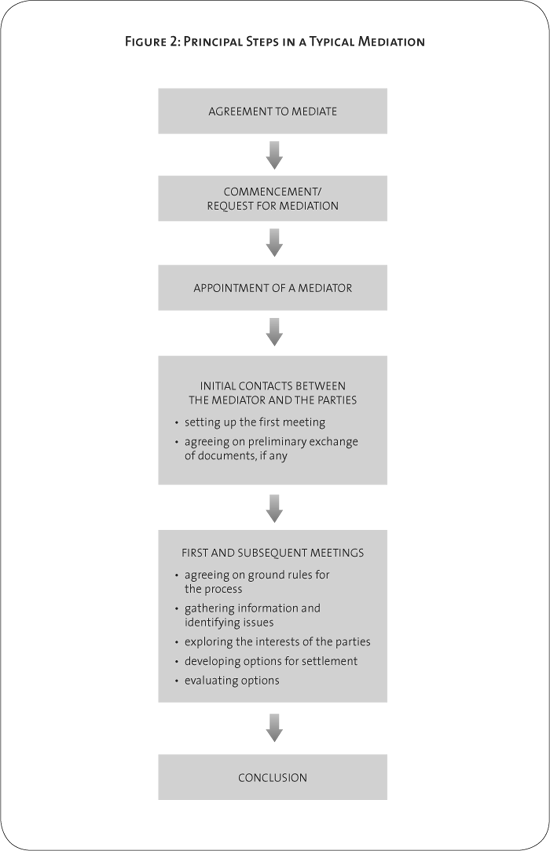
Principle Steps in a Typical WIPO Arbitration
Introduction
The World Intellectual Property Organization Arbitration and Mediation Center has established itself as a premier institution for resolving intellectual property disputes through alternative dispute resolution mechanisms. Since its establishment in 1994, the WIPO Center has administered thousands of disputes involving patents, trademarks, copyrights, technology transfer agreements, research and development contracts, and other intellectual property matters. The arbitration process under WIPO offers parties a neutral, specialized, and efficient method to resolve complex intellectual property disputes without resorting to traditional litigation.
WIPO arbitration is particularly attractive for parties engaged in cross-border disputes where different legal systems and jurisdictions are involved. The procedure provides flexibility, confidentiality, and access to arbitrators with specific technical expertise in intellectual property matters. Unlike court proceedings, which are often public and bound by rigid procedural rules, WIPO arbitration allows parties to tailor the process to their specific needs while maintaining enforceability under the New York Convention on the Recognition and Enforcement of Foreign Arbitral Awards [1].
Legal Framework Governing WIPO Arbitration
The legal foundation of WIPO arbitration rests on multiple international and domestic legal instruments. The primary framework is provided by the WIPO Arbitration Rules, which were most recently updated in 2021 to reflect modern practices including electronic filing and virtual hearings [2]. These rules are designed specifically for intellectual property disputes and incorporate provisions that address the unique challenges posed by such matters, including the handling of confidential technical information and trade secrets.
The enforceability of WIPO arbitral awards derives primarily from the Convention on the Recognition and Enforcement of Foreign Arbitral Awards, adopted in New York on June 10, 1958. This convention, to which over 160 countries are parties, ensures that arbitral awards rendered in one signatory state are recognized and enforceable in other signatory states. The WIPO Arbitration Rules specifically acknowledge this framework in their provisions regarding the form and certification of awards, ensuring compliance with the requirements of Article IV of the New York Convention.
Additionally, many national arbitration laws recognize and support the WIPO arbitration framework. The UNCITRAL Model Law on International Commercial Arbitration, adopted by numerous jurisdictions worldwide, provides a harmonized legal framework that facilitates the recognition and enforcement of arbitration agreements and awards. The WIPO Arbitration Rules explicitly reference the law applicable to the arbitration, which is generally the arbitration law of the place of arbitration unless parties have agreed otherwise, provided such agreement is permitted by the law of the chosen place.
Commencement of WIPO Arbitration Proceedings
The arbitration process begins when a claimant files a Request for Arbitration with the WIPO Arbitration and Mediation Center [3]. This request must be transmitted simultaneously to both the Center and the respondent, establishing the formal commencement date as the date on which the Center receives the request. The WIPO Arbitration Rules specify detailed requirements for the content of this initial filing to ensure clarity and procedural efficiency from the outset.
The Request for Arbitration must contain several essential elements. First, it must include an explicit demand that the dispute be referred to arbitration under the WIPO Arbitration Rules, along with the names, addresses, and contact information of both parties and the claimant’s representative. The request must also include a copy of the arbitration agreement, which may be either a standalone arbitration contract or an arbitration clause embedded within a larger commercial agreement. A brief description of the dispute’s nature and circumstances is required, including an indication of the rights and property involved and the nature of any technology at issue. The claimant must also provide a statement of the relief sought with an indication of any amount claimed where possible.
Before the Center takes action on the request, the claimant must pay a non-refundable registration fee as specified in the WIPO Schedule of Fees applicable on the date the request is received. If this fee is not paid within fifteen days of a written reminder from the Center, the claimant is deemed to have withdrawn the request. This initial filing stage is critical as it sets the foundation for the entire arbitration process and determines the scope of issues to be resolved.
Respondent’s Answer and Initial Responses
Upon receiving the Request for Arbitration, the respondent has thirty days to submit an Answer to the Request to both the Center and the claimant. This answer must address the elements presented in the initial request and may include indications of any counterclaim or set-off that the respondent wishes to assert. If the claimant filed a Statement of Claim with the initial request, the respondent may also accompany the answer with a Statement of Defense, though this is not mandatory at this early stage.
The Answer to the Request serves multiple functions in the arbitration process. It allows the respondent to contest jurisdictional issues, challenge the validity or scope of the arbitration agreement, and present preliminary defenses. The respondent must also disclose the identity of any third-party funder involved in supporting its participation in the arbitration, maintaining transparency about potential conflicts of interest. If a counterclaim is asserted, it must be accompanied by payment of a separate registration fee, calculated according to the same fee schedule applicable to the initial claim.
During this initial response phase, parties may also begin discussions regarding the composition of the arbitral tribunal. The WIPO Rules provide flexibility in determining whether a sole arbitrator or a three-member tribunal will hear the dispute. Where parties have not agreed on the number of arbitrators, the default is a sole arbitrator, unless the Center determines that a three-member tribunal is more appropriate given the complexity, value, or other circumstances of the case.
Composition and Establishment of the Arbitral Tribunal
The composition of the arbitral tribunal represents one of the most critical phases of WIPO arbitration. The selection process must balance party autonomy with the need for qualified, impartial decision-makers who possess relevant expertise in intellectual property matters. The WIPO Arbitration Rules provide detailed procedures for appointment, ensuring both efficiency and fairness in tribunal formation [4].
When parties have agreed to appoint a sole arbitrator, they must jointly nominate this individual within thirty days of the arbitration’s commencement. If they fail to reach agreement within this period, the Center will appoint the arbitrator through a list procedure. The Center sends each party an identical list of at least three candidates, accompanied by statements of their qualifications. Each party then has twenty days to delete names of candidates they object to and number the remaining candidates in order of preference. The Center then appoints an arbitrator taking into account these preferences and objections. If no mutually acceptable candidate emerges, the Center is authorized to appoint a sole arbitrator using its discretion.
For three-member tribunals, the appointment process follows a different structure designed to give each party input while maintaining neutrality in the presiding arbitrator. The claimant nominates one arbitrator in the Request for Arbitration, while the respondent nominates a second arbitrator within thirty days of receiving the request. These two party-appointed arbitrators must then jointly nominate a third arbitrator within twenty days of the second arbitrator’s appointment. This third arbitrator serves as the presiding arbitrator and plays a crucial role in managing the proceedings and ensuring procedural fairness.
The WIPO Rules impose strict requirements regarding arbitrator impartiality and independence. Each prospective arbitrator must disclose any circumstances that might give rise to justifiable doubt about their impartiality or independence before accepting appointment. This includes financial interests, professional relationships, or prior involvement with either party or the subject matter of the dispute. These disclosure obligations continue throughout the arbitration, with arbitrators required to promptly reveal any new circumstances that arise. Parties may challenge an arbitrator within fifteen days of learning about circumstances that create justifiable doubt, with the Center making the final decision on such challenges through its internal procedures.
Conduct of Arbitral Proceedings
Once the tribunal is established, the Center notifies all parties, marking the formal beginning of the evidentiary and procedural phase. Within thirty days of receiving this notification, the tribunal typically conducts a preparatory conference with the parties. This conference, which may be held by telephone, videoconference, or in person, serves to organize and schedule subsequent proceedings in a time and cost-efficient manner. During this conference, the tribunal establishes procedural timelines, discusses the method of conducting hearings, addresses preliminary jurisdictional issues, and sets expectations for the submission of evidence and legal arguments [5].
The claimant must submit its Statement of Claim within thirty days after receiving notification of the tribunal’s establishment, unless this statement already accompanied the initial Request for Arbitration. This statement must contain a detailed presentation of the facts and legal arguments supporting the claim, along with a clear statement of the relief sought. Importantly, the statement must be accompanied by as much supporting evidence as possible, including documents, technical specifications, expert reports, and any other materials upon which the claimant relies. Where evidence is particularly voluminous, the claimant may reference additional evidence it is prepared to submit upon request.
The respondent then has thirty days after receiving the Statement of Claim to submit its Statement of Defense. This document must respond specifically to the particulars raised in the claim and must similarly be accompanied by relevant evidence. Any counterclaim or set-off must ordinarily be raised in the Statement of Defense, though the tribunal may in exceptional circumstances permit later assertion of such claims. If a counterclaim is filed, the claimant has a right to reply, with the same evidentiary and procedural requirements applying.
The tribunal possesses broad powers to manage the evidentiary process efficiently while ensuring fairness to both parties. It may order parties to produce specific documents or other evidence, permit or require further written statements beyond the initial pleadings, and determine the admissibility, relevance, materiality, and weight of all evidence presented. The tribunal may also order site visits, experiments, or inspections of relevant property, machinery, or processes, which is particularly important in patent and technology disputes where understanding the physical implementation of an invention is crucial.
Hearings represent a critical component of many arbitrations, though not all cases require them. If either party requests a hearing, the tribunal must conduct one for the presentation of witness evidence or oral argument. The tribunal decides whether hearings will be conducted in person, by videoconference, or using online tools, after consultation with the parties. All hearings are private unless the parties agree otherwise, protecting the confidentiality of sensitive commercial and technical information. During hearings, witnesses may be questioned by the parties under the tribunal’s control, and the tribunal itself may pose questions at any stage of the witness examination.
Special Procedures for Intellectual Property Disputes
WIPO arbitration rules include several specialized provisions designed to address the unique challenges of intellectual property disputes. One of the most significant is the framework for handling confidential information and trade secrets. When a party wishes to submit confidential information, whether to the tribunal or to an expert appointed by the tribunal, it may apply to have such information classified as confidential. The tribunal then determines whether the information meets the criteria for confidential treatment, which requires that it be non-public, commercially significant, and treated as confidential by the possessing party [6].
If the tribunal classifies information as confidential and determines that disclosure without special protection would cause serious harm, it establishes conditions for limited disclosure and requires anyone receiving such information to sign confidentiality undertakings. In exceptional circumstances, the tribunal may appoint a confidentiality advisor who determines classification and disclosure conditions independently, or who acts as an expert reporting to the tribunal without disclosing confidential information to the opposing party. This sophisticated approach balances the need for fair proceedings with the protection of valuable proprietary information.
The tribunal may also appoint independent technical experts to report on specific issues, particularly valuable in complex patent or technology disputes where specialized knowledge is required to understand the technical subject matter. After receiving an expert’s report, the tribunal communicates copies to the parties, who may submit written opinions and, at their request, question the expert at a hearing. Parties may also present their own expert witnesses to testify on the disputed points, though the tribunal retains ultimate discretion in assessing all expert evidence in light of the case’s overall circumstances.
Another specialized procedure addresses experiments and testing, which frequently arise in patent validity and infringement disputes. When a party intends to rely on experiments it has conducted, it must provide advance notice to the tribunal and the opposing party, specifying the experiment’s purpose, methodology, results, and conclusions. The opposing party may request that experiments be repeated in its presence, and the tribunal determines whether such repetition is justified and establishes an appropriate timetable. This ensures transparency and verifiability of technical evidence while maintaining procedural efficiency.
Interim Measures and Emergency Relief
The WIPO Arbitration Rules recognize that parties may require urgent relief before a full arbitral tribunal can be constituted or before the arbitration process reaches its conclusion. The rules therefore provide for both interim measures during the arbitration and emergency relief procedures for situations requiring immediate action [7].
Once the tribunal is established, it possesses broad authority to issue provisional orders or take interim measures deemed necessary. These may include injunctions preventing certain actions, measures for conserving goods that form part of the dispute’s subject matter, orders for depositing disputed items with third parties, or orders for selling perishable goods. The tribunal may make granting such measures conditional on the requesting party furnishing appropriate security. Importantly, parties seeking interim measures or security for claims or costs from judicial authorities are not deemed to have waived their arbitration agreement, recognizing that national courts may sometimes be better positioned to grant certain types of urgent relief.
For situations requiring urgent relief before the tribunal is established, the WIPO Rules provide an emergency relief procedure. A party seeking emergency relief submits a request to the Center, which promptly appoints an emergency arbitrator, normally within two days. This emergency arbitrator has the authority to grant interim measures and determine their own jurisdiction, conducting proceedings in a manner appropriate to the urgency while ensuring each party receives a fair opportunity to present its case. The emergency arbitrator may conduct proceedings by telephone, videoconference, or based on written submissions alone. Emergency relief proceedings terminate if regular arbitration is not commenced within thirty days, and the costs of emergency proceedings are initially fixed by the emergency arbitrator subject to the regular tribunal’s final determination.
Arbitral Awards and Final Determinations
The arbitral award represents the culmination of the WIPO arbitration process and constitutes a final, binding determination of the parties’ dispute. The tribunal’s authority to render awards derives from both the parties’ agreement to arbitrate and the supportive framework of international and national arbitration laws. The WIPO Arbitration Rules specify detailed requirements for award form, content, and notification to ensure enforceability and finality [8].
The tribunal decides the substantive dispute according to the law or rules of law chosen by the parties. If parties have designated the law of a particular state, this reference is construed as directly referring to that state’s substantive law rather than its conflict of laws rules, unless expressly stated otherwise. When parties have not chosen applicable law, the tribunal determines the appropriate law or rules of law, always deciding with due regard to relevant contract terms and applicable trade usages. The tribunal may decide as amiable compositeur or ex aequo et bono only if the parties have expressly authorized such decision-making.
Awards must be in writing and state both the date of making and the place of arbitration. Unless parties have agreed that reasons are unnecessary and the applicable arbitration law does not require reasons, the award must contain a reasoned explanation of the tribunal’s decision. This reasoning requirement is particularly important for intellectual property disputes, where detailed analysis of technical, factual, and legal issues is often necessary for parties to understand the decision and for potential reviewing courts to assess the award’s validity.
The tribunal may render separate awards on different issues at different times, providing flexibility to resolve certain matters before others when procedurally efficient. The award requires signatures from the arbitrators, with a majority signature sufficient for multi-member tribunals or the presiding arbitrator’s signature alone when no majority exists. Before finalizing the award, the tribunal may consult with the Center regarding matters of form to ensure enforceability. The Center then formally communicates an original award to each party and the arbitrators, and upon request provides certified copies that satisfy the requirements of the New York Convention for international recognition and enforcement.
By agreeing to WIPO arbitration, parties undertake to carry out the award without delay and waive their right to any form of appeal or recourse to courts, insofar as such waiver is valid under applicable law. The award becomes effective and binding from the date the Center formally communicates it to the parties. Parties may, within thirty days of receiving the award, request correction of clerical, typographical, or computational errors, or request an additional award regarding claims presented but not addressed. These limited post-award procedures ensure accuracy without reopening substantive determinations.
Costs and Financial Aspects of WIPO Arbitration
The financial structure of WIPO arbitration involves multiple fee components designed to cover both administrative costs and arbitrator compensation while remaining predictable and reasonable for parties. Understanding these cost elements is essential for parties considering or initiating WIPO arbitration proceedings [9].
The initial financial requirement is the registration fee, which is non-refundable and must be paid when filing either a Request for Arbitration or a counterclaim. The Center will not take action on any filing until this fee is paid, and failure to pay within fifteen days of a written reminder results in the claim or counterclaim being deemed withdrawn. Following registration, parties must pay an administration fee to the Center, calculated according to the WIPO Schedule of Fees applicable on the arbitration’s commencement date. This fee may be increased if claims or counterclaims are subsequently increased during the proceedings.
Arbitrator fees are fixed by the Center after consultation with the arbitrators and parties, following the applicable fee schedule. Upon tribunal establishment, the Center requires both claimant and respondent to deposit equal amounts as advances for arbitration costs, which include arbitrator fees, properly incurred arbitrator expenses, costs of expert advice or assistance required by the tribunal, and necessary expenses such as meeting and hearing facility costs. The Center may require supplementary deposits during the arbitration if initial deposits prove insufficient.
In the final award, the tribunal fixes and apportions the arbitration costs between the parties in light of all circumstances and the arbitration’s outcome, subject to any agreement between the parties. The tribunal may also, considering all circumstances and the outcome, order a party to pay all or part of reasonable expenses incurred by the other party in presenting its case, including costs for legal representatives and witnesses. This “costs follow the event” approach, common in international arbitration, means that the losing party typically bears most or all costs, though tribunals retain discretion to apportion costs differently based on the proceedings’ specific circumstances.
Confidentiality and Privacy Protections
Confidentiality represents one of the primary advantages of WIPO arbitration over court litigation, particularly important for intellectual property disputes involving sensitive technical information, business strategies, and proprietary knowledge. The WIPO Arbitration Rules establish a multi-layered confidentiality framework protecting different aspects of the arbitration process.
The existence of the arbitration itself is generally confidential. Parties may not unilaterally disclose information concerning the arbitration’s existence to third parties unless required by law or regulatory bodies, and even then only by disclosing the minimum legally required and providing details of the disclosure to the tribunal and the other party. However, parties may disclose the names of other parties and the relief requested for purposes of satisfying good faith or candor obligations owed to third parties, recognizing that complete secrecy may sometimes conflict with other legal duties.
Documentary and other evidence provided during the arbitration receives protection ensuring that information not in the public domain is not used or disclosed to third parties for any purpose without consent or court order. This protection binds parties whose access to such information arises exclusively from their arbitration participation. Witnesses called by a party are not considered third parties for these purposes, but the calling party remains responsible for ensuring witnesses maintain equivalent confidentiality regarding evidence or information accessed for testimony preparation.
The arbitral award itself is treated as confidential and may only be disclosed to third parties if parties consent, if the award enters the public domain through court proceedings, or if disclosure is necessary to comply with legal requirements or to establish or protect legal rights against a third party. The Center and arbitrators are also bound to maintain confidentiality regarding the arbitration, award, and any non-public documentary or other evidence, except as necessary for court actions relating to the award or as otherwise required by law. This comprehensive confidentiality regime protects commercial and technical secrets while allowing necessary disclosures when legal requirements demand or when court enforcement becomes necessary.
Conclusion
WIPO arbitration provides a sophisticated, flexible, and effective mechanism for resolving intellectual property disputes through a process designed specifically for the unique challenges these matters present. The procedural framework balances party autonomy with institutional support, technical expertise with legal rigor, and confidentiality with procedural fairness. From the initial filing through tribunal constitution, evidentiary proceedings, and final award, the WIPO Arbitration Rules create a structured yet adaptable process that has proven successful across thousands of cases involving parties from diverse jurisdictions and legal traditions.
The legal foundation supporting WIPO arbitration, anchored in the New York Convention and supported by harmonized national laws based on the UNCITRAL Model Law, ensures that WIPO awards are widely enforceable internationally. The specialized procedures for handling confidential information, technical evidence, and complex intellectual property issues make WIPO arbitration particularly well-suited for patent, trademark, copyright, and technology transfer disputes. The availability of interim measures and emergency relief provides parties with tools to protect their interests throughout the process, while the confidentiality framework preserves the value of proprietary information.
As intellectual property becomes increasingly central to global commerce and as cross-border disputes multiply, WIPO arbitration offers a proven alternative to the uncertainties, delays, and expenses often associated with multi-jurisdictional litigation. The continuing evolution of the WIPO Arbitration Rules, including recent adaptations for virtual proceedings and electronic filing, demonstrates the institution’s commitment to maintaining relevance and efficiency in a rapidly changing technological and legal landscape. For parties engaged in international intellectual property relationships, including WIPO arbitration clauses in contracts represents sound risk management and dispute resolution planning.
References
[1] United Nations Convention on the Recognition and Enforcement of Foreign Arbitral Awards (New York, 1958). Available at: https://www.uncitral.org/en/texts/arbitration/conventions/foreign_arbitral_awards.html
[2] WIPO Arbitration and Mediation Center, “WIPO Arbitration Rules” (2021). Available at: https://www.wipo.int/amc/en/arbitration/rules/index.html
[3] WIPO Arbitration and Mediation Center, “Arbitration Procedures”. Available at: https://www.wipo.int/amc/en/arbitration/procedures/
[4] WIPO Arbitration and Mediation Center, “What is Arbitration?”. Available at: https://www.wipo.int/amc/en/arbitration/what-is-arb.html
[5] WIPO, “Guide to WIPO Arbitration” (WIPO Publication No. 4527). Available at: https://www.wipo.int/publications/en/details.jsp?id=4527
[6] WIPO Arbitration Rules, Article 54 (Disclosure of Trade Secrets and Other Confidential Information). Available at: https://www.wipo.int/amc/en/arbitration/rules/index.html
[7] WIPO Arbitration Rules, Article 49 (Emergency Relief Proceedings). Available at: https://www.wipo.int/amc/en/arbitration/rules/index.html
[8] WIPO Arbitration Rules, Articles 61-68 (Awards and Decisions). Available at: https://www.wipo.int/amc/en/arbitration/rules/index.html
[9] WIPO Arbitration and Mediation Center, “Schedule of Fees and Costs”. Available at: https://www.wipo.int/amc/en/arbitration/fees/
