 Whatsapp

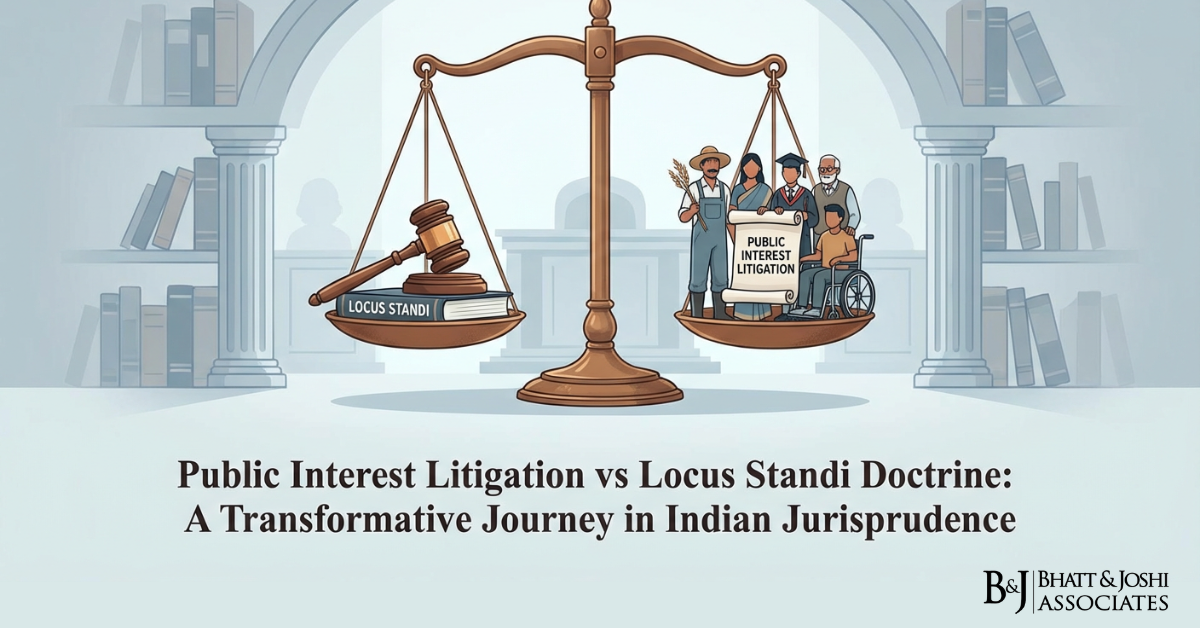
Public Interest Litigation vs Locus Standi Doctrine: A Transformative Journey in Indian Jurisprudence
Introduction
The Indian judicial landscape witnessed a revolutionary transformation during the post-Emergency period when the Supreme Court fundamentally altered the traditional understanding of who could approach courts for justice. This transformation centered on two contrasting legal concepts: the rigid doctrine of locus standi and the progressive mechanism of Public Interest Litigation. The doctrine of locus standi, derived from the Latin phrase meaning “place to stand,” historically required that only persons directly affected by a legal wrong could seek judicial remedy. This principle, rooted in adversarial litigation of ancient vintage, insisted on direct injury to the aggrieved party before courts would entertain any action. However, the emergence of Public Interest Litigation during the 1980s fundamentally challenged this orthodox approach, creating a new pathway for marginalized and disadvantaged sections of society to access justice through the intervention of public-spirited individuals and organizations.
Understanding the Locus Standi Doctrine
The traditional doctrine of locus standi represented one of the most serious stumbling blocks in the advancement of social justice for underprivileged sections in India. This doctrine established that an individual whose constitutional or legal right was infringed could apply for relief under the Constitution, particularly through writs available under Article 226 for High Courts and Article 32 for the Supreme Court. The doctrine’s essential ingredients, laid down under Order 7 Rule 11 of the Civil Procedure Code 1908, required the petitioner to demonstrate a direct and personal stake in the outcome of legal proceedings.
Prior to the 1980s, only aggrieved parties could personally approach courts seeking remedies for their grievances. Any person not personally affected could not approach courts as a proxy for the victim or aggrieved party. In other words, only affected parties possessed the locus standi required by law to file cases and continue litigation, while non-affected persons had no such standing. This stringent requirement effectively meant that large segments of Indian society, particularly those suffering from poverty, illiteracy, and social disadvantage, remained unable to access judicial remedies despite constitutional guarantees of fundamental rights.
The Supreme Court of the United States confirmed that the essence of locus standi lies in determining whether the litigant is entitled to have the court decide the merits of the case or specific issues. Three essential elements traditionally defined this standing: first, the plaintiff must have suffered or will imminently suffer injury through invasion of a legally protected interest that is concrete and particularized; second, there must be a causal connection between the injury and the conduct complained of, so that the injury is fairly traceable to the challenged action; and third, it must be likely that a favorable court decision will redress the injury. In the Indian context, these requirements created substantial barriers for those seeking justice on behalf of vulnerable populations who could not approach courts themselves.
Constitutional Framework for Writ Jurisdiction
The Indian Constitution provides two primary avenues for enforcing fundamental rights through writ jurisdiction. Article 32 guarantees the right to move the Supreme Court by appropriate proceedings for enforcement of fundamental rights conferred by Part III of the Constitution. Dr. B.R. Ambedkar famously described Article 32 as the heart and soul of the Constitution because it provides remedial measures for enforcement of fundamental rights, making the remedy itself a fundamental right. The Supreme Court, under this provision, has the power to issue directions, orders, or writs including habeas corpus, mandamus, prohibition, quo warranto, and certiorari for enforcement of fundamental rights.
Article 226 provides High Courts with broader powers throughout the territories in relation to which they exercise jurisdiction. Unlike Article 32, which is limited to enforcement of fundamental rights, Article 226 enables High Courts to issue writs not only for enforcement of fundamental rights but also for any other purpose. This wider scope allows High Courts to intervene in matters involving statutory violations, administrative excesses, and legal injustice even where no fundamental right is directly infringed. The discretionary nature of Article 226 allows High Courts to balance judicial efficiency with constitutional responsibility, though they may decline to entertain writ petitions in certain circumstances. This dual structure reflects constitutional wisdom: while the Supreme Court ensures uniformity and authoritative interpretation of fundamental rights, High Courts provide localized and accessible constitutional oversight.
Judicial Liberalisation of Locus Standi and the Emergence of Public Interest Litigation
The entire scenario of access to justice underwent radical transformation when the post-Emergency Supreme Court tackled the problem through fundamental changes and alterations in the requirements of locus standi and the concept of party aggrieved. The splendid efforts of Justice P.N. Bhagwati and Justice V.R. Krishna Iyer proved instrumental in this juristic revolution of the 1980s that converted India’s apex court into a Supreme Court for all Indians. The Supreme Court realized that departing from the traditional rule of locus standi and broadening access to justice had become necessary. Where a legal wrong or legal injury is caused to a person or class of persons who, by reason of poverty, disability, or socially or economically disadvantaged position, cannot approach the court for relief, any member of the public, social action group, interest group, or concerned citizen, acting bona fide, could maintain an application in the High Court or Supreme Court seeking judicial redress.
Justice Krishna Iyer advanced a liberal interpretation of locus standi for the first time in Dabholkar’s case, marking the beginning of what would become known as Public Interest Litigation or PIL. This liberalization of the locus standi rule gave birth to a remarkable landmark in India’s modern judicial system. PIL represents the innovative use of judicial power to ameliorate the miseries of common people arising from repression, governmental lawlessness, and administrative deviance. It has established itself as an effective means to secure implementation of constitutional and legal rights of the underprivileged and to ensure social justice to them.
The landmark decision on expanded locus standi came in S.P. Gupta v. Union of India in 1981 [1], popularly known as the Judges’ Transfer Case. In this case, senior advocates in several states had filed suits challenging the Union Law Minister’s assertion of power to transfer state high court judges to other jurisdictions, bypassing normal consultation procedures. Justice Bhagwati articulated the concept of PIL by stating that where a legal wrong or legal injury is caused to a person or to a determinate class of persons by reason of violation of any constitutional or legal right, and such person or determinate class of persons, by reasons of poverty, helplessness, or disability or socially or economically disadvantaged position, are unable to approach the court for relief, any member of the public can maintain an application for appropriate direction, order, or writ.
The S.P. Gupta judgment established several foundational principles that continue to influence constitutional jurisprudence. The Court held that judicial independence is essential and forms part of the Constitution’s basic structure, requiring meaningful consultation between the executive and judiciary for appointments and transfers of judges. Significantly, the judgment expanded locus standi to allow public interest litigation for broader accountability, enabling concerned citizens to approach constitutional courts on behalf of marginalized or disadvantaged groups. The Court also introduced procedural innovations that became hallmarks of PIL in India, relaxing strict procedural requirements and allowing even letters written by public-spirited individuals to be treated as writ petitions. Justice Bhagwati emphasized that courts should not insist on strict compliance with procedural technicalities when dealing with public interest matters affecting rights of disadvantaged groups.
Landmark PIL Cases and Their Impact
The first reported instance of public interest litigation emerged from the case of Hussainara Khatoon v. State of Bihar. This case concerned a series of articles published in the Indian Express that exposed the plight of undertrial prisoners in Bihar. Advocate Kapila Hingorani filed a writ petition drawing the Court’s attention to the deplorable plight of these prisoners, many of whom had been in jail for periods longer than the maximum permissible sentences for the offences they had been charged with. The Supreme Court accepted the locus standi of the advocate to maintain the writ petition. Justice P.N. Bhagwati immediately ordered the release of seventy such undertrial prisoners who had suffered from this systemic oversight in Bihar. The case eventually led to the Court issuing guidelines to release almost forty thousand undertrial prisoners throughout India and stressed the importance of the right to free legal aid.
In Bandhua Mukti Morcha v. Union of India [2], the Supreme Court initiated a PIL in response to a letter petition filed by Bandhua Mukti Morcha, a social reform group committed to ending the practice of bonded labor in India. Justice Bhagwati’s opinion described the justifications and rationale for relaxation of procedural requirements in PIL. The Court held that Public Interest Litigation is not adversary litigation but a challenge and opportunity to the government and its officers to make basic human rights meaningful to the deprived and vulnerable sections of society. The Court is thus assisting them in realization of constitutional objectives. Under Article 32, the Court has power to appoint a Commission for making inquiry concerning violation of human rights. The Supreme Court ordered the release of all bonded laborers and provided them with compensation.
The case of Parmanand Katara v. Union of India [3] marked another significant development in PIL jurisprudence. The Supreme Court accepted an application by an advocate that highlighted a news item titled “Law Helps the Injured to Die” published in The Hindustan Times. The petitioner brought to light the difficulties faced by persons injured in road and other accidents in availing urgent and life-saving medical treatment, since many hospitals and doctors refused to treat them unless certain procedural formalities were completed in these medico-legal cases. Based on the petition, the Supreme Court held that preservation of human life is of paramount importance and that every doctor, whether at a government hospital or otherwise, has the professional obligation to extend services with expertise for protecting life. The Supreme Court directed medical establishments to provide instant medical aid to such injured people, notwithstanding formalities to be followed.
Rural Litigation and Entitlement Kendra v. State of Uttar Pradesh [4] dealt with mining activities that had led to environmental degradation, deforestation, and displacement of local communities. This was the very first case of environmental PIL in India, representing the first event of its kind in the country. A fierce legal battle was fought between affected residents on one side and rich limestone contractors, powerful industrialists, and even the government on the other, bringing into sharp focus the conflict between development and conservation. The Supreme Court recognized that the right to a healthy environment was an integral part of the right to life under Article 21 of the Constitution. The arguments used before the Supreme Court were instrumental in the passage of the Environment Protection Act in 1986.
The Vishakha v. State of Rajasthan case represented a watershed moment in addressing sexual harassment at workplaces [5]. Naina Kapur, a lawyer who had attended Bhanwari Devi’s criminal trial, was frustrated by the criminal justice system’s inability to provide remedies and restore the victim’s dignity, so she decided to initiate a PIL action in the Supreme Court. The Vishakha writ had been filed in 1992 in the names of five NGOs against the State of Rajasthan, the state’s Women and Child Welfare Department, and its Department of Social Welfare along with the Union of India. This famous judgment recognized sexual harassment as a clear violation of fundamental constitutional rights of life, liberty, equality, and non-discrimination as well as the right to carry out any occupation. Guidelines were written directed towards employers, and sexual harassment was defined. The guidelines also enlisted steps for harassment prevention and a description of complaint procedures to be strictly observed at all workplaces for preservation and enforcement of rights.
MC Mehta v. Union of India [6] dealt with the issue of environmental pollution in Delhi and was the first PIL to be filed on an environmental issue. The Supreme Court replaced the strict liability principle with the absolute liability principle to protect citizens’ rights. This case became one of many filed by environmental lawyer MC Mehta that transformed environmental jurisprudence in India. In another M.C. Mehta case concerning pollution in the Ganga River, the Supreme Court ruled that the petitioner did not need to be a riparian owner to challenge pollution. The case emphasized the right of any concerned citizen to seek enforcement of environmental laws for the public good.
Regulatory Framework and Guidelines for PIL
The concept of Public Interest Litigation has its origin in the United States in the 1960s, but India has developed its own unique framework adapted to the country’s social realities. According to the Supreme Court in Janata Dal v. H.S. Chaudhary, Public Interest Litigation means a legal action started in a court of law for enforcement of public or general interest where the public or a particular class of the public have some interest that affects their legal rights or liabilities. Public interest is the interest belonging to a particular class of the community that affects their legal rights or liabilities.
In the case of public interest litigation, the strict rule of locus standi applicable to private litigation is relaxed, and a broad rule is evolved by the courts in modern times. The right of locus standi can be given to any member of the public acting bona fide and having sufficient interest in instituting an action for redressal of public wrong or public injury, but who is not a mere busybody or a meddlesome interloper. Since the dominant object of interest litigation is to ensure all observance of the provisions of the Constitution or the law which can be best achieved to advance cause of community or disadvantaged groups and individuals or public interest, any person having no personal gain or private motivation or any other oblique consideration but acting bona fide and having sufficient interest is permitted to maintain an action for judicial redress.
Any citizen of India or organization has the right to file a PIL for a public interest or cause. A PIL can be filed in the Supreme Court under Article 32 and the High Court under Article 226 of the Constitution. The court can even treat a letter as a writ petition, however, the letter must be addressed by an aggrieved or public-spirited person for enforcement of legal or constitutional rights. Thus, anyone can file a PIL, the only condition being that it must be filed in the interest of the public. Although not necessary, it is recommended and even important that petitioners take the help of lawyers to understand the procedure fully and for ease of filing and drafting of petitions.
The Supreme Court has laid down several guidelines for checking the misuse of Public Interest Litigation in India. The court should promote genuine and legitimate Public Interest Litigations and deter PILs filed for ulterior motives or extraneous considerations. The High Courts should establish comprehensive rules that encourage genuine PILs and discourage those filed with oblique motives. The court should verify the credentials of the petitioner as well as the accuracy and validity of the contents of the petition before admitting a PIL. Clear-cut criteria for filing and admitting PILs should be developed to prevent misuse. Establishing requirements of detailed disclosures regarding the petitioner’s identity, interests, and funding sources can enhance transparency in PIL filings. Penalizing PILs filed on frivolous grounds can be considered to address misuse.
Challenges and Misuse of PIL Mechanism
Despite its transformative potential, the PIL mechanism has faced criticism for being misused for frivolous or politically motivated litigation. The Supreme Court has had to balance the liberal approach to standing established in S.P. Gupta with the need to prevent abuse of the PIL mechanism. Recent judgments have sought to establish safeguards against frivolous litigation while preserving the essential accessibility that makes PIL a powerful tool for social justice.
In the landmark case of Raunaq International Limited v. IVR Construction Ltd, Justice Sujata V. Manohar rightly enunciated that when a stay order is obtained at the instance of a private party or even at the instance of a body litigating in public interest, any interim order which stops the project from proceeding further must provide for reimbursement of costs to the public in case ultimately the litigation started by such individual or body fails. This principle helps ensure that PIL is not weaponized to halt legitimate projects without consequences.
The courts have observed that unfortunately, of late, such an important jurisdiction, which has been carefully carved out, created, and nurtured with great care and caution by the courts, is being blatantly abused by filing some petitions with oblique motives. There have been instances where PILs have been dismissed as “publicity interest litigation” or “politics interest litigation” or “paise income litigation.” The Supreme Court stated in State of Uttaranchal v. Balwant Singh Chaufal that in order to preserve the purity and sanctity of PIL, it has become imperative to issue appropriate guidelines.
In Ms. Indira Jaising v. Supreme Court of India [7], a PIL was filed before the Supreme Court challenging, among other things, the arbitrary and opaque manner in which advocates were being designated as senior advocates. The Supreme Court held that the expression “is of the opinion” appearing in Section 16(2) of the Advocates Act 1961, although subjective, must be founded on objective criteria. In contrast, the Court has also imposed substantial costs on petitioners filing frivolous PILs. While the petition mechanism seeks to protect the independence of the judiciary in some cases, the Supreme Court has dismissed petitions and imposed fees, holding that such petitions sought to scandalize the highest judicial system of the country and that petitioners should be prohibited from filing so-called public interest litigation.
Areas Where PIL Has Made Significant Impact
Public Interest Litigation has been instrumental in addressing various social justice issues across multiple domains. In matters concerning bonded labor, PIL has been used as a strategy to combat atrocities prevailing in society. The Supreme Court has provided specific areas of litigation where PIL can be filed, including bonded labor matters, neglected children, petitions from jails complaining of harassment, petitions for premature release and seeking release after having completed specific periods in jail, death in jail, transfer, release on personal bond, and speedy trial as a fundamental right.
Petitions against police for refusing to register cases, harassment by police, and death in police custody fall within PIL’s scope. Petitions against atrocities on women, in particular harassment of brides, bride burning, rape, and murder, have been addressed through PIL. Petitions complaining of harassment or torture of villagers by co-villagers or by police from persons belonging to Scheduled Castes and Scheduled Tribes and economically backward classes have found remedy through PIL. Other matters of public importance include adulteration, maintenance of heritage and culture, antiques, forest and wildlife protection.
PIL has expanded fundamental rights jurisprudence significantly. The right to life in Article 21 has been expanded to include the right to free legal aid, right to live with dignity, right to education, right to work, freedom from torture, and prohibition of fetters and handcuffing in prisons. Perceptive judges have persistently innovated on the side of the poor. In the Bandhua Mukti Morcha case, the apex court put the burden of proof on the respondent, stating it would treat every case of forced labor as a case of bonded labor unless proven otherwise by the employer.
Contemporary Relevance and Future Directions
Public Interest Litigation continues to evolve as a powerful instrument of social change and judicial activism. Several factors have contributed to the increase in PIL in recent times. Increased awareness about the legal system and human rights, as well as greater access to education, has led to a rise in the number of people who are able to understand and use the PIL mechanism to bring about social change. The strengthening of the legal system, particularly the judiciary, has made it easier for individuals and groups to access courts and file PIL cases. The Supreme Court’s formulation of guidelines for PIL cases has also made the process more transparent and streamlined.
Media coverage and the growth of activism have brought public attention to issues that would otherwise have gone unnoticed. The rise of activism has led to a growing number of individuals and groups taking up public interest issues and using the PIL mechanism to seek redress. PIL has helped to strengthen the Indian judiciary by allowing courts to take suo motu action to address issues of public importance. It has played a critical role in bringing about social and political change in India and has been instrumental in exposing and addressing various issues that affect the public at large.
However, enforcement challenges remain. Even when courts issue directives or orders in PIL cases, enforcement mechanisms may be lacking, particularly in cases involving structural or systemic issues. Without effective implementation, court judgments may fail to bring about desired outcomes or lasting change. Moving forward, establishing clear criteria for filing and admitting PILs, requiring detailed disclosures regarding petitioner identity and funding sources, conducting public awareness campaigns, and undertaking capacity building of judicial institutions and legal professionals involved in PILs will be essential to preserve the integrity and effectiveness of this mechanism.
Conclusion
Public Interest Litigation represents a transformative journey from the rigid confines of the traditional locus standi doctrine to a more inclusive and accessible justice delivery system. The relaxation of locus standi requirements through PIL has democratized access to justice in India, enabling marginalized communities to seek redress for violations of their rights. From the pioneering efforts of Justice P.N. Bhagwati and Justice V.R. Krishna Iyer in the 1980s to contemporary applications addressing environmental protection, women’s rights, and social justice, PIL has fundamentally altered the relationship between the Indian judiciary and the people it serves.
The tension between public Interest Litigation and locus standi reflects broader questions about the role of courts in a democracy. While the traditional doctrine of locus standi sought to maintain judicial efficiency by limiting access to courts, public Interest litigation recognizes that justice delayed or denied to vulnerable populations is a greater threat to constitutional values. The evolution from strict standing requirements to liberalized PIL procedures demonstrates the judiciary’s commitment to making constitutional rights meaningful for all citizens, not just those with resources and knowledge to navigate legal systems.
As India continues to grapple with issues of inequality, environmental degradation, and social justice, PIL remains an essential instrument for ensuring that the Constitution’s promises are not merely theoretical but practically enforceable. The challenge lies in preserving PIL’s transformative potential while preventing its misuse for frivolous or politically motivated purposes. By maintaining vigilance against abuse while keeping courts accessible to genuine public interest concerns, the Indian judiciary can continue to serve as a guardian of constitutional values and a champion of the disadvantaged. The journey from locus standi to Public Interest Litigation is not merely a technical evolution in legal procedure but a testament to the Indian Constitution’s living character and its commitment to justice for all.
References
[1] S.P. Gupta v. Union of India, AIR 1982 SC 149, https://indiankanoon.org/doc/112850760/
[2] Bandhua Mukti Morcha v. Union of India, AIR 1984 SC 802, https://indiankanoon.org/doc/8833805/
[3] Parmanand Katara v. Union of India, AIR 1989 SC 2039, https://indiankanoon.org/doc/498126/
[4] Rural Litigation and Entitlement Kendra v. State of Uttar Pradesh, AIR 1985 SC 652, https://indiankanoon.org/doc/1334065/
[5] Vishakha v. State of Rajasthan, AIR 1997 SC 3011, https://indiankanoon.org/doc/1031794/
[6] M.C. Mehta v. Union of India, AIR 1987 SC 1086, https://indiankanoon.org/doc/1486949/
[7] Ms. Indira Jaising v. Supreme Court of India, (2017) 9 SCC 766, https://indiankanoon.org/doc/142655280/
[8] Constitution of India, Article 32 and Article 226, https://indiankanoon.org/doc/1712542/
[9] Hussainara Khatoon v. State of Bihar, AIR 1979 SC 1360, https://indiankanoon.org/doc/1569628/
