 Whatsapp

Rights of Overseas Citizens of India with Regards to Matrimonial Disputes
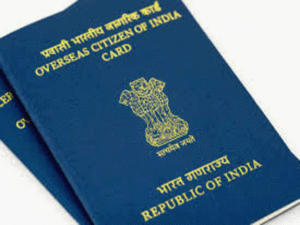
Understanding Overseas Citizenship of India
The Overseas Citizenship of India scheme represents a significant policy development aimed at addressing the aspirations of the Indian diaspora. An Overseas Citizen of India refers to a person who holds citizenship of another country but possesses Indian ancestry or connections to India through birth, descent, or marriage. The scheme was introduced through the Citizenship (Amendment) Act, 2005[1], and has since become a crucial mechanism for maintaining ties between India and its diaspora community spread across the globe.
The eligibility for OCI status is governed by Section 7A of the Citizenship Act, 1955[2]. A foreign national may qualify for OCI registration if they were citizens of India on or after January 26, 1950, or were eligible to become citizens on that date. Additionally, those who belonged to territories that became part of India after August 15, 1947, or are children, grandchildren, or great-grandchildren of such persons, qualify for OCI status. The scheme also extends to spouses of foreign origin married to Indian citizens or existing OCI cardholders, provided the marriage has been registered and has subsisted for at least two continuous years before the application.
Rights of Overseas Citizens are an important aspect of the OCI scheme. While the law explicitly excludes certain categories from eligibility—such as citizens of Pakistan or Bangladesh, or foreign military and police personnel—OCI cardholders enjoy specific privileges and benefits in India, reflecting their continued connection to the country.
Rights and Restrictions Under Overseas Citizens of India (OCI) Status
While OCI status confers numerous benefits, it is fundamentally distinct from full Indian citizenship. Under Section 7B of the Citizenship Act, 1955, OCI cardholders enjoy several rights that facilitate their connection with India. These include a multiple-entry, lifelong visa for visiting India, exemption from registration with the Foreign Regional Registration Officer regardless of the length of stay, and the ability to own residential and commercial properties in India.
Despite these advantages, OCI cardholders face significant restrictions. They cannot vote in elections, hold public office, serve in constitutional positions such as President, Vice President, or judges of the Supreme Court or High Courts, or generally hold government employment. Additionally, they cannot acquire agricultural land, plantation property, or farmhouses in India. They must obtain special permits before engaging in missionary work, mountaineering, or journalism, and require Protected Area Permits or Restricted Area Permits to visit certain restricted zones, just like any foreign national.
OCI Status and Matrimonial Disputes: Jurisdictional Framework
The intersection of OCI status and matrimonial disputes presents unique legal challenges. When marriages involving OCI persons encounter difficulties, questions arise regarding which courts have jurisdiction, which laws apply, and what remedies are available. Protecting the rights of Overseas Citizens of India in such situations has become a key consideration for Indian courts, which have progressively developed jurisprudence addressing these issues while balancing principles of private international law with constitutional guarantees of justice and equality.
The landmark case of Neerja Saraph v. Jayant Saraph[3] highlighted the predicament faced by women in NRI and overseas marriages. In this case, a woman married to an NRI was abandoned shortly after marriage when her husband returned to the United States and subsequently filed for annulment. The Supreme Court expressed grave concern over the growing exploitation of women through such marriages and suggested legislative reforms to protect their interests. The Court emphasized that marriages solemnized in India between an Indian woman and an NRI should not be easily annulled by foreign courts. This judgment established important principles regarding the right to seek damages, enforce orders by Indian courts, obtain injunctions against husbands traveling or taking children abroad, and claim property shares from husbands and in-laws.
Building upon these principles, the Karnataka High Court addressed the specific situation of OCI cardholders in Michael Graham Prince v. Nisha Misra[4]. This case involved two British nationals holding OCI cards who had married in India according to Hindu Arya Samaj rites. When matrimonial disputes arose, the husband challenged the jurisdiction of Indian family courts, arguing that only English courts had jurisdiction over the matter. The Karnataka High Court decisively rejected this contention, holding that OCI cardholders can seek matrimonial relief in Indian courts against estranged partners who are also OCI cardholders. The Court observed that while OCI persons are foreign nationals, the issuance of OCI cards by the Government of India means they are not strangers to the country. Furthermore, notifications issued under Section 7B of the Citizenship Act treat OCI cardholders on par with Non-Resident Indians in many aspects, and matrimonial relief is not among the excluded rights under the Overseas Citizens of India statute.
The Court emphasized the principle of spousal equality as a necessary facet of gender equality enshrined under Article 14 of the Constitution. It noted that when a marriage has taken place in India where parties are ordinarily residing, Indian courts have substantive jurisdiction to adjudge matrimonial disputes. The judgment stressed that parties cannot be asked to seek redress in another country, particularly when the grieving party is the wife, and this view gains support from several international conventions.
Application of Section 125 CrPC to OCI Persons
Section 125 of the Code of Criminal Procedure provides a crucial safety net for wives, children, and parents who are unable to maintain themselves[5]. This provision has been consistently interpreted as a secular law applicable to all persons in India, regardless of religion, caste, or citizenship status. Its application to OCI persons engaged in matrimonial disputes represents an important aspect of ensuring justice and preventing destitution.
The Supreme Court’s decision in Mohd. Ahmed Khan v. Shah Bano Begum[6] established the foundational principle that Section 125 CrPC overrides personal laws when they conflict regarding maintenance obligations. The Court held that this provision applies irrespective of the citizenship and personal law of the parties involved. The objective of Section 125 is to prevent vagrancy and destitution by ensuring that those with sufficient means fulfill their obligation to maintain dependent family members. The Court emphasized that this social welfare legislation must be interpreted liberally to effectuate its humanitarian purpose.
In the context of OCI persons, the Patna High Court’s decision in Suresh Narayan Sinha v. Akhauri Balbhadra Prasad becomes particularly relevant. The Court held that while international law principles generally restrict courts from entertaining suits against foreigners not residing within their jurisdiction, municipal law can override these principles when the legislature confers such jurisdiction. Sections 125 and 126 of CrPC, read together, do not exclude foreigners from their purview. Therefore, even if there is a conflict with private international law principles, municipal law prevails to allow these provisions free operation. This reasoning extends to OCI cardholders, who, despite being foreign nationals, can be brought within the ambit of Section 125 CrPC when they have connections with India through marriage and residence.
Private International Law Principles in OCI Marriages
The Bombay High Court’s decision in Muncherji Cursetji Khambata v. Jessie Graant Khambata established important principles of private international law applicable to matrimonial disputes with foreign elements. The Court held that the forms necessary to constitute a valid marriage and the construction of the marriage contract depend on the lex loci contractus, meaning the law of the place where the contract was made. Upon marriage, the wife automatically acquires the domicile of her husband. The status of the spouses and their rights and obligations arising under the marriage contract are governed by the lex domicilii, the law of the country where they are domiciled for the time being. The rights and obligations relating to dissolution of marriage do not form part of the marriage contract itself but arise from and are incidental to such contract, and are also governed by the lex domicilii.
These principles provide a framework for determining which law applies to different aspects of an OCI marriage. However, as the Michael Graham Prince case demonstrates, Indian courts are willing to exercise jurisdiction over matrimonial disputes involving OCI persons when the marriage was solemnized in India and parties have been residing in India, regardless of their foreign nationality or domicile.
Enforcement and Recognition of Foreign Matrimonial Decrees
A critical issue in OCI matrimonial disputes concerns the recognition and enforcement of foreign court decrees in India. Section 13 of the Code of Civil Procedure sets forth the circumstances under which foreign judgments are not conclusive. A foreign judgment is not binding if it was not pronounced by a court of competent jurisdiction, was not given on the merits of the case, appears on the face of proceedings to be founded on an incorrect view of international law, was obtained by fraud, or if it sustains a claim founded on a breach of Indian law.
The Supreme Court’s approach in cases involving foreign matrimonial decrees affecting marriages solemnized in India has been cautious and protective of parties’ rights. Courts have held that only a court recognized by the law under which the parties were married as having competent jurisdiction should be considered a court of competent jurisdiction for recognition purposes. Furthermore, if the ground on which a foreign court granted relief is not available under the personal law applicable to the parties in India, such a decree may not be recognized or enforced.
This framework becomes particularly important for OCI marriages, where parties may seek to obtain favorable decrees from foreign courts and then enforce them in India. Indian courts have consistently held that marriages solemnized in India under Indian law cannot be easily dissolved or annulled by foreign courts, especially when one party did not submit to the jurisdiction of the foreign court or the grounds for relief were not available under Indian law.
Regulatory Framework Under Government Notifications
The Central Government has issued several notifications under Section 7B of the Citizenship Act that clarify the rights available to Overseas Citizens of India cardholders. The notifications dated April 11, 2005, November 5, 2007, and January 5, 2009, specify that in many aspects related to matrimonial disputes, OCI persons are treated on par with Non-Resident Indians. While Section 7B(2) excludes certain rights from being granted to OCI cardholders, such as voting rights and eligibility for public employment, the right to seek matrimonial relief is not among the excluded rights.
This regulatory framework provides legal certainty that OCI cardholders can approach Indian courts for matrimonial relief, including divorce, maintenance, child custody, and property disputes arising from marriage. The principle of treating OCI persons similarly to NRIs in matrimonial matters recognizes their substantial connection with India through their ancestral ties, marriage relationships, and often through property ownership and residence in India.
Jurisdiction and Venue in OCI Matrimonial Cases
Determining the appropriate court and venue for OCI matrimonial cases depends on several factors. The Family Courts Act provides that family courts have jurisdiction over matrimonial disputes where the parties reside within the court’s territorial jurisdiction. The word “residence” is not prefixed with “ordinarily” in the statute, suggesting it should be given an expansive meaning. Courts have held that the requirement is satisfied if the party seeking relief has been residing within the jurisdiction, even if that residence is not permanent or ordinary residence in the strict sense.
For OCI persons, this means that if they have been residing in India within the jurisdiction of a particular family court, that court can entertain matrimonial proceedings regardless of their foreign nationality or domicile abroad. The principle that law is not the slave of dictionaries and that statutory words do not have fixed meanings supports this flexible approach to jurisdictional requirements.
Constitutional Dimensions of Overseas Citizenship of India Matrimonial Rights
The constitutional framework provides an additional layer of protection for OCI persons involved in matrimonial disputes in India. Article 14 of the Constitution guarantees equality before the law and equal protection of laws, which includes gender equality and elimination of gender-based differentiation in legal remedies. Article 15 prohibits discrimination on grounds including sex, and Article 21 protects the right to life and personal liberty, which has been interpreted to include the right to live with dignity.
The Supreme Court has held that once foreigners are lawfully within Indian territory, they are entitled to certain essential rights necessary for a meaningful life, based on the maxim ubi jus ibi remedium, meaning where there is a right, there must be a remedy. This principle also extends to OCI cardholders, ensuring that the rights of Overseas Citizens are upheld and that they can access legal remedies in India due to their special connection with the country.
The concept of spousal equality, recognized as a necessary facet of gender equality under Article 14, requires that both persons in a marriage have truly fair equality of opportunity in terms of opting into marriage and opting out through dissolution. Allowing one spouse to curtail the exit option of the other spouse on grounds of lack of jurisdiction or similar factors would militate against constitutional philosophy and the principle of effective freedom for both parties to determine the nature of their lives.
Practical Implications and Legal Strategies
For OCI persons facing matrimonial difficulties, the evolved legal framework provides several avenues for relief in Indian courts. When a marriage has been solemnized in India according to Hindu, Muslim, Christian, or secular laws, Indian courts have jurisdiction to entertain divorce petitions, maintenance applications, child custody disputes, and property division proceedings. The fact that parties hold foreign citizenship through OCI status does not divest Indian courts of jurisdiction when there are substantial connections with India.
Parties seeking maintenance can approach magistrates under Section 125 CrPC, which provides a speedy and summary remedy without requiring extended trials or complex proof. The secular nature of this provision ensures its applicability regardless of the personal law applicable to the marriage. Courts have the power to grant interim maintenance pending final disposal of the case, providing immediate relief to dependent parties.
Even if a foreign spouse tries to initiate proceedings abroad, Indian courts can issue anti-suit injunctions to prevent injustice or to assert jurisdiction where India is the more appropriate forum, thereby safeguarding the rights of Overseas Citizens within the country’s legal system.
Conclusion
The legal framework governing matrimonial rights of Overseas Citizens of India reflects a careful balance between principles of private international law and the constitutional imperatives of justice, equality, and protection of vulnerable parties. Indian courts have demonstrated a progressive approach in asserting jurisdiction over matrimonial disputes involving OCI persons when marriages were solemnized in India and parties have connections with the country. The application of secular laws like Section 125 CrPC ensures that OCI persons cannot escape maintenance obligations by claiming exemption based on foreign citizenship or personal laws. The evolving jurisprudence recognizes that OCI status, while not conferring full citizenship, creates sufficient nexus with India to justify the exercise of jurisdiction by Indian courts over matrimonial matters. This approach serves the interests of justice, particularly in protecting women who might otherwise be left without effective remedies due to jurisdictional complexities in cross-border marriages.
References
[1] Government of India, Ministry of Home Affairs. (2005). OCI Cardholder Brochure. Retrieved from https://www.mha.gov.in/PDF_Other/BROCHURE_OCI_25042017.pdf
[2] Government of India. (1955). Citizenship Act, 1955. Retrieved from https://ociservices.gov.in/faq
[3] Neerja Saraph v. Jayant Saraph, (1994) 6 SCC 461. Retrieved from https://indiankanoon.org/doc/577389/
[4] Michael Graham Prince v. Nisha Misra, Writ Petition No. 15356 of 2020, Karnataka High Court. Retrieved from https://www.barandbench.com/news/overseas-citizens-of-india-can-seek-divorce-indian-courts-karnataka-high-court
[5] Government of India. (1973). Code of Criminal Procedure, 1973, Section 125. Retrieved from https://indiankanoon.org/doc/1056396/
[6] Mohd. Ahmed Khan v. Shah Bano Begum, AIR 1985 SC 945. Retrieved from https://indiankanoon.org/doc/823221/
[7] Wikipedia. (2024). Overseas Citizenship of India. Retrieved from https://en.wikipedia.org/wiki/Overseas_Citizenship_of_India
[8] Consulate General of India, San Francisco. (n.d.). FAQ’s on OCI. Retrieved from https://www.cgisf.gov.in/page/faq-s-on-oci/
[9] India Law Offices. (2021). New Rules and Restrictions for OCI Card Holders. Retrieved from https://www.indialawoffices.com/legal-articles/new-rules-and-regulations-for-oci-card-holders

Advocate Aaditya Bhatt
Senior Standing Counsel Income Tax Department, Advocate Gujarat High Court. Aaditya combines his technical and legal expertise to deliver strategic counsel in litigation, constitutional, and regulatory matters. He represents clients before High Courts and Tribunals with a technology-driven approach.
