 Whatsapp

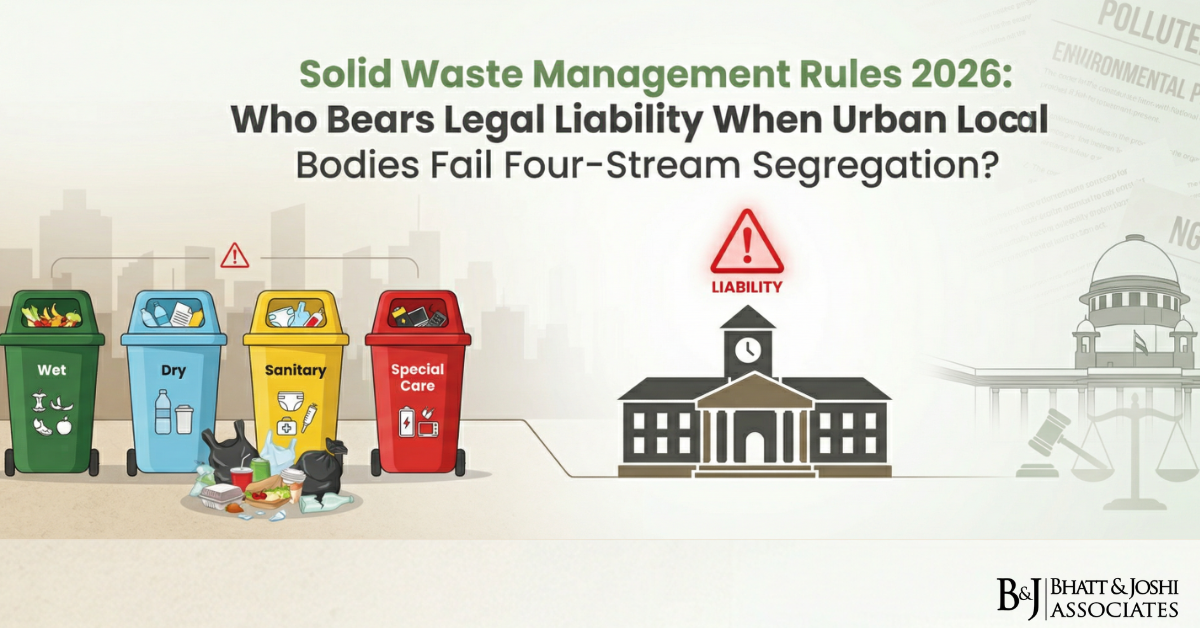
Solid Waste Management Rules 2026 (SWM Rules 2026): Who Bears Legal Liability When Urban Local Bodies Fail Four-Stream Segregation?
Abstract: The Solid Waste Management Rules, 2026, notified by the Ministry of Environment, Forest and Climate Change under the Environment (Protection) Act, 1986, come into effect on April 1, 2026. They replace the decade-old SWM Rules 2016 and introduce a mandatory four-stream waste segregation regime — wet, dry, sanitary, and special care waste — alongside environmental compensation grounded in the Polluter Pays Principle. This article examines the legal liability framework applicable when Urban Local Bodies (ULBs) fail to operationalise four-stream segregation, tracing liability through constitutional doctrine, statutory obligations, judicial pronouncements, and tribunal orders. It draws on landmark rulings from the Supreme Court and the National Green Tribunal to demonstrate that lack of funds or infrastructure is no legal shield for a ULB’s non-performance of its public duty.
1. Introduction: A New Segregation Mandate and the Liability Gap
India’s urban waste crisis has for decades been framed as an administrative failure masquerading as a governance challenge. The Solid Waste Management Rules, 2016, promised source segregation, decentralised processing, and scientific disposal. Yet a decade of implementation produced a stubborn gap between regulatory text and ground reality. Mixed waste continued to overwhelm landfills, unsegregated garbage moved through collection chains untouched, and Urban Local Bodies (ULBs) continued to cite financial incapacity as a first and last defence against accountability.
Into this landscape arrived the Solid Waste Management Rules, 2026 (SWM Rules 2026), notified by the Ministry of Environment, Forest and Climate Change (MoEFCC) under the Environment (Protection) Act, 1986. The Rules come into full force from April 1, 2026, and introduce what is arguably the most structurally demanding reform in India’s history of waste governance: mandatory four-stream segregation at source [1]. Waste must now be segregated into wet waste (kitchen scraps, vegetable peels, food leftovers), dry waste (plastic, paper, metal, glass, wood), sanitary waste (diapers, sanitary napkins, tampons, condoms), and special care waste (bulbs, batteries, expired medicines, paint cans, mercury thermometers). Each stream carries its own downstream obligation — wet waste to composting or bio-methanation, dry waste to Material Recovery Facilities (MRFs), sanitary waste to secure wrapped storage, and special care waste to authorised collection agencies.
The central legal question this article addresses is this: when a ULB fails to facilitate, operationalise, or enforce four-stream segregation — whether by not providing separate collection infrastructure, deploying mixed-waste vehicles, failing to operate MRFs, or not framing bye-laws — who bears legal liability? The answer sits at the intersection of constitutional law, environmental statute, municipal law, and a substantial body of judicial and tribunal precedent that this piece unpacks in detail.
2. The Regulatory Framework: From Three Streams to Four
The SWM Rules 2026 represent a deliberate escalation from the three-category system — wet, dry, domestic hazardous — established under the SWM Rules 2016. The 2016 framework, notified on April 8, 2016, under the Environment (Protection) Act, 1986, was the first to formally mandate source segregation as a legal obligation rather than a policy target. It imposed duties on waste generators to segregate and hand over segregated waste, and tasked ULBs with building collection, transportation, processing, and disposal infrastructure [2]. However, enforcement remained structurally thin. Domestic hazardous waste — the third stream — was routinely mixed with other waste due to the absence of separate bins, dedicated vehicles, and collection protocols.
The 2026 Rules respond to this directly. The four-stream model carves sanitary waste as a distinct fourth category, recognising its infection risk and the public health hazard of mixing used diapers and sanitary napkins with biodegradable or dry waste. Special care waste — paint cans, bulbs, mercury thermometers, and expired medicines — is treated as the fourth pillar, distinct from the earlier undifferentiated “domestic hazardous” category. What is critical from a liability standpoint is that the 2026 Rules formalise environmental compensation grounded in the Polluter Pays Principle for non-compliance — covering not just individual generators but any entity responsible for improper solid waste management, including ULBs whose failures in collection infrastructure and segregation systems result in stream contamination [1]. The Central Pollution Control Board (CPCB) is tasked with issuing compensation guidelines, while State Pollution Control Boards (SPCBs) are empowered to impose the compensation. The Rules also impose higher landfill fees on ULBs that send unsegregated waste to sanitary landfills — fees deliberately priced above the cost of proper segregated processing — making regulatory non-compliance economically irrational, not merely legally impermissible.
3. Constitutional Foundations of ULB Liability
Any serious analysis of ULB liability for SWM failures must begin with the constitutional architecture. Article 21 of the Constitution of India guarantees the right to life, and Indian courts have read into it a fundamental entitlement to a clean and pollution-free environment. The connection between unsegregated waste, contamination of water bodies, methane emissions from uncontrolled landfills, and direct threats to human health and life has been judicially established without ambiguity. This means a ULB’s failure to implement four-stream segregation is not merely a technical statutory default — it is a potential violation of a citizen’s fundamental right, justiciable before the Supreme Court under Article 32 and before High Courts under Article 226.
Article 48A, inserted into the Constitution by the 42nd Amendment in 1976, imposes a directive on the State to protect and improve the environment. Article 51A(g) makes it a fundamental duty of every citizen — and by extension every State organ including ULBs — to protect and improve the natural environment including forests, lakes, rivers, and wildlife. While these provisions are not individually enforceable in a court of law, they form the normative background against which the conduct of ULBs is evaluated. The Supreme Court has repeatedly used Articles 48A and 51A(g) as interpretive tools to broaden the scope of Article 21 liability in environmental litigation, treating inaction by State authorities on waste management as a failure that directly implicates the constitutional right to life.
4. Statutory Liability Under the Environment (Protection) Act, 1986
The Environment (Protection) Act, 1986 (EPA) is the parent statute under which the SWM Rules 2026 have been notified. Section 5 of the EPA grants the Central Government sweeping power to issue binding written directions to “any person, officer or any authority” — which expressly includes the power to direct “the closure, prohibition or regulation of any industry, operation or process” or “stoppage or regulation of the supply of electricity or water or any other service.” This power is not restricted to private actors. It extends directly to ULBs as statutory authorities. A ULB that persistently fails to implement segregation systems under the SWM Rules 2026 can therefore be the subject of binding Central Government directions under Section 5.
Section 15 of the EPA prescribes penalties for any person who fails to comply with any provision of the Act or any rule, order, or direction issued thereunder. The punishment is imprisonment for up to five years or a fine of up to one lakh rupees, or both. For continuing violations — and failure to implement segregation infrastructure is by nature a continuing default, renewed with every day that passes — an additional fine of up to five thousand rupees per day may be imposed. If the violation extends beyond one year, the imprisonment term may be extended to seven years. Since the SWM Rules 2026 were made under the EPA, a ULB’s failure to discharge its duties under the Rules is a failure under the EPA itself, and exposes the responsible officials to penal consequences under Section 15.
Section 17 of the EPA addresses offences by government departments specifically. Where an offence under the Act is committed by a government department, the Head of the Department shall be deemed guilty of the offence and may be prosecuted accordingly, unless he or she can prove that the offence was committed without knowledge, or that all due diligence was exercised to prevent it. This provision effectively pierces the veil of the government department and attaches personal criminal liability to the officer in charge — a powerful mechanism when applied to a ULB commissioner or municipal chief executive who fails to act on the four-stream mandate.
5. The Doctrine of Municipal Inability: A Defence That Courts Have Refused
The most common defence offered by ULBs in environmental litigation has been financial incapacity — the argument that implementing full segregation infrastructure requires funds, equipment, and personnel that smaller municipalities simply do not have. Indian courts have consistently and emphatically rejected this defence.
The foundational rejection came from Justice V.R. Krishna Iyer’s celebrated judgment in Municipal Council, Ratlam v. Shri Vardhichand & Ors., (1980) 4 SCC 162. The facts were rooted in ground reality that mirrors ULB failures today: residents of Ward No. 12, Ratlam, moved the Sub-Divisional Magistrate under Section 133 of the Code of Criminal Procedure, 1973, to compel the municipality to construct proper drainage systems and provide sanitation facilities. The municipality argued that it lacked the funds to comply. The Supreme Court dismissed the argument and held: “A responsible municipal council constituted for the precise purpose of preserving public health cannot run away from its principal duty by pleading financial inability.” Justice Krishna Iyer went further, stating that “decency and dignity are non-negotiable facets of human rights and constitute a first charge on local self-governing bodies,” and that public health infrastructure cannot be held “at the risk of a self-created bankruptcy or a perverted expenditure budget” [3]. The municipality was directed to implement a drainage scheme on a time-bound basis, and the Court held that Section 133 CrPC empowers courts to compel affirmative action from statutory bodies.
This reasoning applies with full force to ULBs defaulting on four-stream segregation obligations under the SWM Rules 2026. A ULB that claims it cannot provide separate bins, vehicles, or processing infrastructure for wet, dry, sanitary, and special care waste is making precisely the argument the Supreme Court rejected in Ratlam four and a half decades ago. The obligation to provide sanitation and waste management infrastructure is not conditional on budgetary comfort — it is a statutory and constitutional imperative that courts will enforce.
6. Almitra H. Patel v. Union of India: Accountability as a Judicial Command
The landmark writ petition filed by environmental activist Almitra H. Patel as WP No. 888/1996 before the Supreme Court, culminating in the ruling in Almitra H. Patel v. Union of India, (2000) 2 SCC 679, constitutes the most expansive judicial intervention in India’s solid waste governance. Led by Justice B.N. Kirpal, the Court found that the Municipal Corporation of Delhi (MCD) and the New Delhi Municipal Council (NDMC) were “wholly remiss in the discharge of their duties under law.” The Court observed: “It is no doubt correct that rapid industrial development, urbanisation and regular flow of persons from rural to urban areas have made major contribution towards environmental degradation, but at the same time the authorities entrusted with the work of pollution control cannot be permitted to sit back with folded hands on the pretext that they have no financial or other means to control pollution and protect the environment” [4].
The judgment issued ten operative directions, including the identification of landfill sites for the next twenty years, construction of compost plants, appointment of Executive Magistrates to enforce littering laws, and publication of the contact details of sanitation officials to ensure citizen access to grievance redressal. It also catalysed the formulation of the Municipal Solid Waste (Management and Handling) Rules, 2000. After the Supreme Court transferred the matter to the NGT in September 2014, monitoring continued under In re: Compliance of Municipal Solid Waste Management Rules, 2016, OA No. 606/2018. Under this OA, the NGT has summoned Chief Secretaries of all States and UTs to appear by video conference, directed time-bound action plans, and imposed compensation orders — all of which inform the accountability framework under the SWM Rules 2026 [10].
7. NGT Orders and Environmental Compensation: Maharashtra as a Case Study
The National Green Tribunal, established under the National Green Tribunal Act, 2010, has emerged as the most active adjudicatory forum for solid waste management enforcement in India. The NGT derives its jurisdiction over SWM violations from Schedule I of the NGT Act, which lists the EPA 1986 among the statutes under which it may hear disputes. Section 15 of the NGT Act empowers the Tribunal to grant relief and compensation to victims of environmental damage and to provide for restoration of damaged property or the environment. Section 20 mandates that the Tribunal shall apply the Polluter Pays Principle while passing any order or decision.
The Tribunal’s application of these provisions to governmental waste management failures was dramatically demonstrated in its order holding the Government of Maharashtra liable for environmental compensation of Rs. 12,000 crore. The coram of Justice Adarsh Kumar Goel (Chairperson), Justice Sudhir Agarwal, and Prof. A. Senthil Vel, monitoring compliance with Supreme Court directions in Almitra H. Patel v. Union of India, 2014 SCC OnLine SC 1844 and Paryavaran Suraksha v. Union of India, (2017) 5 SCC 326, computed compensation at Rs. 10,840 crores for gaps in liquid waste treatment and Rs. 1,200 crores for un-remediated legacy waste, totalling Rs. 12,000 crores, and directed Maharashtra to deposit the sum in a separate ring-fenced account within two months [5]. The Tribunal observed: “Award of above compensation has become necessary under Section 15 of the NGT Act to remedy the continuing damage to the environment and to comply with directions of the Hon’ble Supreme Court.” The Chief Secretary of the State was made personally answerable for compliance.
This judgment is significant for ULB liability under the SWM Rules 2026 for multiple reasons. It confirms that governmental entities — not only private polluters — fall squarely within the Polluter Pays framework. It demonstrates that financial orders of extraordinary magnitude can follow governmental inaction in waste management. And it establishes that continuous default in waste management — rather than a discrete environmental incident — is sufficient to trigger liability under Section 15 of the NGT Act [9].
8. Shared But Asymmetric Liability Under SWM Rules 2026
The SWM Rules 2026 mark a structural shift from treating solid waste management as a ULB-centric municipal service to framing it as a shared legal responsibility across the waste management chain. Households, bulk waste generators, institutions, event organisers, brand owners, and facility operators are all assigned clearer duties, with non-compliance potentially attracting penalties under local bye-laws [8]. However, this shared responsibility architecture does not dilute ULB liability — it layers accountability onto additional actors while retaining ULBs as the primary institutional guarantors of the system’s functioning.
Bulk Waste Generators — defined under the 2026 Rules as entities with a floor area of 20,000 square metres or more, water consumption of 40,000 litres per day or more, or solid waste generation of 100 kilograms per day or more — bear direct responsibility for ensuring that waste generated on their premises is collected, segregated, transported, and processed in an environmentally sound manner. The Extended Bulk Waste Generator Responsibility (EBWGR) framework, new under the 2026 Rules, requires them to either process wet waste on-site or obtain EBWGR certificates where on-site processing is not feasible. These generators account for nearly 30 percent of India’s total solid waste, and their direct compliance obligations meaningfully reduce the operational burden on ULBs [1].
Yet the fundamental principle across Indian jurisprudence remains intact: the local body is the last institutional guarantor of sanitation within its jurisdiction. When a generator defaults, the ULB cannot passively watch as mixed waste enters the collection chain. It must enforce through bye-law penalties, correction notices, and spot fines. Where it does not, the failure is attributable to the ULB itself, and both the Polluter Pays Principle under Section 20 of the NGT Act and the penal provisions of Section 15 of the EPA are available against its responsible officials.
9. NGT OA No. 606/2018: The Continuing Monitoring Framework
In re: Compliance of Municipal Solid Waste Management Rules, 2016 and other environmental issues, OA No. 606/2018 before the National Green Tribunal, represents the most sustained institutional monitoring of ULB compliance in Indian environmental law. Under this OA — which continues to operate and is being re-calibrated to the SWM Rules 2026 — the Tribunal has directed all Chief Secretaries to appear before it by video conference to account for the status of waste management in their States. The Tribunal has observed in its orders that “local authorities constituted for providing services to the citizens are lethargic and insufficient in their functioning which is impermissible. Non-accountability has led to lack of effort on the part of the employees.”
In its 2022 and 2023 orders under this OA, the NGT reiterated that lack of funds cannot be pleaded as a defence against the constitutional responsibility to provide a pollution-free environment, holding: “It is the constitutional responsibility of the State and the Local Bodies to provide pollution free environment and to arrange necessary funds from contributors or others. Being part of the right to life, which is also a basic human right and an absolute liability of the State, lack of funds or other resources such as land cannot be a plea to deny such right.” In February 2026, as the Supreme Court received submissions about the SWM Rules 2026 commencing on April 1, 2026, the bench of Justices Pankaj Mithal and S.V.N. Bhatti observed that “the statutory mechanism is not yielding desired results because of several factors at the field level” and directed that “authorities must complete the spadework before the rules come into effect or the ground situation will not improve” [6].
10. Mapping the Accountability Chain
From the foregoing analysis, the liability chain for four-stream segregation failure under the SWM Rules 2026 runs through several identifiable levels. At the first level, the waste generator — household, commercial establishment, or bulk waste generator — bears primary responsibility to segregate at source. Under the bye-laws framed by ULBs pursuant to their obligations under the SWM Rules, generators who fail to segregate are liable to spot fines and user charge penalties [7]. These bye-laws derive their authority from State municipal corporation acts and must be consistent with the SWM Rules under the EPA.
At the second level, ULBs bear the duty of providing separate collection infrastructure per stream, operating segregated transportation, coordinating with MRFs, and enforcing generator compliance. Where a ULB deploys mixed-waste vehicles, fails to provide separate bins for four streams, or routes unsegregated waste to landfills, it incurs the enhanced landfill fees under the 2026 Rules and remains exposed to environmental compensation proceedings before the NGT. Responsible officers — municipal commissioners, chief executives, and heads of sanitation departments — are the individuals against whom personal criminal liability under Section 15 read with Section 17 of the EPA attaches.
At the third level, SPCBs and Pollution Control Committees are tasked with levying environmental compensation in accordance with CPCB guidelines. The digital monitoring portal mandated under the 2026 Rules — through which waste generation, collection, transport, processing, disposal, and legacy dumpsite remediation data must be reported — creates an electronic audit trail that SPCBs and the NGT can use to identify defaults and trigger compensatory proceedings in near real time.
11. Conclusion: Liability Is Not Aspirational
The Solid Waste Management Rules 2026 are not the first instrument to mandate segregation in India, but they are structurally the most demanding. The shift from a three-stream to a four-stream model, the formalisation of the Polluter Pays Principle as an operative compensation mechanism, the introduction of higher landfill fees as a financial deterrent, and the digital monitoring portal together create a compliance architecture far more resistant to the passive non-compliance that plagued the 2016 Rules.
The legal liability when ULBs fail to implement four-stream segregation is not theoretical. It rests on a foundation built over four decades: the Ratlam Municipal Council judgment’s unambiguous rejection of financial incapacity as a defence, the Almitra Patel series of rulings establishing the right to a clean environment as a justiciable fundamental right under Article 21, the NGT’s Rs. 12,000 crore compensation order against Maharashtra for waste management failure, and the continuing monitoring framework under OA 606/2018. These are not aspirational standards — they are enforceable judicial commands.
A ULB that reaches April 1, 2026, without four-stream segregation bins deployed, without separate collection vehicles, without MRF coordination, and without framed and operational bye-laws does not merely risk administrative censure. It risks environmental compensation orders, personal penal prosecution of its officers under the EPA, judicial mandamus from High Courts, and summons before the NGT Chairperson to explain inaction. The courts have spoken with consistent clarity for over four decades: lack of funds, lack of staff, and lack of infrastructure are not defences. They are precisely the reasons the State and its local bodies must act with urgency, priority, and without further delay.
References
[1] Press Information Bureau, Ministry of Environment, Forest and Climate Change, “New Solid Waste Management Rules Notified; To Come into Force from April 1, 2026” (January 2026). Available at: https://www.pib.gov.in/PressReleasePage.aspx?PRID=2219676®=3&lang=1
[2] Ministry of Environment, Forest and Climate Change, Solid Waste Management Rules, 2016, notified under the Environment (Protection) Act, 1986, Gazette of India, Extraordinary, April 8, 2016. Available at: https://cdnbbsr.s3waas.gov.in/s30f46c64b74a6c964c674853a89796c8e/uploads/2024/07/20240710555191345.pdf
[3] Municipal Council, Ratlam v. Shri Vardhichand & Ors., (1980) 4 SCC 162, 1980 AIR 1622, Supreme Court of India. Available at: https://indiankanoon.org/doc/440471/
[4] Almitra H. Patel v. Union of India, (2000) 2 SCC 679, Writ Petition No. 888/1996, Supreme Court of India. Available at: https://elaw.org/resource/india-almitra-h-patel-v-union-india-wp-8881996-20000215-municipal-waste-case
[5] “NGT Directs Maharashtra Government to Pay Compensation of Rs. 12,000 Crore Due to Improper Waste Management,” SCC Times, September 16, 2022. Available at: https://www.scconline.com/blog/post/2022/09/16/ngt-directs-maharashtra-government-to-pay-compensation-of-rs-12000-crore-due-to-improper-waste-management/
[6] “Supreme Court Mandates Waste Management Infrastructure Compliance by April 2026,” Down to Earth, February 13, 2026. Available at: https://www.downtoearth.org.in/environment/daily-court-digest-major-environment-orders-february-13-2026
[7] Centre for Science and Environment, “Origin & Provisions of Municipal Bye-Laws & Solid Waste Management by Urban Local Bodies,” Down to Earth, March 2024. Available at: https://www.downtoearth.org.in/waste/origin-provisions-of-municipal-bye-laws-solid-waste-management-by-urban-local-bodies-94658
[8] “India’s New Solid Waste Management Rules Promise Greater Discipline, While Navigating Familiar Fault Lines,” Down to Earth, January 2026. Available at: https://www.downtoearth.org.in/waste/indias-new-solid-waste-management-rules-promise-greater-discipline-while-navigating-familiar-fault-lines
[9] “A Review of the NGT on Environmental Compensation and Waste Management Implementation,” Live Law, June 28, 2023. Available at: https://www.livelaw.in/articles/a-review-of-the-ngt-on-environmental-compensation-and-waste-management-implementation-231437
[10] In re: Compliance of Municipal Solid Waste Management Rules, 2016 and other environmental issues, OA No. 606/2018, National Green Tribunal, New Delhi, order dated April 30, 2019. Available at: https://indiankanoon.org/doc/90223511/
