Whatsapp

Startup Losses and Section 79 of the Income Tax Act, 1961: When Anti-Abuse Rules Kill Legitimate Restructuring
Introduction
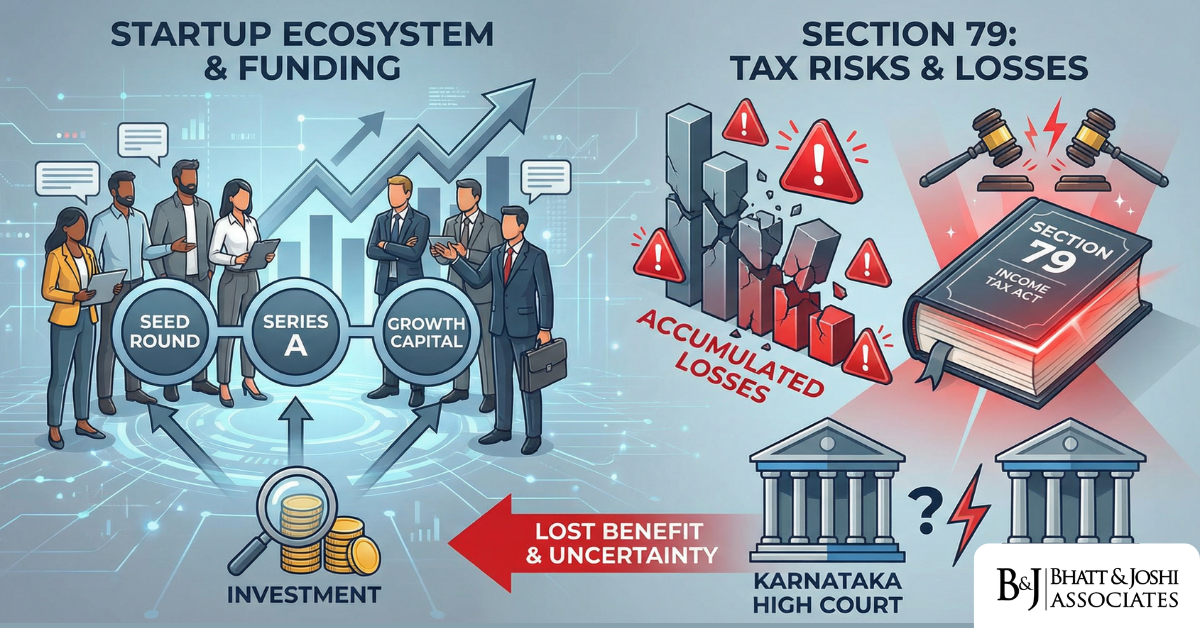
India’s startup ecosystem has grown into one of the most dynamic in the world, yet founders and investors continue to grapple with a tax provision that was never designed with them in mind. Section 79 of the Income Tax Act, 1961 [1] is an anti-abuse rule, written to prevent profitable companies from buying loss-making shells purely to harvest accumulated tax losses. In practice, however, it frequently punishes genuine business reorganisations — investor funding rounds, internal group restructurings, and founder share transfers — that have nothing to do with tax avoidance. For closely held startups, which almost by definition undergo regular changes in shareholding as they move through successive rounds of venture capital, Section 79 can silently wipe out years of accumulated losses, destroying the very deferred tax asset that makes a young company attractive to future investors. This article examines what Section 79 provides verbatim, how it has been amended to accommodate startups, what the courts have said about it, and where the provision still falls dangerously short of protecting legitimate commercial restructuring.
What Section 79 of the Income Tax Act, 1961 Actually Says
The operative text of Section 79(1) of the Income Tax Act, 1961 reads as follows:
“Notwithstanding anything contained in this Chapter, where a change in shareholding has taken place during the previous year in the case of a company, not being a company in which the public are substantially interested, no loss incurred in any year prior to the previous year shall be carried forward and set off against the income of the previous year, unless on the last day of the previous year, the shares of the company carrying not less than fifty-one per cent of the voting power were beneficially held by persons who beneficially held shares of the company carrying not less than fifty-one per cent of the voting power on the last day of the year or years in which the loss was incurred.” [1]
The provision applies exclusively to closely held companies — those not substantially owned by the public. Its single operative test is whether persons who beneficially held shares carrying at least 51% of the voting power on the last day of the year in which the loss was incurred continue to hold that same 51% on the last day of the year in which set-off is claimed. If that continuity is broken, the accumulated business losses simply lapse. Critically, the section uses the phrase “beneficially held” and not merely “held,” a distinction that the courts have spent decades unpacking.
The section was introduced pursuant to the recommendations of the Taxation Inquiry Commission — the Mathai Commission — of 1953–54. Its stated purpose was to curb the practice of profitable enterprises acquiring loss-making undertakings solely to use accumulated tax losses to offset their own profits, what is colloquially known as “trafficking in losses.” [2]
The Startup Carve-Out: Finance Act 2017 and the Section 80-IAC Proviso
Recognising that startups raise capital through multiple rounds of dilutive equity funding and that founders frequently exit or reduce their holdings as the company matures, the Finance Act, 2017 inserted a specific proviso to Section 79(1). The proviso provides that even if the 51% continuity condition is not satisfied, an eligible startup as referred to in Section 80-IAC of the Act may still carry forward and set off its losses, provided that all shareholders who held shares carrying voting power on the last day of the year in which the loss was incurred continue to hold those shares on the last day of the year in which set-off is sought. [3] This exemption is available only for losses incurred during the seven years beginning from the year of incorporation.
The Finance (No. 2) Act, 2019, effective from 1 April 2020, substituted the entire Section 79 and introduced additional statutory exceptions — changes in shareholding arising from death of a shareholder, from a gift to a relative, from the amalgamation or demerger of a foreign parent company subject to 51% continuity of that foreign company’s shareholders, from a resolution plan approved under the Insolvency and Bankruptcy Code or under Section 242 of the Companies Act, 2013, and from the strategic disinvestment of a public sector company. [1]
The startup carve-out sounds generous on its face. But the condition that all original shareholders must continue to hold their shares is, in practice, far more restrictive than the general 51% test applicable to other companies. For ordinary closely held companies, new investors may acquire up to 49% of the voting power without triggering Section 79. For eligible startups, a single original shareholder who exits — even a minor angel investor who held 1% — can theoretically put the entire accumulated loss at risk. This asymmetry reflects a legislative choice to ensure that the startup exemption covers only situations where the founding group remains completely intact, but the real-world impact is that it excludes precisely the kind of early investor churn that is normal and healthy in startup financing.
The Concept of Beneficial Ownership: Where Courts Have Disagreed
The single most litigated question under Section 79 is what it means for shares to be “beneficially held.” Two High Courts have reached diametrically opposite conclusions on this question, and the resulting uncertainty continues to affect corporate restructurings across the country.
The Karnataka High Court addressed this in CIT v. AMCO Power Systems Ltd. [4], decided in 2015. In that case, all shares of AMCO Power Systems were originally held by AMCO Batteries Ltd. (“ABL”). ABL transferred a portion of its shares to its wholly owned subsidiary, AMCO Properties and Investments Ltd. (“APIL”), and later transferred 49% of its remaining shares to Tractors and Farm Equipments Limited (“TAFE”), an unrelated party. At that point, ABL directly held only 6%, APIL held 45%, and TAFE held 49%. The Revenue disallowed the carry forward of losses on the ground that ABL no longer held 51% of the voting power directly. The Karnataka High Court disagreed. It held that since ABL was the holding company of APIL and controlled APIL’s Board entirely, ABL effectively exercised voting power over APIL’s 45% stake, and together ABL and APIL controlled 51%, all ultimately under ABL’s direction. The Court ruled that Section 79 “speaks of 51% voting power” and that the purpose of the provision is to prevent losses from being misused by a new owner — a purpose entirely absent where control never left the ABL group. [4]
The Delhi High Court took a completely contrary view in Yum Restaurants (India) Pvt. Ltd. v. ITO [5], decided in January 2016. There, 100% of Yum India’s shares were transferred from Yum Asia Pte. Ltd. to Yum Restaurants International (Singapore) Pte. Ltd., with the ultimate parent throughout being Yum! Brands USA. The taxpayer argued that the ultimate beneficial owner was always Yum USA and that no real change in beneficial ownership had taken place. The Delhi High Court rejected this, holding that Yum Asia and Yum Singapore were distinct legal entities and that there was no agreement or arrangement on record demonstrating that the beneficial owner of the shares was Yum USA rather than the immediate holding entity. The Court found that there was “indeed a change of ownership of 100% shares of Yum India from Yum Asia to Yum Singapore, both of which were distinct entities” and that the “question of piercing the veil at the instance of Yum India does not arise.” [5] Section 79 was held applicable and Yum India was denied set-off of its accumulated losses.
These two cases represent the sharpest fault line in Section 79 jurisprudence. The Karnataka court applied a substance-over-form approach, treating consolidated group control as determinative. The Delhi court demanded explicit contractual or documentary evidence of beneficial ownership in an entity beyond the registered shareholder. Since neither decision has been overturned by the Supreme Court, taxpayers remain subject to different standards depending on the jurisdiction in which they are assessed — a situation that generates unpredictability in precisely the kind of cross-border group reorganisations that Indian startups most commonly undertake.
The Supreme Court’s Foundational Position
The Supreme Court laid down the foundational interpretation of Section 79 in Commissioner of Income Tax, Bombay v. Italindia Cotton Co. (P) Ltd. [6], decided on 5 September 1988. The question was whether the two conditions that save a company from Section 79 — that 51% of voting power continues to be beneficially held by the same persons, or that the change in shareholding was not effected with a view to avoiding tax — operate cumulatively or in the alternative. The Supreme Court held that they operate in the alternative. It stated that the benefit is available “notwithstanding the change in shareholding in the previous year, if shares representing not less than 51% of the voting power remain beneficially held by the same persons on the relevant dates” and equally available if “the change was not effected with a view to avoiding or reducing any liability to tax.” [6] Satisfaction of either condition is sufficient to negate the disallowance.
This principle means that even where genuine beneficial ownership has shifted beyond the 49% threshold, a taxpayer who can establish to the Assessing Officer that the restructuring was not tax-motivated can still preserve its accumulated losses. This second limb is, however, a factual determination susceptible to subjective assessment by Revenue officers, and in practice the burden of proof that the restructuring had no tax-avoidance motive rests heavily on the taxpayer.
The Mumbai ITAT: When Section 79 Is Triggered
The Mumbai Bench of the Income Tax Appellate Tribunal brought procedural clarity in Sodexo India Services Pvt. Ltd. [7], holding that Section 79 is attracted only in the year in which set-off is actually claimed, not in the year when the change in shareholding occurs. The Tribunal also reaffirmed that where the ultimate beneficial ownership of the company has remained unchanged, Section 79 cannot be invoked merely because the registered holder has changed. Since Sodexo India’s shares had moved between entities within the same group while the ultimate parent remained constant, the revisionary proceedings invoking Section 79 were held unsustainable. [7]
The timing clarification carries a double-edged consequence. It means that a restructuring that looks clean when executed could be reviewed under the shareholding composition that exists at the time set-off is eventually claimed, potentially years later. Careful monitoring of shareholder registers over the entire loss utilisation period is therefore essential for any closely held company with accumulated losses.
Where the Framework Falls Short
Despite the 2017 carve-out, Section 79 remains structurally inadequate for the startup funding lifecycle. The “all shareholders” condition is commercially unrealistic — early-stage investors, employee option-holders who exercise and sell, and seed-round angels routinely exit before a startup reaches profitability. The seven-year limitation compounds this: startups in capital-intensive industries — deep technology, life sciences, hardware, electric vehicles — commonly do not reach profitability within seven years, and once losses fall outside the seven-year window the startup carve-out ceases to apply. [8] The turnover threshold under Section 80-IAC adds a further complication, since a company that crosses the relevant threshold in a later year may find that it no longer qualifies as an eligible startup when it attempts to claim set-off, even though it unquestionably qualified when the losses were incurred.
For startups receiving foreign venture capital through offshore holding structures — near-universal in Indian tech startups — the Delhi High Court’s insistence on explicit documentary evidence of beneficial ownership creates structural risk. A fund manager sitting in Singapore who invested through a Mauritius SPV is the beneficial owner in any economic sense, but the Revenue may treat the SPV as the beneficial shareholder for Section 79 purposes. The PwC analysis of the Mumbai ITAT’s 2021 ruling, which denied Section 79’s application where voting power and beneficial ownership effectively remained unchanged after an intra-group merger, shows that taxpayers can succeed on these facts — but the litigation cost and uncertainty remain significant. [9]
Conclusion
Section 79 of the Income Tax Act, 1961 was designed to prevent tax trafficking in losses. Over six decades of litigation it has evolved into something considerably more complex — a provision that routinely catches legitimate group reorganisations and startup funding rounds within its net, while courts across the country disagree about whether and how beneficial ownership arguments can displace its application. The 2017 startup carve-out was well-intentioned but too narrowly drawn: the “all shareholders” condition is commercially impractical, the seven-year window is insufficient for many industries, and DPIIT recognition introduces administrative fragility into what ought to be a tax-stable relationship. Until Parliament revisits Section 79 with genuine attention to the startup funding lifecycle, or until the Supreme Court resolves the conflict between the Karnataka and Delhi High Courts on beneficial ownership, taxpayers will continue to face avoidable loss forfeitures that have nothing to do with tax avoidance.
References
[1] Section 79, Income Tax Act, 1961, as amended by Finance (No. 2) Act, 2019 — https://indiankanoon.org/doc/814605/
[2] PwC India, “Section 79 and its implications on global and domestic transactions/restructuring,” Tax Guru, June 2022 — https://taxguru.in/income-tax/section-79-implications-global-domestic-transactions-restructuring.html
[3] Argus Partners, “Extended Set Off and Carry Forward Period under Section 79 of the IT Act” — https://www.argus-p.com/updates/updates/extended-set-off-and-carry-forward-period-under-section-79-of-the-it-act/
[4] CIT v. AMCO Power Systems Ltd., Karnataka High Court, ITA Nos. 766, 765, 767, 769 of 2009 and 1046 of 2008 — https://itatonline.org/archives/cit-vs-amco-power-systems-ltd-karnataka-high-court-s-79-as-the-purpose-of-the-provision-is-to-prevent-misuse-of-losses-by-transferring-ownership-it-should-be-restricted-to-cases-of-transfer-of-be/
[5] Yum Restaurants (India) Pvt. Ltd. v. ITO, Delhi High Court, ITA Nos. 349 and 388 of 2015, decided 13 January 2016 — https://indiankanoon.org/doc/85916376/
[6] CIT, Bombay v. Italindia Cotton Co. (P) Ltd., Supreme Court of India, Civil Appeal No. 1520(NT) of 1986, decided 5 September 1988 — https://courtverdict.com/supreme-court-of-india/the-commissioner-of-income-tax-bombay-vs-ms-italindia-cotton-co-p-ltd
[7] S.R. Patnaik, “Section 79 cannot be invoked when there is no change in ultimate beneficial shareholding,” Cyril Amarchand Blogs, March 2023 — https://tax.cyrilamarchandblogs.com/2023/03/section-79-cannot-be-invoked-when-there-is-no-change-in-ultimate-beneficial-shareholding/
[8] “Section 79: Carry Forward and Set Off of Losses in Case of Eligible Startups,” Tax Guru, August 2019 — https://taxguru.in/income-tax/section-79-carry-set-loss-case-ofeligible-startups-condition-relaxed.html
[9] PwC India, “Applicability of Section 79 of the Act denied where there is no change in voting power and beneficial ownership,” Tax Insights, September 2021 — https://www.pwc.in/assets/pdfs/news-alert/tax-insights/2021/pwc_tax_insights_15_september_2021_applicability_of_section_79_of_the_act_denied_where_there_is_no_change_in_voting_power_and_beneficial_ownership.pdf