Whatsapp

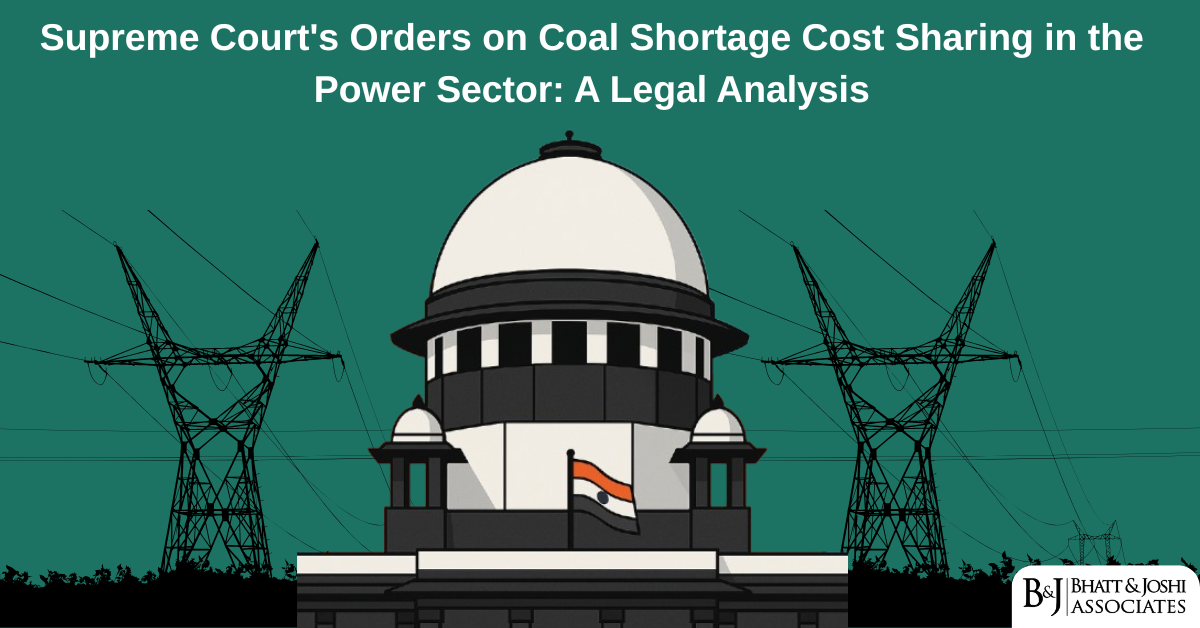
Supreme Court’s Orders on Coal Shortage Cost Sharing in the Power Sector: A Legal Analysis
Introduction
The Indian power sector has witnessed significant judicial interventions in recent years, particularly concerning coal shortage cost sharing. The Supreme Court of India’s recent ruling in September 2025 has established crucial precedents for how distribution companies (DISCOMs) must handle the financial burden of coal shortages and associated costs [1]. This landmark judgment has far-reaching implications for the power sector’s operational framework and regulatory compliance mechanisms.
The power sector in India operates under a complex regulatory framework where multiple stakeholders, including power generation companies, distribution companies, and regulatory authorities, must navigate intricate legal and operational challenges. Coal shortage cost sharing has become a recurring issue, creating disputes over cost allocation and responsibility sharing among various entities in the power supply chain.
Regulatory Framework Governing Coal Shortage Cost Allocation
The Electricity Act, 2003: Foundation of Power Sector Regulation
The Electricity Act, 2003, serves as the primary legislation governing India’s electricity sector, providing the legal framework for regulation, generation, transmission, and distribution of electrical energy [2]. Section 125 of the Electricity Act, 2003, specifically addresses appeals to the Supreme Court, stating that appeals can only be made on “substantial questions of law.” This provision has been crucial in determining the scope of judicial review in power sector disputes.
The Act establishes a three-tier regulatory structure comprising the Central Electricity Regulatory Commission (CERC), State Electricity Regulatory Commissions (SERCs), and the Appellate Tribunal for Electricity (APTEL). This hierarchical framework ensures proper adjudication of disputes while maintaining regulatory consistency across the sector.
Role of Central Electricity Regulatory Commission (CERC)
CERC operates as the apex regulatory authority for the electricity sector, with jurisdiction over inter-state transmission, bulk power markets, and central generating companies [3]. Under the Electricity Act, 2003, CERC possesses the authority to determine tariffs for generating companies and transmission licensees, regulate inter-state transmission and trading of electricity, and adjudicate disputes between licensees.
In matters relating to coal shortage compensation, CERC has consistently applied the principle of pro-rata apportionment among all beneficiaries. This approach ensures that costs arising from external factors such as coal shortages are distributed fairly among all power purchasers, preventing any single entity from bearing disproportionate financial burdens.
Appellate Tribunal for Electricity (APTEL) Jurisdiction
APTEL functions as the appellate authority for decisions made by CERC and SERCs, providing an intermediate judicial forum before appeals can be made to the Supreme Court [4]. The tribunal has jurisdiction to hear appeals against orders of electricity regulatory commissions and can also adjudicate disputes involving generating companies, transmission licensees, and distribution licensees.
The tribunal’s role in coal shortage cost allocation cases has been to ensure that regulatory decisions align with the broader objectives of the Electricity Act, 2003, while maintaining sectoral stability and protecting consumer interests. APTEL’s decisions have consistently supported the principle of equitable cost sharing among all power purchasers.
The GMR Kamalanga Case: A Landmark Supreme Court Ruling
Case Background and Factual Matrix
The Supreme Court’s decision in Haryana Power Purchase Centre (HPPC) and Others v. GMR Kamalanga Energy Limited and Others represents a significant milestone in power sector jurisprudence [5]. The dispute originated from a coal shortfall at GMR Kamalanga Energy Limited’s (GKEL) 1050 MW thermal power plant in Odisha, which forced the company to rely on expensive imported coal to meet its supply obligations.
The central question before the court was whether additional costs arising from coal shortages should be shared proportionally among all power procurers or borne exclusively by the affected distribution companies. This dispute involved multiple parties, including Haryana Utilities, which claimed exclusive rights to 300 MW linkage coal under their Power Purchase Agreement (PPA), and GRIDCO of Odisha, which asserted priority rights based on their earlier agreement.
Legal Arguments and Contentions
Haryana Utilities argued that their PPA specifically allocated 300 MW of linkage coal exclusively for their use, thereby exempting them from sharing the additional costs incurred due to coal shortages affecting other beneficiaries. They contended that the contractual arrangement created distinct entitlements that should be respected in cost allocation decisions.
GRIDCO of Odisha, on the other hand, claimed priority rights under their earlier agreement, arguing that temporal precedence should determine allocation priorities during coal shortage scenarios. Both parties sought to establish preferential treatment in cost allocation, challenging CERC’s order for proportional cost sharing among all beneficiaries.
Supreme Court’s Analysis and Decision
Chief Justice B.R. Gavai and Justice K. Vinod Chandran, constituting the bench, delivered a unanimous judgment that upheld the concurrent findings of CERC and APTEL [6]. The court established several important legal principles that will guide future coal shortage cost allocation disputes.
The Supreme Court categorically rejected the argument that any distribution company could claim priority for power supply based on the prior date of agreement or specific coal source allocations. The court observed that “coal supply from all sources has to be apportioned amongst all the three DISCOMs in proportion to the energy supplied to them.”
The judgment emphasized that appeals under Section 125 of the Electricity Act can only be entertained on substantial questions of law. The court noted that “unless it is found that the findings are perverse, arbitrary or in violation of statutory provisions, it will not be permissible for this Court to interfere with the same.”
Change in Law Provisions and Their Application
Understanding Change in Law Events
Change in Law provisions in power purchase agreements serve as risk allocation mechanisms that protect generating companies from unforeseen regulatory or legal changes that materially affect project economics [7]. These provisions typically allow generators to seek compensation for additional costs or reduced revenues resulting from changes in applicable laws, regulations, or government policies.
In the context of coal shortage scenarios, Change in Law events can be triggered when government policies or regulatory decisions force generators to alter their fuel procurement strategies, leading to increased operational costs. The application of these provisions requires careful analysis of causation, materiality, and the scope of compensable events.
Regulatory Treatment of Change in Law Claims
CERC has developed detailed guidelines for evaluating Change in Law claims, requiring generators to demonstrate direct causation between the legal/regulatory change and the claimed impact. The commission’s approach emphasizes the need for comprehensive documentation and quantitative analysis to support compensation claims.
The regulatory framework mandates that Change in Law compensation should be allocated among all beneficiaries in proportion to their contracted capacity or energy offtake. This approach ensures that the financial burden is distributed equitably, preventing any single purchaser from bearing disproportionate costs.
Cost Sharing Mechanisms in Power Purchase Agreements
Proportional Cost Sharing Principles
The principle of proportional cost sharing has emerged as the dominant framework for allocating unforeseen costs in the power sector. This approach distributes additional costs among all beneficiaries based on their contracted capacity or actual energy offtake, ensuring equitable treatment regardless of specific contractual provisions or temporal precedence.
Proportional allocation mechanisms serve multiple policy objectives, including maintaining sector stability, preventing cross-subsidization among different consumer categories, and ensuring that cost recovery remains aligned with benefit distribution. These principles have been consistently applied by regulatory authorities across various dispute scenarios.
Implementation Challenges and Solutions
The implementation of proportional cost sharing mechanisms faces several practical challenges, including accurate measurement of beneficiary shares, timing of cost recovery, and handling of disputes over allocation methodologies. Regulatory authorities have addressed these challenges through detailed procedural guidelines and standardized calculation methodologies.
CERC has issued specific regulations governing cost allocation procedures, requiring detailed documentation of costs, transparent calculation methodologies, and periodic reconciliation mechanisms. These measures ensure that cost sharing arrangements remain fair and administratively feasible.
Impact on Distribution Companies and Power Market Dynamics
Financial Implications for DISCOMs
The Supreme Court’s ruling on proportional cost sharing has significant financial implications for distribution companies across India. DISCOMs can no longer claim exemptions from sharing coal shortage costs based on specific contractual arrangements or temporal precedence, potentially increasing their financial exposure during coal shortage scenarios.
This judicial precedent requires DISCOMs to incorporate coal shortage risk provisions in their financial planning and tariff calculations [8]. Distribution companies must now account for potential cost sharing obligations when evaluating power purchase agreements and planning their procurement strategies.
Market Efficiency and Risk Distribution
The court’s decision promotes market efficiency by ensuring that risks associated with coal shortages are distributed among all market participants rather than concentrated on specific entities. This approach prevents market distortions that could arise from asymmetric risk allocation and encourages more balanced contractual arrangements.
The ruling also enhances predictability in cost allocation disputes, providing clear guidance to market participants on how coal shortage costs will be distributed. This predictability reduces transaction costs and facilitates more informed decision-making by power sector stakeholders.
Comparative Analysis with International Practices
Global Approaches to Fuel Shortage Cost Allocation
International power markets have developed various approaches to handle fuel shortage cost allocation, ranging from market-based mechanisms to regulatory cost recovery frameworks. European electricity markets typically rely on market mechanisms where generators bear fuel price risks, while regulated markets in developing countries often incorporate cost pass-through provisions similar to India’s approach.
The Indian model of proportional cost sharing aligns with international best practices that emphasize equitable risk distribution among market participants. However, the specific implementation details and regulatory oversight mechanisms reflect India’s unique market structure and developmental priorities.
Lessons from International Dispute Resolution
International experience suggests that clear regulatory guidelines and consistent judicial interpretation are crucial for effective dispute resolution in power sectors. The Supreme Court’s ruling provides such clarity for the Indian context, establishing precedents that align with global trends toward transparent and equitable cost allocation mechanisms.
Future Implications and Sector Development
Evolution of Regulatory Framework
The Supreme Court’s decision is likely to influence the evolution of India’s power sector regulatory framework, potentially leading to more detailed guidelines on coal shortage cost sharing mechanisms and risk distribution principles. Regulatory authorities may need to update their regulations to reflect the judicial interpretation and ensure consistent application across different scenarios.
Future regulatory developments may also address emerging challenges such as renewable energy integration, energy storage costs, and grid modernization expenses, applying similar proportional allocation principles established in the context of coal shortage cost sharing.
Impact on Power Purchase Agreement Design
The ruling will significantly impact how future power purchase agreements are structured, particularly regarding risk allocation clauses and cost sharing mechanisms. Developers and purchasers will need to carefully consider the implications of proportional cost sharing when negotiating contract terms and pricing structures [9].
Legal practitioners and industry participants must now account for the Supreme Court’s interpretation when drafting Change in Law provisions and cost allocation clauses, ensuring alignment with established judicial precedents while protecting their clients’ interests.
Conclusion
The Supreme Court’s ruling on coal shortage cost sharing represents a watershed moment in Indian power sector regulation, establishing clear principles for equitable cost allocation among market participants. The decision reinforces the regulatory framework’s emphasis on fair treatment and prevents any single entity from claiming preferential treatment based on contractual specifics or temporal precedence.
The judgment’s impact extends beyond the immediate parties, providing guidance for future disputes and influencing how power sector risks are allocated and managed. As India continues to develop its electricity markets and integrate renewable energy sources, these principles will serve as foundational elements for maintaining sector stability and promoting efficient market operations.
The ruling also demonstrates the importance of consistent regulatory interpretation and judicial review in maintaining confidence in India’s power sector regulatory framework. By upholding the decisions of CERC and APTEL, the Supreme Court has reinforced the credibility of sectoral regulators while establishing important precedents for future cost allocation disputes.
References
[1] Supreme Court of India. (2025). Haryana Power Purchase Centre (HPPC) and Others v. GMR Kamalanga Energy Limited and Others. 2025 LiveLaw (SC) 877. Available at: https://www.livelaw.in/pdf_upload/622920202025-09-08-619491.pdf
[2] Government of India. (2003). The Electricity Act, 2003. Act No. 36 of 2003.
[3] Central Electricity Regulatory Commission. (2024). CERC Functions and Jurisdiction.
[4] Appellate Tribunal for Electricity. (2024). Jurisdiction and Powers of APTEL.
[5] LiveLaw. (2025). “Supreme Court Dismisses Discom Appeals, Affirms All Purchasers Must Share Coal Shortage Costs Equally.” Available at: https://www.livelaw.in/supreme-court/electricity-act-supreme-court-dismisses-discom-appeals-affirms-all-purchasers-must-share-coal-shortage-costs-equally-303266
[6] SCC Online. (2025). “DISCOMs must share coal shortage costs equally, cannot claim priority for power supply.” Available at: https://www.scconline.com/blog/post/2025/09/10/supreme-court-discoms-coal-shortage-cost-sharing/
[7] Central Electricity Regulatory Commission. (2019). Guidelines for Determination of Tariff by Competitive Bidding Process for Procurement of Power from Grid Connected Solar PV Power Projects.
[8] Law Chakra. (2025). “Supreme Court Orders States To Settle Electricity Dues Within 4 Years.” Available at: https://lawchakra.in/supreme-court/settle-electricity-dues-in-4years/
[9] Global Legal Insights. (2024). “Energy Laws and Regulations 2025 | India.” Available at: https://www.globallegalinsights.com/practice-areas/energy-laws-and-regulations/india/