 Whatsapp

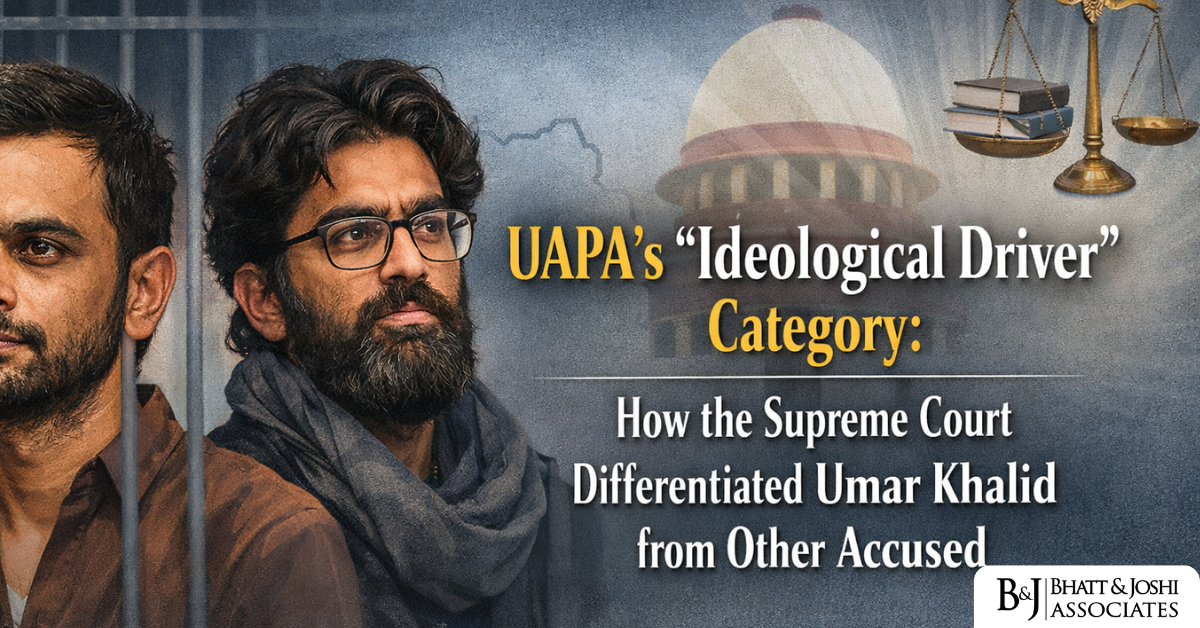
UAPA’s “Ideological Driver” Category: Supreme Court Denies Umar Khalid and Sharjeel Imam’s Bail While Granting Bail to Other Accused
Introduction
On January 5, 2026, the Supreme Court of India delivered a landmark judgment that has significant implications for bail jurisprudence under the Unlawful Activities (Prevention) Act, 1967. In a decision where the Supreme Court denies bail to Umar Khalid and Sharjeel Imam, the Court simultaneously granted bail to five other accused in the Delhi riots larger conspiracy case. Khalid and Imam had been incarcerated for nearly six years without trial. The judgment introduced the concept of an “ideological driver” category, creating a judicial hierarchy among co-accused that distinguished alleged masterminds from facilitators. This differentiation was based on the Court’s assessment that Khalid and Imam occupied a central and directive role as strategic architects of the alleged conspiracy, while the other five accused played ancillary or limited roles.
The case has brought renewed attention to how courts interpret and apply stringent anti-terror legislation, particularly the restrictive bail provisions under UAPA. The judgment crafted by Justices Aravind Kumar and N.V. Anjaria spanning 142 pages across 444 paragraphs represents a significant development in understanding how national security considerations intersect with constitutional guarantees of personal liberty under Article 21 of the Indian Constitution [2].
Legal Framework: Understanding UAPA and Section 43D(5)
The Unlawful Activities (Prevention) Act was originally enacted in 1967 to address unlawful associations and activities threatening India’s sovereignty and territorial integrity. However, successive amendments, particularly those in 2004, 2008, 2012, and 2019, transformed it into India’s primary anti-terrorism legislation with increasingly stringent provisions. The 2008 amendment introduced Section 43D(5), which created an exceptionally high threshold for bail in terrorism-related cases [3].
Section 43D(5) of UAPA provides that a person accused of an offence punishable under Chapters IV and VI of the Act shall not be released on bail if the court, on perusal of the case diary or the report under Section 173 of the Code of Criminal Procedure, has reasonable grounds for believing that the accusation against such person is prima facie true. This provision represents a conscious departure from the general criminal law principle that bail is the rule and jail is the exception. Under UAPA, the presumption is reversed, making bail an exception rather than the rule when prima facie evidence exists against the accused.
The statutory framework under Section 43D(5) requires courts to assess whether prosecution material discloses a prima facie case without conducting a mini-trial or weighing evidence in detail. This creates a delicate balance where courts must satisfy themselves about the existence of reasonable grounds while avoiding an in-depth examination of merits that would be appropriate only during trial. The provision has been interpreted by courts as requiring a threshold inquiry of limited but real content to determine whether the material placed on record discloses the existence of ingredients essential to constitute the offence under UAPA [4].
The “Ideological Driver” Distinction: Creating a Hierarchy of Culpability
The Supreme Court’s January 2026 judgment introduced a novel categorization within the framework of conspiracy cases under UAPA by distinguishing between “ideological drivers” or “principal architects” and those playing facilitative or ancillary roles. This hierarchical approach to culpability marked a significant departure from treating all co-accused uniformly despite facing similar charges under the same statutory provisions.
For Umar Khalid and Sharjeel Imam, the court accepted the prosecution’s narrative that they occupied a central and directive role as ideological drivers and masterminds of the alleged conspiracy. The court characterized their alleged involvement as extending from conceptualization and strategic planning to mobilization and orchestration of protests that the prosecution claimed were designed to transform into violent riots. Their alleged activities included delivering speeches, attending planning meetings, and being part of communication networks that the prosecution presented as evidence of conspiracy [5].
The court’s reasoning emphasized that Khalid and Imam were not merely participants but were positioned at the level of ideological conception and strategic direction. In explaining why the Supreme Court denies bail to Umar Khalid and Sharjeel Imam, the judgment relied on prosecution material suggesting their involvement in strategizing the transformation of protests against the Citizenship Amendment Act into what was characterized as disruptive chakka jams aimed at paralysing Delhi. The court found that allegations against them indicated a continuous chain of activities setting the conspiracy in motion, where their physical absence from sites of actual violence was rendered legally irrelevant by the theory of phased conspiracy liability [6].
In contrast, the five co-accused who were granted bail, namely Gulfisha Fatima, Shifa ur Rehman, Meeran Haider, Shadab Ahmed, and Salim Khan, were characterized by the court as having played limited, subsidiary, or facilitative roles in the alleged conspiracy. The court determined that while these individuals faced serious charges under UAPA, the prosecution material against them disclosed involvement that was ancillary rather than central to the alleged larger conspiracy. This distinction became the foundation for differential treatment in bail consideration despite all seven accused facing charges under the same provisions of UAPA and the Indian Penal Code.
Expansion of “Terrorist Act” Definition Under Section 15 UAPA
A crucial aspect of the Supreme Court’s reasoning involved an expansive interpretation of what constitutes a terrorist act under Section 15 of UAPA. Section 15(1) defines a terrorist act as one done with intent to threaten or likely to threaten the unity, integrity, security, economic security, or sovereignty of India, or with intent to strike terror in people. The provision enumerates specific means including bombs, dynamite, explosive substances, inflammable substances, firearms, lethal weapons, poisonous gases, chemicals, and biological or radioactive substances [7].
However, the provision also includes the residuary phrase “by any other means of whatever nature.” The Supreme Court’s interpretation of this phrase became central to its decision. It is in this interpretative framework that the Supreme Court denies bail to Umar Khalid and Sharjeel Imam, concluding that the statutory intent was not to confine the definition of terrorist acts to the use of conventional weapons alone. Instead, the emphasis was placed on the design, intent, and effect of the act rather than solely on the instrumentality employed.
The court accepted the prosecution’s contention that organized, sustained, and coordinated road blockades or chakka jams, when strategically planned to choke arterial roads, disrupt essential services, and overwhelm state administrative capacity, could constitute terrorist acts even in the absence of conventional violence. The court specifically noted that the prosecution case alleged that protests were deliberately transformed into sustained and replicated blockades at strategically selected locations with the objective of choking movement across the National Capital and disrupting essential services.
This interpretation significantly expanded the scope of Section 15 beyond traditional acts of violence involving weapons. The court reasoned that confining the provision only to conventional modes of violence would unduly narrow its ambit contrary to plain statutory language. By accepting that coordinated civic disruption threatening economic security could fall within the ambit of terrorist acts, the court created a precedent with far-reaching implications for future cases involving protests and civil disobedience movements.
Application of Section 43D(5): The Prima Facie Test
The Supreme Court’s application of Section 43D(5) in this case demonstrates the stringent nature of bail jurisprudence under UAPA. The court clarified that the expression “prima facie true” contemplates an inquiry of statutory plausibility rather than evidentiary sufficiency. This means the court must conduct a threshold inquiry to satisfy itself whether the prosecution material discloses the existence of ingredients essential to constitute the offence, without embarking on a detailed examination that would be appropriate only during trial.
The court distinguished between examining evidence and accepting prosecution material at face value. While acknowledging that bail proceedings should not involve weighing evidence or conducting mini-trials, the court simultaneously held that the assessment must be based on material that discloses statutory ingredients. In the case of Khalid and Imam, the court found that witness statements, communication records, location data, and alleged attendance at meetings provided sufficient material to satisfy the prima facie threshold under Section 43D(5).
The court’s analysis considered the nature of allegations, which included conspiracy to commit terrorist acts under Sections 15, 17, and 18 of UAPA, along with various offences under the Indian Penal Code. The prosecution presented material including protected witness testimonies, WhatsApp group communications, speeches delivered at various forums, and alleged participation in meetings where strategies were discussed. The court held that taken together, this material established reasonable grounds for believing that accusations against Khalid and Imam were prima facie true, thereby triggering the statutory bar on bail under Section 43D(5).
The Najeeb Precedent and Its Limited Application
A significant aspect of the judgment involved the court’s interpretation of its earlier decision in Union of India v. K.A. Najeeb [8]. In that 2021 judgment, a three-judge bench had held that constitutional courts retain the power to grant bail despite statutory restrictions under UAPA when prolonged incarceration occurs and speedy trial seems unlikely, as continued detention would violate Article 21 rights to life and personal liberty.
The Najeeb judgment had provided crucial relief to an undertrial who had been in custody for over five years while his trial progressed at an extremely slow pace. The court in that case recognized that the right to speedy trial is a fundamental right encompassed within Article 21, and that statutory fetters under Section 43D(5) do not completely oust the jurisdiction of constitutional courts to grant bail when fundamental rights are infringed.
However, in the January 2026 judgment concerning Khalid and Imam, the Supreme Court clarified that Najeeb does not create a mechanical rule or trump card that mandates automatic bail merely due to passage of time. The court emphasized that Najeeb should be understood as providing a constitutional safeguard to be invoked in appropriate cases rather than as a mathematical formula of universal application. The court held that delay in trial must be weighed against the gravity of the offence and the role of the accused, and that for alleged masterminds like Khalid and Imam, their conspiratorial centrality meant the statutory bar on bail prevailed despite delay.
The court distinguished the facts of Najeeb from the present case on several grounds. In Najeeb, the trial had been separated from co-accused whose trials had been completed with sentences awarded, while Najeeb’s separate trial was pending due to his initial absconding. In contrast, Khalid and Imam were being tried together with other accused, and the court held that this factual distinction was material in determining the applicability of the Najeeb principle.
The court also noted that the delay in the present case could not be attributed solely to the prosecution, pointing to the voluminous nature of the record with over 1,000 documents and 835 witnesses, along with procedural objections raised by the defence. This reasoning suggested that delay caused partly by the defence or by the complexity of the case itself would not automatically trigger the Najeeb safeguard in the same manner as delay attributable entirely to prosecution inaction.
Judicial Precedents and Conflicting Interpretations
The Supreme Court’s judgment navigated a complex landscape of precedents that have shaped UAPA bail jurisprudence over the years. The court relied significantly on its earlier decision in Gurwinder Singh v. State of Punjab [9], a 2024 judgment that held the conventional principle of “bail is the rule, jail is the exception” does not find place under the UAPA regime. The Gurwinder Singh case had established a twin-prong test for bail consideration under UAPA, where courts must first assess whether reasonable grounds exist for believing accusations are prima facie true, and only if this test is not satisfied should courts proceed to the general bail criteria under Section 439 of the Criminal Procedure Code.
However, critics have pointed out that the reliance on Gurwinder Singh, a two-judge bench decision, appeared to overlook the binding precedent of K.A. Najeeb, decided by a three-judge bench. Under established principles of judicial hierarchy, decisions of larger benches have greater precedential value than those of smaller benches. The apparent tension between these precedents has generated substantial academic and professional commentary questioning the consistency of the court’s approach.
The judgment also referenced the 2019 decision in Zahoor Ahmad Shah Watali v. National Investigation Agency, where the court had held that at the bail stage under UAPA, the degree of satisfaction required is lighter than under other special statutes, and courts should not weigh material but only form an opinion based on broad probabilities. The Watali decision had effectively required courts to accept the prosecution’s version without detailed scrutiny, making bail extremely difficult to obtain once charges are framed.
These precedents collectively create a framework where bail under UAPA has become increasingly restrictive. The progression from Watali through Gurwinder Singh to the present judgment reflects a judicial approach that prioritizes national security considerations and gives significant deference to prosecution material in terrorism-related cases, even when this results in prolonged pre-trial detention.
Constitutional Concerns: Balancing Liberty and Security
The judgment attempts to address constitutional concerns about prolonged incarceration without trial while ultimately prioritizing the statutory embargo under UAPA. The court acknowledged that Khalid and Imam’s incarceration of nearly six years raises serious concerns under Article 21, which guarantees life and personal liberty. The court recognized that prolonged pre-trial detention can amount to punishment without conviction, effectively undermining the presumption of innocence that forms a cornerstone of criminal jurisprudence.
However, the court held that in cases involving principal conspirators under UAPA, the factor of prolonged incarceration alone cannot override the statutory embargo on bail where the prima facie threshold continues to be satisfied. The court reasoned that UAPA is a special statute enacted to address offences implicating sovereignty, integrity, and security of the state, and therefore falls within the expression “procedure established by law” under Article 21. This interpretation suggests that the stringent bail provisions of UAPA are themselves part of the constitutionally permissible procedure for deprivation of liberty.
The court emphasized that constitutional promises do not guarantee unregulated liberty but rather ensure that deprivations of liberty are not arbitrary, unconscionable, or unfair. By characterizing UAPA’s framework as a legitimate procedure established by law, the court suggested that prolonged detention under its provisions does not automatically constitute a constitutional violation, provided the statutory requirements are satisfied.
As a remedial measure, the court directed that Khalid and Imam could renew their bail applications only after one year or upon completion of examination of protected witnesses, whichever is earlier. This restraint on repeated bail applications was justified by the court on grounds that when a statute imposes a high threshold and the case is conspiracy-centric, repeated bail reconsideration on the same material is not the norm. Critics have argued this effectively denies the accused meaningful opportunity to seek relief even if circumstances change or new material emerges.
Implications for Protest Rights and Political Dissent
The judgment’s expansive interpretation of terrorist acts under Section 15 UAPA has significant implications for the exercise of constitutional rights to freedom of speech, assembly, and protest under Article 19. By accepting that organized, sustained road blockades could constitute terrorist acts based on their potential to disrupt essential services and economic security, the court has created a framework where legitimate protest activities could potentially be characterized as terrorism.
The court distinguished between ordinary protests and what it characterized as strategic mobilization designed to paralyze civic functioning. However, critics argue this distinction is inherently subjective and provides insufficient guidance about where the line should be drawn. The judgment’s emphasis on intent and effect rather than means creates ambiguity about what forms of mass mobilization and civil disobedience remain protected as constitutional rights versus those that could be prosecuted as terrorist activities.
Historical examples of large-scale protests in India, such as the All India Railway Strike of 1974 or the farmers’ protests of 2020-2021, have involved significant disruption to normal functioning without inviting terrorism charges. The present judgment’s reasoning potentially opens the door for similar characterizations in future cases, depending on how prosecution agencies frame their allegations and what interpretation courts adopt regarding strategic intent and systematic disruption.
The concept of “ideological drivers” also raises concerns about how courts will assess leadership roles in social movements and political mobilization. The judgment accepts that persons who conceptualize strategies, deliver speeches, and coordinate activities can be held liable for terrorist acts even when they are not physically present at sites of violence. This theory of liability could have chilling effects on political speech and associational activities, as leaders of movements may face exposure to severe consequences under anti-terror laws based on prosecutorial interpretations of their role.
Conclusion
The January 2026 decision in which the Supreme Court denies bail to Umar Khalid and Sharjeel Imam, while granting bail to five co-accused, represents a significant development in UAPA jurisprudence through its introduction of the “ideological driver” categorization. The judgment creates a framework for hierarchical assessment of culpability in conspiracy cases, distinguishes between principal architects and facilitators, and provides differential treatment in bail considerations based on alleged roles.
The court’s expansive interpretation of what constitutes a terrorist act under Section 15 UAPA, particularly its acceptance that coordinated civic disruption can qualify as terrorism even without conventional violence, has far-reaching implications. The strict application of Section 43D(5)’s prima facie test, combined with a limited reading of the Najeeb precedent, reinforces the exceptional difficulty of obtaining bail in UAPA cases, particularly for those characterized as masterminds or ideological leaders.
The judgment attempts to balance constitutional guarantees of personal liberty with parliamentary intent regarding national security legislation, ultimately prioritizing the latter while acknowledging concerns about prolonged incarceration. The legal and academic community remains divided on whether this balance is appropriately struck, with critics arguing the approach effectively transforms pre-trial detention into punishment and undermines fundamental rights, while supporters contend it reflects appropriate judicial deference to legislative wisdom on national security matters.
As UAPA continues to be applied in cases involving political activists, students, journalists, and others accused of anti-national activities, the principles established in this judgment will significantly influence how courts approach bail, assess conspiracy liability, and interpret the boundaries between legitimate protest and terrorist activity. The long-term impact on civil liberties, political dissent, and the criminal justice system’s treatment of national security cases remains a subject of ongoing debate and concern.
References
[1] Supreme Court Observer. (2026). Jail is the rule – Supreme Court Observer. Available at: https://www.scobserver.in/journal/jail-is-the-rule-umar-khalid-bail-uapa-sharjeel-imam/
[2] The Print. (2026). Umar Khalid, Sharjeel Imam & ‘vertical chain of command’ theory. Available at: https://theprint.in/judiciary/how-sc-relied-on-prosecution-theory-of-vertical-chain-of-command-to-deny-bail-to-umar-sharjeel/2819302/
[3] SCC Times. (2024). Unlawful Activities (Prevention) Act, 1967: Interpretation on Rigours of Grant of Bail. Available at: https://www.scconline.com/blog/post/2021/12/31/unlawful-activities-prevention-act-1967-interpretation-on-rigours-of-grant-of-bail/
[4] The Quint. (2026). Umar and Sharjeel Denied Bail: How Supreme Court’s Delhi Riots Ruling Expands UAPA Beyond Violence. Available at: https://www.thequint.com/opinion/supreme-court-delhi-riots-bail-liberty-umar-khalid-sharjeel-imam
[5] Vajira Mandravi. (2026). How the Supreme Court Broadened the Meaning of Terrorist Act Under UAPA. Available at: https://vajiramandravi.com/current-affairs/how-the-supreme-court-broadened-the-meaning-of-terrorist-act-under-uapa/
[6] Supreme Court Observer. (2026). Umar Khalid’s Bail Application Tracker. Available at: https://www.scobserver.in/journal/umar-khalid-bail-application-tracker/
[7] Citizens for Justice and Peace. (2022). Ready reckoner to the Unlawful Activities (Prevention) Act, 1967. Available at: https://cjp.org.in/ready-reckoner-to-the-unlawful-activities-prevention-act-1967/
[8] Record of Law. (2025). Union of India v K.A. Najeeb (2021) 3 SCC 713. Available at: https://recordoflaw.in/union-of-india-v-k-a-najeeb-2021-3-scc-713/
[9] SCC Online. (2024). Supreme Court illuminates on bail under Section 43D (5) of UAPA against general rule of CrPC. Available at: https://www.scconline.com/blog/post/2024/02/13/supreme-court-illuminates-bail-under-section-43d-5-of-uapa-against-crpc/
