Whatsapp

Arbitral Awards Not Liable to Be Set Aside on Mere Error in Law or Misappreciation of Evidence: Supreme Court Limits Judicial Interference with Arbitral Awards
The Supreme Court of India recently delivered a significant judgment that reaffirms the fundamental principles limiting judicial interference with arbitral awards under the Arbitration and Conciliation Act, 1996. In the case of Ramesh Kumar Jain v. Bharat Aluminium Company Limited, decided on December 18, 2024, a two-judge bench comprising Justice Aravind Kumar and Justice N.V. Anjaria overturned the Chhattisgarh High Court’s decision, holding that the High Court exceeded its jurisdiction under Section 37 by acting as an appellate court and re-appreciating evidence [1]. This judgment underscores the non-negotiable principle that arbitral awards should not be set aside merely because courts disagree with the arbitrator’s interpretation or factual findings.
Understanding the Statutory Framework of Arbitral Review
The Arbitration and Conciliation Act, 1996, was enacted to provide a legislative framework for domestic and international arbitration in India, drawing substantially from the UNCITRAL Model Law. The Act embodies the principle of minimal judicial intervention, explicitly enshrined in Section 5, which states that “notwithstanding anything contained in any other law for the time being in force, in matters governed by this Part, no judicial authority shall intervene except where so provided in this Part.” This foundational provision reflects the legislature’s intent to preserve the autonomy of arbitral tribunals and ensure finality of arbitral awards.
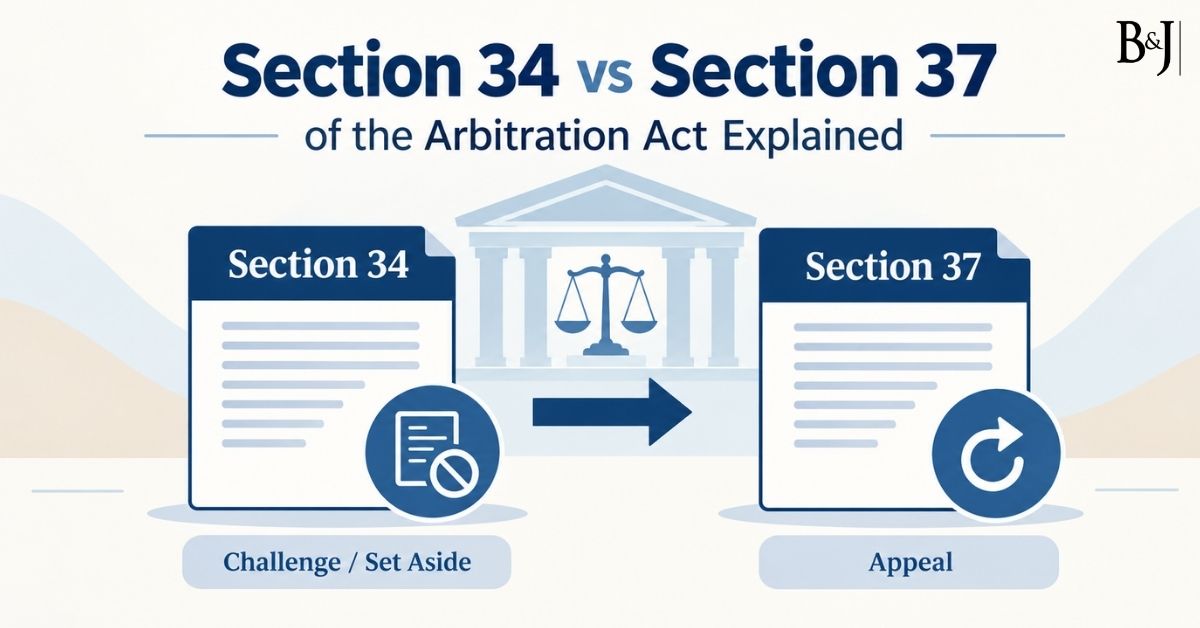
Section 34 of the Act provides the primary mechanism for challenging arbitral awards. Under Section 34(1), recourse to a court against an arbitral award may be made only by an application for setting aside such award. The grounds for setting aside an award are exhaustively enumerated under Section 34(2), which includes circumstances such as incapacity of parties, invalidity of the arbitration agreement, lack of proper notice, the award dealing with disputes beyond the scope of submission to arbitration, or the award being in conflict with the public policy of India [2]. Following the 2015 Amendment to the Act, Section 34(2A) was introduced, providing an additional ground for setting aside domestic arbitral awards when they are vitiated by patent illegality appearing on the face of the award.
The Scope of Section 37: Appellate Jurisdiction
Section 37 of the Arbitration and Conciliation Act delineates the orders from which appeals may lie to a court authorized by law. According to Section 37(1), an appeal shall lie from orders refusing to refer parties to arbitration under Section 8, granting or refusing interim measures under Section 9, and crucially, setting aside or refusing to set aside an arbitral award under Section 34 [3]. The appellate power under Section 37 is deliberately narrow and co-extensive with the limited grounds available under Section 34. Courts exercising jurisdiction under Section 37 cannot expand the scope of review beyond what is permissible under Section 34, nor can they re-appreciate evidence or substitute their own interpretation for that of the arbitral tribunal.
The legislative intent behind this restricted appellate jurisdiction is clear: to prevent prolonged litigation and ensure that arbitration remains an effective alternative dispute resolution mechanism. The Supreme Court has consistently held that the power of judicial review under Section 37 is confined to examining whether the court below correctly applied the principles under Section 34, rather than conducting a fresh review of the arbitral award itself.
Patent Illegality as a Ground for Setting Aside Awards
The concept of patent illegality has evolved significantly through judicial interpretation. Originally introduced through the Supreme Court’s decision in ONGC Ltd. v. Saw Pipes Ltd., where the court expanded the interpretation of public policy to include patent illegality, this ground was given statutory recognition through the 2015 Amendment. Section 34(2A) now explicitly provides that an arbitral award arising out of arbitrations other than international commercial arbitrations may be set aside if the court finds that the award is vitiated by patent illegality appearing on the face of the award [4].
However, the provision itself contains important limitations. The proviso to Section 34(2A) clarifies that an award shall not be set aside merely on the ground of an erroneous application of the law or by re-appreciation of evidence. This crucial safeguard ensures that courts do not transform themselves into appellate tribunals reviewing the merits of arbitral decisions.
Defining Patent Illegality: Judicial Precedents
The Supreme Court in Associate Builders v. Delhi Development Authority provided authoritative guidance on what constitutes patent illegality [5]. The court held that patent illegality must go to the root of the matter and cannot be invoked for trivial errors. Specifically, patent illegality encompasses three categories: contravention of substantive law of India that goes to the root of the matter, contravention of the Arbitration Act itself, and instances where the arbitrator fails to consider the terms of the contract or adopts a reasoning that no fair-minded person could adopt.
In the subsequent landmark decision of Ssangyong Engineering & Construction Co. Ltd. v. National Highways Authority of India, the Supreme Court further clarified that not every error of law would constitute patent illegality [6]. The court emphasized that judicial interference is warranted only when the arbitrator’s decision is based on no evidence, ignores vital evidence, or is so irrational that no reasonable person could have arrived at such a conclusion. This high threshold prevents courts from second-guessing arbitral awards based merely on alternative interpretations of facts or law.
The Recent Supreme Court Judgment: Ramesh Kumar Jain v. BALCO
The facts of the recent case involved a dispute between Ramesh Kumar Jain and Bharat Aluminium Company Limited concerning compensation for extra work performed under a contract. The arbitral tribunal had awarded compensation based on the principle of quantum meruit, reasoning that while the contract was silent on the rate for certain additional work, the claimant was entitled to reasonable compensation for work actually performed [1].
The Commercial Court had initially upheld the arbitral award, finding that the tribunal had properly applied the doctrine of quantum meruit where the contract was silent. However, the Chhattisgarh High Court, exercising appellate jurisdiction under Section 37, set aside the award on grounds of patent illegality. The High Court held that the arbitrator had “rewritten the contract” by fixing an additional rate in the absence of contractual agreement and that the award was based on guesswork without proper evidentiary foundation.
Supreme Court’s Analysis and Reasoning
The Supreme Court commenced its analysis by reiterating the foundational principles governing arbitral review. The bench emphasized that the Arbitration and Conciliation Act is founded on the principle of minimal judicial interference, as expressly reflected in Section 5. Judicial scrutiny under Sections 34 and 37 is narrowly circumscribed, ensuring that courts do not engage in unwarranted judicial interference with arbitral awards or act as appellate tribunals over the arbitral tribunal’s decisions. The court noted that while an arbitrator is bound by the express terms of a contract, this does not prohibit interpretation of implied terms or filling contractual gaps where the contract is silent on certain matters.
Drawing upon established precedents including Delhi Airport Metro Express Pvt. Ltd. v. Delhi Metro Rail Corporation and Parsa Kente Collieries Ltd. v. Rajasthan Rajya Vidyut Utpadan Nigam Ltd., the Supreme Court reiterated that the arbitral tribunal is the master of evidence. Courts exercising jurisdiction under Sections 34 and 37 cannot interfere merely because another view is possible. The court can intervene only when the arbitrator’s interpretation is so unreasonable that no fair-minded person would adopt it, or when the decision is based on no evidence whatsoever.
The Supreme Court held that the High Court had “impermissibly re-appreciated facts and substituted its own interpretation” for that of the arbitral tribunal. The bench observed that awarding reasonable compensation under quantum meruit when a contract is silent on rates does not amount to rewriting the contract. Rather, it represents a legitimate exercise of the arbitrator’s interpretative function to give effect to the parties’ intention and prevent unjust enrichment. The court emphasized that arbitral awards are not liable to be set aside merely on the ground of erroneous interpretation of law or alleged misappreciation of evidence, and there exists a threshold that parties seeking to set aside an award must satisfy before courts can exercise their powers under Sections 34 and 37.
The Principle of Minimal Judicial Intervention
The doctrine of minimal judicial intervention represents the cornerstone of modern arbitration jurisprudence in India. This principle recognizes that parties who choose arbitration as their dispute resolution mechanism have voluntarily agreed to submit to the decision of the arbitral tribunal. The finality and binding nature of arbitral awards, as provided under Section 35 of the Act, would be rendered meaningless if courts were permitted to conduct extensive review of factual and legal determinations made by arbitrators.
The Supreme Court has repeatedly emphasized that courts must resist any temptation of judicial interference in arbitral awards, preserving the finality of arbitration and respecting party autonomy. In its decision in Dyna Technologies Pvt. Ltd. v. Crompton Greaves Ltd., the court observed that if courts were to interfere with arbitral awards in the usual course on factual aspects, the commercial wisdom behind opting for alternative dispute resolution would stand frustrated. The mandate under Section 34 is to respect the finality of the arbitral award and party autonomy in choosing an alternative forum for dispute adjudication.
Balancing Judicial Review with Party Autonomy
While minimal judicial intervention is the guiding principle, it does not mean that arbitral awards are immune from judicial scrutiny altogether. The Act provides specific grounds under Section 34 where intervention is justified, such as where fundamental principles of justice have been violated, where the award suffers from jurisdictional errors, or where it contravenes the public policy of India. The key lies in maintaining the delicate balance between providing necessary safeguards against arbitrary or illegal awards while respecting the autonomy of the arbitration process.
The Supreme Court in Punjab State Civil Supplies Corporation Ltd. v. Sanman Rice Mills articulated this balance, holding that the scope of judicial interference with arbitral awards is virtually prohibited, if not absolutely barred, and that interference is confined only to the extent envisaged under Section 34 [7]. The appellate power of Section 37 is limited within the domain of Section 34, meaning that appellate courts cannot expand the grounds of review beyond what is statutorily permissible.
Contractual Interpretation and Gap-Filling by Arbitrators
One of the central issues addressed in the recent Supreme Court judgment concerns the authority of arbitrators to interpret contracts and fill gaps where the contract is silent. The court clarified that while arbitrators are bound by clear stipulations between parties, and an award ignoring such stipulations would violate public policy by undermining freedom of contract, this does not mean that every award providing a benefit not expressly mentioned in the contract is in violation of public policy or constitutes rewriting of the contract.
The principle of quantum meruit, which entitles a party to reasonable compensation for work done in the absence of an agreed price, is a well-established doctrine in contract law. When an arbitrator applies this principle to award compensation for extra work where the contract is silent on the applicable rate, the arbitrator is not rewriting the contract but rather giving effect to the implied obligation that work performed should be compensated. This represents a legitimate exercise of interpretative authority rather than an impermissible addition to contractual terms [8].
The Master of Evidence Doctrine
The Supreme Court has consistently held that the arbitral tribunal is the sole judge of the quality and quantity of evidence. This principle, often referred to as the “master of evidence” doctrine, means that arbitrators have the primary responsibility to weigh evidence, assess credibility, and draw inferences from the material before them. Courts reviewing arbitral awards cannot substitute their own assessment of evidence for that of the arbitrator unless the arbitrator’s conclusions are based on no evidence, ignore vital evidence, or are so perverse that no reasonable person could have reached them.
In the context of the recent judgment, the Supreme Court rejected the High Court’s characterization of the arbitrator’s damage assessment as “guesswork.” The court noted that the arbitrator had considered the evidence presented, including documentary proof and witness testimony, and had arrived at a reasoned conclusion regarding compensation. The fact that the High Court might have weighed the evidence differently or reached a different conclusion did not justify interference with the award.
International Perspective and India’s Pro-Arbitration Stance
India’s approach to judicial review of arbitral awards must be understood in the context of its aspirations to become a hub for international commercial arbitration. The 2015 Amendment to the Arbitration and Conciliation Act was prompted in part by the recommendations of the 246th Law Commission Report, which highlighted delays and inefficiencies in arbitration enforcement that were deterring parties from choosing India as a seat for arbitration [9].
The distinction drawn between domestic and international commercial arbitrations with respect to the ground of patent illegality reflects this pro-arbitration orientation. While domestic awards may be challenged on grounds of patent illegality under Section 34(2A), this ground is not available for challenging international commercial arbitrations seated in India or for resisting enforcement of foreign awards under Part II of the Act. This differentiation aligns India’s arbitration framework with international standards set by conventions such as the New York Convention on the Recognition and Enforcement of Foreign Arbitral Awards.
Comparative Analysis with Global Practices
The Supreme Court’s recent judgment aligns with international best practices regarding judicial review of arbitral awards. Arbitration-friendly jurisdictions worldwide have adopted similar approaches that emphasize party autonomy and restrict judicial intervention to exceptional circumstances. The UNCITRAL Model Law, upon which India’s arbitration legislation is based, provides for limited grounds of challenge that focus primarily on procedural fairness and fundamental violations rather than substantive review of the merits.
By adhering to these principles and curtailing excessive judicial interference with arbitral awards, India is positioning itself as a more attractive destination for arbitration. The recent judgment sends a clear message to the international arbitration community that Indian courts will respect arbitral autonomy and will not lightly disturb awards merely because an alternative interpretation is possible.
Implications for Future Arbitration Practice
The Supreme Court’s decision in Ramesh Kumar Jain v. BALCO has several important implications for arbitration practice in India. First, it reinforces the message that parties choosing arbitration can have confidence in the finality of arbitral awards. This certainty is crucial for commercial parties who seek expeditious and conclusive resolution of disputes without the prospect of prolonged litigation through multiple tiers of courts.
Second, the judgment provides clear guidance to High Courts and lower courts regarding the proper exercise of appellate jurisdiction under Section 37. Courts must resist the temptation to re-appreciate evidence or substitute their own contractual interpretation for that of arbitrators. The narrow scope of review under Section 37 means that appellate courts should focus on whether the court below correctly applied the principles under Section 34, rather than conducting a de novo review of the arbitral award itself.
Third, the decision affirms that arbitrators have substantial latitude in interpreting contracts, filling gaps, and awarding appropriate remedies even when the contract may not explicitly provide for them. This interpretative freedom is essential for arbitrators to do justice between parties and prevent unjust enrichment, particularly in construction and infrastructure disputes where changed circumstances and additional work are common.
Conclusion
The Supreme Court’s judgment represents a significant reaffirmation of the core principles underlying India’s arbitration framework. By holding that arbitral awards are not liable to be set aside on mere error in law or misappreciation of evidence, the court has reinforced the doctrine of minimal judicial interference with arbitral awards and upheld party autonomy in choosing arbitration as their preferred dispute resolution mechanism.
The decision clarifies that courts exercising jurisdiction under Section 37 cannot act as appellate courts reviewing the merits of arbitral awards. Patent illegality, as a ground for setting aside awards, must be applied judiciously and cannot be invoked merely because courts disagree with the arbitrator’s interpretation or factual findings. The threshold for judicial interference is high, requiring demonstration that the award is based on no evidence, ignores vital evidence, or is so perverse that no reasonable person could have arrived at such a conclusion.
As India continues to develop its arbitration jurisprudence and seeks to attract international arbitration, judgments such as this play a crucial role in demonstrating the judiciary’s commitment to arbitration-friendly principles. The emphasis on respecting arbitral autonomy, limiting judicial interference with arbitral awards to exceptional circumstances, and ensuring finality of awards aligns India with global best practices and strengthens its position as a viable seat for domestic and international commercial arbitration.
References
[1] Law Trend. (2024). Arbitrator Can Award ‘Quantum Meruit’ Compensation for Extra Work if Contract is Silent on Rate: Supreme Court. Retrieved from https://lawtrend.in/arbitrator-can-award-quantum-meruit-compensation-for-extra-work-if-contract-is-silent-on-rate-supreme-court/
[2] Indian Kanoon. (n.d.). Section 34 in The Arbitration And Conciliation Act, 1996. Retrieved from https://indiankanoon.org/doc/536284/
[3] Indian Kanoon. (n.d.). Section 37 in The Arbitration And Conciliation Act, 1996. Retrieved from https://indiankanoon.org/doc/772406/
[4] The Arbitration Digest. (2025). Critical Analysis of the Ground of ‘Patent Illegality’ in Setting Aside an Arbitral Award. Retrieved from https://thearbitrationdigest.com/critical-analysis-of-the-ground-of-patent-illegality-in-setting-aside-an-arbitral-award/
[5] Law Bhoomi. (2025). Associate Builders v Delhi Development Authority. Retrieved from https://lawbhoomi.com/associate-builders-v-delhi-development-authority/
[6] India Corporate Law. (2022). The Supreme Court reaffirms the scope of patent illegality. Retrieved from https://corporate.cyrilamarchandblogs.com/2020/05/supreme-court-reaffirms-the-scope-of-patent-illegality/
[7] SCC Online. (2025). Arbitration in 2024: Landmark Rulings and Key Takeaways. Retrieved from https://www.scconline.com/blog/post/2025/01/08/arbitration-2024-landmark-cases/
[8] Verdictum. (2024). Arbitral Tribunal Can Interpret Implied Terms Or Fill Contractual Gaps Where Contract Is Silent: Supreme Court. Retrieved from https://www.verdictum.in/court-updates/supreme-court/ramesh-kumar-jain-v-bharat-aluminium-company-limited-balco-2025-insc-1457-1601875
[9] SCC Times. (2022). Decoding the Public Policy of India and Patent Illegality on the Face of an Award. Retrieved from https://www.scconline.com/blog/post/2022/03/23/decoding-the-public-policy-of-india-and-patent-illegality-on-the-face-of-an-award/

Advocate Aaditya Bhatt
Senior Standing Counsel Income Tax Department, Advocate Gujarat High Court. Aaditya combines his technical and legal expertise to deliver strategic counsel in litigation, constitutional, and regulatory matters. He represents clients before High Courts and Tribunals with a technology-driven approach.