 Whatsapp

CAQM as a De Facto Environmental Regulator: The Supreme Court’s Expanding Role in Delhi’s Air Pollution Crisis
Introduction
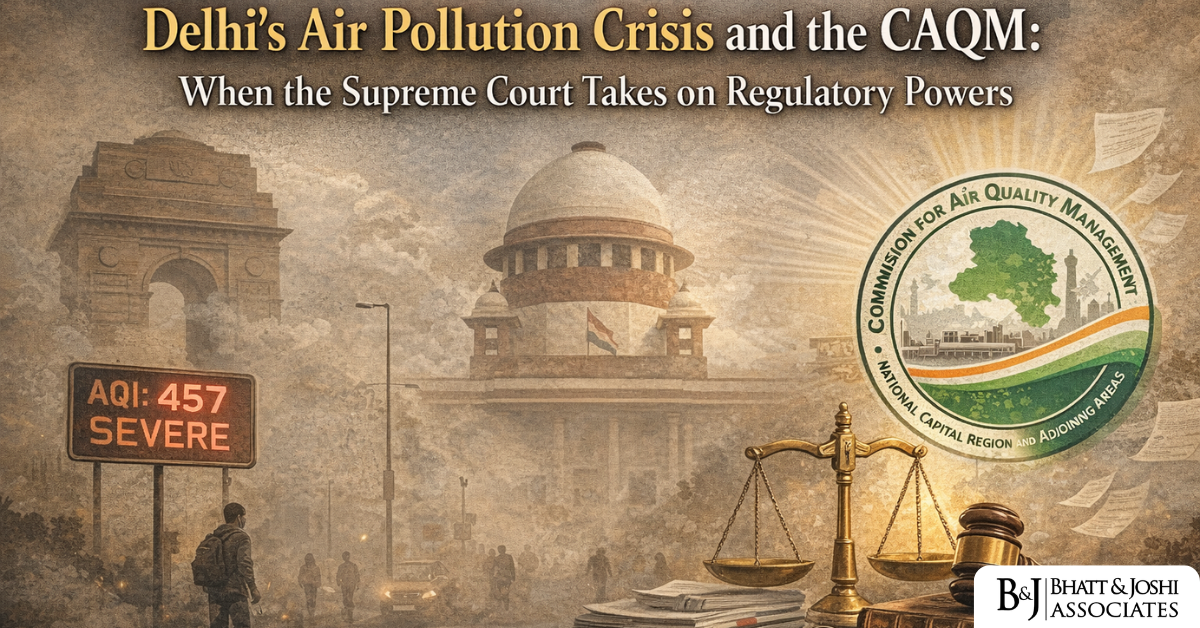
India’s national capital has, for decades, carried the grim distinction of being one of the most polluted cities in the world. Each winter, a toxic haze descends on Delhi and its surrounding National Capital Region, pushing Air Quality Index readings past 400 — a level classified as “severe” — and triggering emergency responses that range from school closures to construction bans. This recurring crisis has brought both the CAQM and broader efforts to control Delhi air pollution into sharp public focus, highlighting the challenges of coordinating action between an overburdened judiciary and a fragmented executive.
The Commission for Air Quality Management in the National Capital Region and Adjoining Areas — universally referred to as the CAQM — was established through an ordinance in 2020 and given permanent statutory footing through the Commission for Air Quality Management in National Capital Region and Adjoining Areas Act, 2021 [1]. Parliament designed CAQM to be the single coordinating authority for air pollution control across Delhi, Haryana, Punjab, Uttar Pradesh, and Rajasthan — five states whose competing agricultural, industrial, and vehicular interests collectively determine the air Delhiites breathe. Yet despite this institutional design, the Supreme Court of India has repeatedly stepped back into the space that CAQM was meant to occupy, directly supervising the implementation of emergency pollution protocols, reprimanding the Commission for inaction, and issuing binding orders that function, in substance, as executive governance. The result is a constitutional curiosity: a statutory regulator that exists in law, but a Supreme Court that behaves, in practice, as though it does not.
The Legislative Inheritance: From EPCA to CAQM
To understand CAQM’s place in the legal ecosystem, one must first understand what it replaced. The Environment Pollution (Prevention and Control) Authority, or EPCA, was constituted in 1998 by the Supreme Court itself, in the long-running M.C. Mehta v. Union of India proceedings [2]. That case, filed originally in 1985 as a writ petition under Article 32 of the Constitution, had evolved over four decades into one of the most consequential examples of continuing mandamus in Indian judicial history. The EPCA was the Court’s institutional response to chronic inter-state coordination failures — an expert body meant to advise and oversee, but one that critically lacked any statutory backing. Without penal powers or independent enforcement authority, the EPCA could recommend but not compel, and the years between 1998 and 2021 saw pollution in Delhi worsen despite its continued functioning.
The push for a statutory replacement gained momentum through separate litigation. In 2020, environmental activist Aditya Dubey, then a minor, filed Writ Petition (Civil) No. 1135 of 2020 before the Supreme Court seeking relief against stubble burning in Punjab and Haryana [3]. The Court, in a three-judge bench headed by the Chief Justice, directed the formation of a committee chaired by retired Justice Madan B. Lokur to monitor stubble burning — a striking illustration of the Court once again filling institutional voids. It was in this charged environment that the central government promulgated the Commission for Air Quality Management in National Capital Region and Adjoining Areas Ordinance, 2020, which was converted into the CAQM Act, 2021 following parliamentary approval.
The CAQM Act, 2021: Statutory Design and Powers
The CAQM Act, 2021 — formally, the Commission for Air Quality Management in National Capital Region and Adjoining Areas Act, 2021 (No. 29 of 2021) — is one of the most centralised environmental statutes India has produced. Its architecture gives the Commission powers that expressly override state governments and State Pollution Control Boards in all matters relating to air quality in the NCR [1].
Section 12(1) of the Act provides: “Notwithstanding anything contained in any other law for the time being in force, the Commission shall have the power to take all such measures, issue directions and entertain complaints, as it deems necessary or expedient, for the purpose of protecting and improving the quality of the air in the National Capital Region and adjoining areas.” Section 12(2)(xi) empowers the Commission specifically to “issue directions in writing to any person, officer or any authority and such person, officer or authority shall be bound to comply with such directions.” The explanation appended to this provision makes clear that this directional power includes the authority to order “the closure, prohibition or regulation of any industry, operation or process” and the “stoppage or regulation of the supply of electricity or water or any other service.”
Section 14 provides enforcement teeth. It empowers the Commission to initiate proceedings against any officer who fails to comply with its orders, with non-compliance punishable by imprisonment of up to five years, a fine of up to one crore rupees, or both. All appeals lie, not to civil courts, but before the National Green Tribunal. This structure was designed to insulate CAQM’s functioning from political interference while ensuring accountability through specialised environmental adjudication.
Despite this formidable statutory design, the Commission has struggled to translate legal authority into consistent on-the-ground enforcement. The Graded Response Action Plan — a tiered framework of emergency air quality measures introduced by the EPCA and continued by CAQM — was revised in September 2024 to be implemented proactively based on meteorological forecasts rather than reactively once AQI thresholds had already been breached. Yet, as the winter of 2024 demonstrated, this proactive mandate went largely unobserved.
The Constitutional Underpinning: Article 21 and the Right to Clean Air
Before examining the judiciary’s specific interventions, it is necessary to locate this discourse within the constitutional framework that makes judicial supervision both possible and, in India’s peculiar jurisprudence, almost inevitable.
In Subhash Kumar v. State of Bihar, (1991) 1 SCC 598, [4] the Supreme Court held that “right to live is a fundamental right under Article 21 of the Constitution and it includes the right of enjoyment of pollution free water and air for full enjoyment of life.” While the petition in that case was dismissed on the ground that it was not filed in genuine public interest, the constitutional proposition it established became foundational. If clean air is an aspect of the right to life and personal liberty under Article 21, then persistent, preventable air pollution is not merely an administrative failure — it is a constitutional violation, and courts possess jurisdiction to remedy it.
This constitutional anchor is what has kept M.C. Mehta v. Union of India — Writ Petition (Civil) No. 13029 of 1985 — alive in its various iterations for more than four decades [2]. The case, filed against vehicular pollution and industrial emissions in Delhi, became a permanent channel through which the Supreme Court has monitored, directed, and occasionally castigated executive bodies responsible for Delhi’s air. The continuing mandamus issued in this case has, over the years, produced orders on CNG conversion for public buses, odd-even vehicle schemes, and, more recently, the implementation of GRAP IV restrictions.
The Court as De Facto Regulator: The 2024 Interventions
The winter of 2024 produced the most direct and pointed display of the Supreme Court’s regulatory posture in recent memory. On 18 November 2024, a bench of Justices A.S. Oka and A.G. Masih took up the air pollution crisis in Delhi in M.C. Mehta v. Union of India. The AQI in Delhi had crossed 401 on 12 November 2024, but the CAQM had waited until 14 November to implement Stage III of the GRAP — a delay the Court found wholly unjustifiable [5].
When the Union of India and CAQM sought to defend the delay by citing meteorological forecasts that predicted improvement, Justice Oka responded with a statement that cut to the heart of the institutional dysfunction: “This is a completely wrong approach… Even in anticipation of AQI decreasing the threshold limit, it is the duty of the commission to start implementation of GRAP III or GRAP IV, as the case may be.” This observation was not merely a rebuke — it was a restatement of CAQM’s own statutory mandate and a direct finding that the Commission had abdicated its function.
The Court did not stop there. It invoked Section 14 of the CAQM Act directly, directing the Commission to initiate proceedings against the officers responsible for the delays. It appointed thirteen advocates as Court Commissioners to physically monitor compliance at Delhi’s entry points — because police and traffic authorities had failed to prevent non-essential trucks from entering the city in violation of Stage IV restrictions [5]. Out of 113 city-entry checkpoints, only 13 had any meaningful enforcement presence, as the Amicus Curiae Aparajita Singh informed the bench on 22 November 2024.
The Court also held that even when AQI levels improved, the Delhi government could not unilaterally downgrade from Stage IV restrictions. It reserved that decision for itself — requiring the government to approach the Court for permission before relaxing emergency measures. This is not the role of an appellate court. This is the role of a regulator overseeing CAQM Delhi air pollution management.
By 5 December 2024, after studying updated AQI data, the bench permitted the CAQM to take a call on reducing Stage IV to Stage II restrictions “in view of the improvement of the situation” — essentially granting the Commission conditional autonomy subject to judicial concurrence [5]. The same evening, the CAQM withdrew Stages III and IV.
Judicial Activism or Institutional Gap-Filling?
Critics of this judicial posture argue that the Supreme Court’s deep involvement in what is, at its core, an executive function distorts constitutional boundaries. The legislature created the CAQM precisely so that the Court could stand back. When the Court supervises truck entry at Delhi’s borders, directs governments to use satellite data from South Korea’s GEO-KOMSAT 2A satellite, and tells state governments which pollutant categories to prioritise, it is performing a function that the CAQM Act assigned to an executive body [5]. There is a genuine institutional cost: prolonged judicial supervision may disincentivise the Commission from building independent decisional capacity, since any significant decision will eventually be ratified or overruled by the Court.
Defenders of the Court’s approach point to the empirical record. The CAQM’s predecessor, EPCA, spent twenty-two years as essentially an advisory body, and Delhi’s air quality deteriorated regardless. The CAQM itself — despite possessing statutory powers that override state governments — has repeatedly waited for AQI levels to become critical before activating emergency protocols. This demonstrates that Delhi air pollution continues to be a serious challenge, even under the CAQM’s authority. If the Commission is not going to use its statutory powers proactively, the argument runs, somebody must. And in India’s constitutional order, that somebody has consistently been the Supreme Court, armed with Articles 32 and 142 of the Constitution.
The Air (Prevention and Control of Pollution) Act, 1981 and the Environment (Protection) Act, 1986 — the foundational environmental statutes — both impose obligations on state and central governments to prevent Delhi air pollution, but neither provides the kind of coordinated multi-state enforcement mechanism that the CAQM Act was meant to create. In their absence, the Court has historically served as the coordinating institution. The CAQM’s track record has not yet persuaded the Court that this historical role has become redundant.
The GRAP Framework: Regulation by Emergency Protocol
The Graded Response Action Plan deserves specific attention because it is the primary tool through which CAQM discharges — or fails to discharge — its mandate. GRAP divides responses to air pollution into four stages based on AQI thresholds: Stage I (Poor, AQI 201–300), Stage II (Very Poor, AQI 301–400), Stage III (Severe, AQI 401–450), and Stage IV (Severe Plus, AQI above 450). Each stage carries progressively stricter restrictions, culminating in Stage IV’s prohibition on non-essential trucks, suspension of construction and demolition activities, and recommended work-from-home mandates for public offices.
CAQM issues these restrictions under Section 12(2)(xi) of the CAQM Act. In November 2024, when AQI in parts of Delhi crossed 450, Stage IV was triggered. But the Supreme Court noted that the Commission’s revised September 2024 GRAP schedule — specifically designed to allow pre-emptive activation based on forecasts — had not been followed. The Court’s October 2018 order in M.C. Mehta, directing pre-emptive steps without waiting for pollution thresholds to be formally breached, had similarly not been complied with. The Court’s November 2024 order invoked Section 14 against the officers responsible [5].
This pattern — statutory mandate, non-compliance, judicial intervention — has repeated itself so regularly that it has ceased to be exceptional. The Supreme Court, sitting in its continuing mandamus jurisdiction, has become the effective appellate authority over CAQM’s emergency decisions, reviewing their proportionality and timing with a degree of scrutiny that any administrative law practitioner would recognise as judicial review on the merits, not merely on process.
Inter-State Coordination and the Limits of Statutory Authority
One dimension of the Delhi air Pollution crisis that the CAQM Act was explicitly designed to address is the problem of inter-state coordination. Stubble burning in Punjab and Haryana — the practice of burning paddy residue after harvest — contributes significantly to Delhi’s winter pollution. The CAQM’s mandate extends to coordinating with these states under Section 12 of the Act. In practice, the Commission has issued directions and imposed environmental compensation under the CAQM in NCR and Adjoining Area (Imposition, Collection and Utilization of Environmental Compensation for Stubble Burning) Rules, 2023, but farm fires have continued at scale.
The Supreme Court, in November 2024, took up the question of satellite monitoring of farm fires, directing CAQM and ISRO to collaborate on obtaining real-time data from geostationary satellites to overcome the limitation of NASA satellites that only capture data at 10:30 AM and 1:30 PM — a gap that, the Amicus noted, farmers had reportedly learned to exploit by timing their burning around satellite passes [5]. This level of operational detail — which satellite systems to use, how many checkpoints to staff — is not typically what courts do. But in the context of Delhi’s air crisis, the Court has found itself repeatedly compelled to fill these gaps.
Conclusion: An Unresolved Constitutional Question
The Commission for Air Quality Management, as constituted under the CAQM Act, 2021, is a statutory body with substantial powers: it overrides state governments, issues binding directions, imposes penalties up to one crore rupees, and operates beyond the jurisdictional limits of any single State Pollution Control Board. On paper, it is exactly what Indian environmental governance has long needed. In practice, its record has been characterised by delayed GRAP activation, insufficient inter-state coordination, and a tendency to manage crises rather than prevent them.
The Supreme Court’s continued deep engagement with Delhi’s air crisis — appointing commissioners, scrutinising satellite data, and deciding when GRAP stages can be relaxed — is not judicial overreach. It reflects a response to a genuine institutional deficit. The constitutional guarantee of clean air under Article 21, articulated in Subhash Kumar and strengthened through decades of M.C. Mehta litigation, requires active enforcement. When the designated enforcer, in this case the CAQM, fails to act decisively, judicial intervention becomes necessary to manage Delhi air pollution effectively.
The more fundamental question is whether this arrangement is sustainable or desirable. The Supreme Court’s docket is already stretched. Deep involvement in technical air quality management pulls judicial attention from other constitutional obligations. The CAQM’s effectiveness depends, ultimately, on it developing the institutional confidence to act without awaiting judicial affirmation. Whether that confidence emerges — and whether the Court is willing to step back once it does — will determine whether the CAQM becomes what Parliament intended: an autonomous, effective environmental regulator, rather than a body that operates only under judicial supervision.
References
[1] Commission for Air Quality Management in National Capital Region and Adjoining Areas Act, 2021 — PRS Legislative Research Overview: https://prsindia.org/billtrack/the-commission-for-air-quality-management-in-national-capital-region-and-adjoining-areas-ordinance-2021
[2] M.C. Mehta v. Union of India, W.P. (C) No. 13029 of 1985 — Indiankanoon (January 2020 Order): https://indiankanoon.org/doc/16059052/
[3] Aditya Dubey (Minor) v. Union of India, W.P. (C) No. 1135 of 2020 — Indiankanoon (December 2021 Order): https://indiankanoon.org/doc/97319720/
[4] Subhash Kumar v. State of Bihar, (1991) 1 SCC 598, AIR 1991 SC 420 — Indiankanoon: https://indiankanoon.org/doc/1646284/
[5] Supreme Court Observer — “Delhi Pollution Crisis: Can the Supreme Court Clear the Air?” (November 2024): https://www.scobserver.in/journal/delhi-pollution-crisis-can-the-supreme-court-clear-the-air/
[6] Supreme Court Observer — “Supreme Court’s Evolving Role in Mitigating Delhi’s Air Pollution Crisis” (December 2024): https://www.scobserver.in/journal/supreme-courts-evolving-role-in-mitigating-delhis-air-pollution-crisis/
[7] M.C. Mehta v. Union of India (GRAP IV Order, November 2024) — Casemine: https://www.casemine.com/judgement/in/674509f6e8c0441261876d18
[8] Section 12 — CAQM Act, 2021 — Indiankanoon: https://indiankanoon.org/doc/22229493/
[9] CPR India Brief — “The CAQM Act 2021: An Overview”: https://cprindia.org/wp-content/uploads/2021/12/The-CAQM-Act-2021-An-Overview_Harish-Ghosh-Mathew.pdf
