 Whatsapp

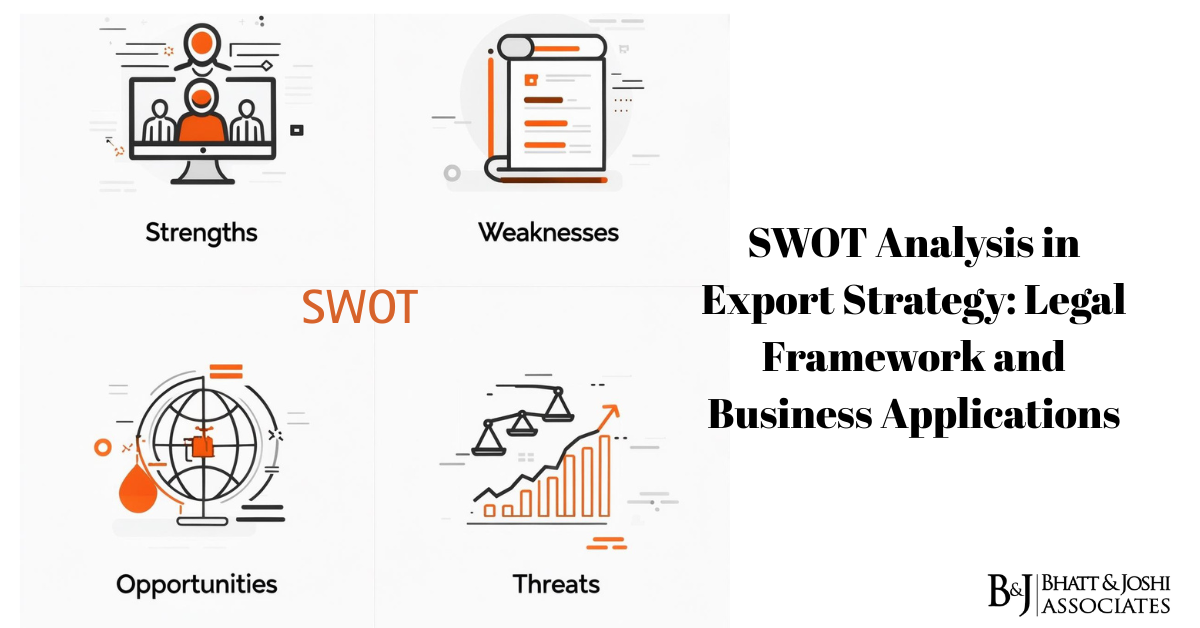
Chapter 5 SWOT Analysis
Introduction
Strategic planning forms the cornerstone of successful international trade operations. Among the various analytical tools available to businesses venturing into export markets, SWOT analysis has emerged as a fundamental methodology for assessing internal capabilities and external market conditions. This framework, which examines Strengths, Weaknesses, Opportunities, and Threats, provides exporters with a structured approach to evaluate their competitive position and formulate effective market entry strategies. The application of SWOT analysis in export planning is not merely a business practice but intersects with various legal and regulatory frameworks that govern international trade in India.
The Export-Import (EXIM) Policy of India, formulated under the Foreign Trade (Development and Regulation) Act, 1992, provides the overarching legal structure within which export businesses must operate[1]. This legislative framework establishes the parameters within which businesses must assess their strengths and weaknesses, while also identifying opportunities and threats in international markets. The Act empowers the Central Government to formulate and announce the export-import policy, making it essential for businesses conducting SWOT analysis to align their strategic assessments with regulatory requirements.
Understanding SWOT Analysis in Export Context
SWOT analysis serves as a diagnostic tool that enables export businesses to systematically evaluate their position in international markets. The methodology divides analysis into four distinct quadrants, with internal factors comprising strengths and weaknesses, while external factors encompass opportunities and threats. This bifurcation allows businesses to distinguish between controllable internal variables and external market forces that require adaptive strategies.
The strategic importance of SWOT analysis in export planning was recognized in various judicial pronouncements. The Delhi High Court, in its observations regarding business planning and strategic decision-making, has emphasized the importance of structured analytical approaches in commercial ventures. While not specifically addressing SWOT analysis, the court has consistently upheld the principle that businesses must demonstrate due diligence and systematic planning in their operations, particularly in international trade transactions where multiple jurisdictions and regulations are involved.
Internal Factors: Strengths in Export Business
Intellectual Property Rights as Strategic Strengths
Patents, trademarks, and other forms of intellectual property constitute significant competitive advantages for export businesses. The Patents Act, 1970, as amended in 2005, governs the protection of inventions in India and provides the legal framework for leveraging patents as business strengths[2]. Section 48 of the Patents Act grants exclusive rights to patentees, enabling businesses to prevent others from making, using, offering for sale, or importing the patented invention. This exclusivity can be a decisive strength in SWOT analysis, particularly for technology-driven export sectors.
The significance of intellectual property in international trade was underscored in the case of Bayer Corporation v. Union of India, where the Intellectual Property Appellate Board examined the balance between patent rights and public interest. The judgment reinforced that patents, while providing competitive advantages, must be exercised within the legal framework established by Indian law. For exporters, this means that patent protection, identified as a strength in SWOT analysis, must be evaluated not only for its market advantage but also for its legal sustainability across different jurisdictions.
Brand equity represents another critical strength for export businesses. The Trade Marks Act, 1999, provides comprehensive protection for brand names and logos, enabling businesses to build and protect their reputation in international markets[3]. Section 28 of this Act grants exclusive rights to registered trademark owners, allowing them to prevent unauthorized use of their marks. Strong brand recognition, when identified as a strength in SWOT analysis, must be supported by proper trademark registration and protection strategies across target export markets.
Proprietary Knowledge and Cost Advantages
Cost advantages derived from proprietary know-how represent a complex strength that intersects with various legal frameworks. The protection of trade secrets and confidential information falls under the purview of common law principles and contractual obligations rather than statutory provisions. Indian courts have consistently recognized the importance of protecting confidential business information, as evidenced in numerous judgments dealing with breach of confidence and misappropriation of trade secrets.
Access to distribution networks and exclusive supply arrangements constitute operational strengths that are governed by contract law and competition regulations. The Competition Act, 2002, regulates business practices to ensure fair competition while permitting legitimate competitive advantages. Section 3 of the Act prohibits anti-competitive agreements, meaning that exclusive distribution arrangements identified as strengths must be structured to comply with competition law requirements.
Internal Factors: Weaknesses in Export Business
Regulatory and Compliance Vulnerabilities
Weaknesses in export businesses often manifest as regulatory compliance gaps or inadequate protection of business assets. The absence of patent protection, identified as a potential weakness in SWOT analysis, exposes businesses to competition and potential infringement in international markets. The global nature of intellectual property protection requires businesses to secure rights not only in India but also in target export markets through mechanisms like the Patent Cooperation Treaty.
A weak brand name or poor reputation among customers represents a market weakness that can have legal implications. The Trade Marks Act provides remedies against trademark infringement and passing off, but these protections are only effective when businesses have established and registered their marks. The absence of trademark protection leaves businesses vulnerable to brand dilution and unfair competition in international markets.
High cost structures and inefficient operations constitute internal weaknesses that may arise from non-compliance with various regulatory frameworks. The Foreign Exchange Management Act, 1999 (FEMA), regulates foreign exchange transactions and can impact the cost structure of export businesses[4]. Non-compliance with FEMA provisions can result in penalties and operational restrictions, representing a significant weakness in export operations.
Access Limitations and Market Barriers
Lack of access to distribution channels and key resources often stems from contractual and regulatory constraints. The Indian Contract Act, 1872, governs commercial agreements and determines the enforceability of distribution arrangements. Weaknesses in contractual relationships, such as poorly drafted agreements or unfavorable terms, can severely limit a business’s ability to access international markets effectively.
External Factors: Opportunities in Export Markets
Market Liberalization and Regulatory Reforms
The identification of opportunities in SWOT analysis requires understanding of regulatory developments and market liberalization initiatives. India’s commitment to international trade agreements under the World Trade Organization framework has created numerous opportunities for exporters. The removal of quantitative restrictions and reduction of tariff barriers in various sectors has opened new markets for Indian exporters.
The Special Economic Zones Act, 2005, creates specific opportunities for export-oriented businesses by providing tax incentives and simplified regulatory procedures[5]. Businesses conducting SWOT analysis must evaluate these opportunities within the context of SEZ regulations and compliance requirements. The Act offers duty-free imports, tax holidays, and simplified procedures that can be leveraged as strategic opportunities for expanding export operations.
Technological advancements and digital trade platforms represent emerging opportunities that are increasingly regulated by law. The Information Technology Act, 2000, provides the legal framework for electronic commerce and digital transactions, enabling exporters to leverage technology for market expansion. The recent amendments to this Act and the proposed Digital Personal Data Protection Act create both opportunities and compliance obligations for export businesses utilizing digital platforms.
Bilateral and Multilateral Trade Agreements
India’s participation in various bilateral and regional trade agreements creates market access opportunities that must be identified in SWOT analysis. Comprehensive Economic Partnership Agreements and Free Trade Agreements with countries like Japan, South Korea, and ASEAN nations provide preferential market access for Indian exporters. These agreements, while creating opportunities, also impose origin requirements and compliance obligations under the Foreign Trade Policy.
Unfulfilled customer needs in international markets represent opportunities that must be evaluated against product standards and regulatory requirements. The Bureau of Indian Standards Act, 2016, establishes quality standards for products, and compliance with these standards is often prerequisite for export certification. Exporters must assess market opportunities while ensuring their products meet both Indian standards and importing country requirements.
External Factors: Threats in Export Markets
Trade Barriers and Protectionist Measures
International trade barriers represent significant threats that export businesses must identify and assess. The increasing trend toward protectionism in various markets manifests through tariff and non-tariff barriers that can severely impact export competitiveness. Anti-dumping measures, countervailing duties, and safeguard actions imposed by importing countries constitute legal threats that require careful monitoring and strategic response.
The Customs Tariff Act, 1975, provides the legal basis for anti-dumping duties in India and reflects similar mechanisms in other jurisdictions[6]. When foreign markets impose such duties on Indian exports, businesses face substantial threats to their market access and profitability. SWOT analysis must incorporate assessment of potential anti-dumping investigations and trade remedy actions in target markets.
Regulatory changes in importing countries represent dynamic threats that can fundamentally alter market conditions. Product safety regulations, environmental standards, and labeling requirements continuously evolve, creating compliance challenges for exporters. The Food Safety and Standards Act, 2006, illustrates how domestic regulations can create export challenges when products must meet different standards in various markets.
Competition and Market Dynamics
The emergence of substitute products and shifts in consumer preferences constitute market threats that interact with legal frameworks. Competition law in various jurisdictions regulates market behavior and can impact how businesses respond to competitive threats. The Competition Act, 2002, while primarily governing domestic competition, influences how Indian exporters structure their international operations and respond to competitive pressures.
Changes in foreign exchange regulations and currency fluctuations represent financial threats that are regulated by FEMA and Reserve Bank of India directives. Exchange rate volatility can erode profit margins and make exports uncompetitive, while regulatory changes in foreign exchange transactions can impact operational flexibility. Exporters must incorporate these regulatory and market threats into their SWOT analysis to develop appropriate hedging and risk management strategies.
Regulatory Framework for Export Operations
Foreign Trade Policy and Export Promotion
The Foreign Trade Policy, updated periodically by the Directorate General of Foreign Trade, establishes the regulatory framework for export operations in India. This policy, formulated under the Foreign Trade (Development and Regulation) Act, 1992, provides various incentive schemes and export promotion measures that businesses must consider in their SWOT analysis. The Merchandise Exports from India Scheme and other incentive programs create opportunities while also imposing compliance obligations.
Export promotion councils and commodity boards play a regulatory role in specific sectors. The Tea Board, established under the Tea Act, 1953, and similar bodies for other commodities regulate quality standards and certification for exports[7]. Registration with appropriate export promotion councils is often mandatory, and the associated requirements must be factored into SWOT analysis as both compliance obligations and potential sources of support and information.
Quality Standards and Certification Requirements
The Export (Quality Control and Inspection) Act, 1963, empowers the Central Government to establish quality control and inspection systems for export commodities[8]. This regulatory framework ensures that Indian exports meet international quality standards, but also imposes compliance costs and procedural requirements on exporters. SWOT analysis must account for these regulatory obligations and their impact on operational efficiency and competitiveness.
The legal requirement for pre-shipment inspection and quality certification varies by product category. Businesses must identify regulatory compliance as either a strength, when they have robust quality systems, or a weakness, when they lack necessary certifications or face compliance challenges. The intersection of quality regulations with market access creates a complex environment where regulatory compliance becomes both a competitive necessity and a potential barrier.
Strategic Application of SWOT Analysis
Integration with Business Planning
The effective application of SWOT analysis in export strategy requires integration with overall business planning and legal compliance frameworks. Businesses must ensure that their strategic assessments are realistic, specific, and grounded in factual analysis of both internal capabilities and external market conditions. The principle of conducting analysis relative to competition, while maintaining objectivity about organizational strengths and weaknesses, aligns with fiduciary duties of company directors under the Companies Act, 2013.
Section 166 of the Companies Act, 2013, requires directors to act in good faith and exercise due diligence in corporate decision-making[9]. This legal obligation extends to strategic planning activities, including SWOT analysis, particularly for companies engaged in international trade. Directors must ensure that export strategies are based on accurate assessment of strengths and weaknesses, and that identified opportunities and threats are properly evaluated against regulatory requirements and market realities.
Risk Management and Compliance
SWOT analysis serves as a risk management tool when properly integrated with legal and regulatory compliance frameworks. The identification of threats, including regulatory changes and market barriers, enables businesses to develop proactive compliance strategies and contingency plans. This approach aligns with the risk management obligations imposed on companies under various regulations, including the Securities and Exchange Board of India (Listing Obligations and Disclosure Requirements) Regulations for listed companies.
The dynamic nature of international trade regulations requires that SWOT analysis be conducted as an ongoing process rather than a one-time exercise. Regular updates to strategic assessments ensure that businesses remain responsive to regulatory changes and market developments. This continuous approach to strategic planning reflects the principle of adaptive management necessary in the complex regulatory environment of international trade.
Conclusion
SWOT analysis represents a critical tool for export businesses operating within India’s comprehensive legal and regulatory framework for international trade. The methodology’s effectiveness depends on proper understanding and integration of various legal requirements, from intellectual property protection and competition law to foreign trade regulations and quality standards. Businesses must conduct SWOT analysis with full awareness of the regulatory environment, ensuring that identified strengths are legally sustainable, weaknesses are addressed through compliance improvements, opportunities are pursued within legal boundaries, and threats are managed through appropriate legal and strategic responses.
The intersection of business strategy and legal compliance in export operations requires sophisticated understanding of multiple regulatory frameworks. From the Foreign Trade (Development and Regulation) Act to sector-specific regulations, exporters must navigate a complex legal landscape while developing competitive strategies for international markets. Proper application of SWOT analysis, grounded in legal understanding and regulatory compliance, enables businesses to develop sustainable export strategies that leverage competitive advantages while managing risks and obligations inherent in international trade.
References
[1] Foreign Trade (Development and Regulation) Act, 1992, https://legislative.gov.in/sites/default/files/A1992-22.pdf
[2] The Patents Act, 1970, https://ipindia.gov.in/writereaddata/Portal/IPOAct/1_31_1_patent-act-1970-11march2015.pdf
[3] The Trade Marks Act, 1999, https://ipindia.gov.in/writereaddata/Portal/IPOAct/1_113_1_TM_Act_1999.pdf
[4] Foreign Exchange Management Act, 1999, https://legislative.gov.in/sites/default/files/A1999-42.pdf
[5] The Special Economic Zones Act, 2005, https://legislative.gov.in/sites/default/files/A2005-28.pdf
[6] The Customs Tariff Act, 1975, https://www.cbic.gov.in/resources//htdocs-cbec/customs/cs-act/formatted-htmls/cs-tariff-act1975
[7] The Tea Act, 1953, https://legislative.gov.in/sites/default/files/A1953-29.pdf
[8] Export (Quality Control and Inspection) Act, 1963, https://legislative.gov.in/sites/default/files/A1963-22.pdf
[9] The Companies Act, 2013, https://www.mca.gov.in/Ministry/pdf/CompaniesAct2013.pdf
