 Whatsapp

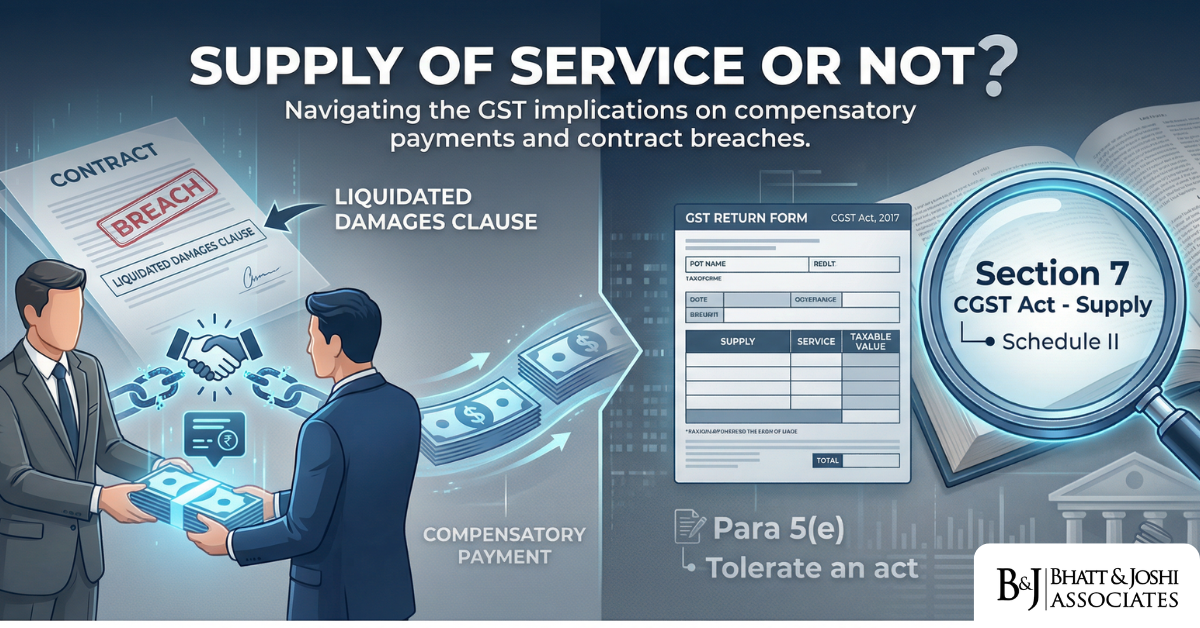
GST on Liquidated Damages: Supply of Service or Not? The Unsettled Jurisprudence After Safari Retreats
Introduction: Liquidated Damages and the Scope of “Supply” Under GST
Few questions in Indian GST law have generated as much confusion at the field level as the one that seems deceptively simple on its face: when a party to a contract breaches its obligations and pays a sum of money to the other side, does that payment attract GST? The answer, one might think, should be obvious. Money paid because you failed to perform is hardly the same as money paid for a service rendered. And yet, tax authorities across the country have issued demand notices, advance rulings have landed on both sides of the fence, and the jurisprudence remains unsettled even years after the CBIC issued a detailed circular on the subject. The October 2024 Supreme Court judgment in the Safari Retreats matter, though principally about input tax credit on immovable property, has reopened interpretive questions about the meaning of “supply” under the CGST Act that now bleed into the liquidated damages debate. This article traces the legal framework, the statutory provisions, the CBIC’s own clarification, the conflicting advance rulings, and what the Safari Retreats decision ultimately means for the taxability of liquidated damages under GST.
The Statutory Framework: Section 7 and Schedule II of the CGST Act
The entire edifice of GST rests on the concept of ‘supply.’ Section 7(1)(a) of the Central Goods and Services Tax Act, 2017 defines supply as including all forms of supply of goods or services or both such as sale, transfer, barter, exchange, licence, rental, lease or disposal made or agreed to be made for a consideration by a person in the course or furtherance of business. The critical elements here are consideration, a person, and furtherance of business. No supply exists without an agreement, express or implied, under which something is done in exchange for value.[1]
Schedule II of the CGST Act classifies certain activities as either goods or services once they have already qualified as a supply under Section 7. Para 5(e) of Schedule II declares that “agreeing to the obligation to refrain from an act or to tolerate an act or a situation, or to do an act” constitutes a supply of service. The crucial amendment introduced by the CGST (Amendment) Act, 2018 brought into force with retrospective effect from 1 July 2017 inserted Section 7(1A), which clarified that Schedule II only classifies a transaction as goods or services after it has first qualified as a supply under Section 7(1).[2] This retrospective amendment effectively settled a significant debate: Schedule II cannot operate as an independent charging provision. An activity that does not constitute a supply under Section 7(1) cannot be dragged into the tax net merely by pointing to an entry in Schedule II.
The contractual underpinning of Para 5(e) is therefore essential. A payment does not become consideration for ‘tolerating an act’ just because money flows from one person to another. There must be an express or implied agreement between the parties that one of them will tolerate a certain act or refrain from something in exchange for payment. Without that bilateral contractual element, no supply exists and no GST can be levied.
Liquidated Damages Under Indian Contract Law
Before examining the tax position, it is worth grounding the analysis in the private law context. Section 73 and Section 74 of the Indian Contract Act, 1872 govern the award of damages upon breach of contract. Section 73 provides that when a contract is broken, the party who suffers by such breach is entitled to receive from the party who has broken it compensation for any loss or damage caused to him thereby. Section 74 goes further, providing that where a contract contains a provision for the payment of a sum upon breach, a party suffering such breach is entitled to receive reasonable compensation not exceeding the amount stated in the contract.[3]
The character of liquidated damages under contract law is therefore unmistakably compensatory. They are not a price paid for a service; they are a remedy for a wrong. Black’s Law Dictionary defines liquidated damages as cash compensation agreed upon by a signed, written contract for breach of contract, paid by the breaching party to the aggrieved party, to compensate for the loss suffered. The contract is entered into for performance, not for its breach. No reasonable commercial party enters a contract hoping it will be breached so that they can collect liquidated damages. The desired outcome of the contract is its execution, not its violation.
CBIC Circular No. 178/10/2022-GST: The Government’s Own Position
The Central Board of Indirect Taxes and Customs issued Circular No. 178/10/2022-GST on 3 August 2022 specifically to address the taxability of liquidated damages, compensation, and penalties arising from breach of contract. The circular was issued in light of the 47th GST Council meeting held at Chandigarh in June 2022, which had recommended that clarifications be issued to reduce unwarranted litigation.[4]
The circular’s reasoning is worth setting out at some length. At paragraph 7.1.3, the CBIC states that liquidated damages are not the desired outcome of a contract — they arise as a consequence of non-performance. The circular clarifies that such payments “are merely a flow of money from the party who causes breach of the contract to the other party as a consequence of the said breach.” Crucially, CBIC went on to state that “liquidated damages cannot be said to be a consideration received for tolerating the breach or non-performance of the contract. They are rather payments for not tolerating the breach.” Therefore, such payments do not constitute consideration for a supply and are not taxable.
The circular also laid down a governing test: the key question is whether the impugned payment constitutes consideration for an independent contract envisaging tolerating an act, refraining from doing an act, or doing an act. If yes, it is a taxable supply; if not, it is merely a compensatory flow and outside the GST net. The distinction is between a payment that acknowledges and monetises the freedom to breach versus a payment that compensates for an undesired breach that neither party intended or agreed to.
The circular provides a concrete illustration: where a builder delays delivery of a flat and pays the buyer liquidated damages for the delay, those payments are not consideration for the buyer tolerating the delay — they are compensation for the breach. The buyer did not agree that the builder could breach; the buyer agreed that if a breach occurred, a predetermined sum would be paid. The distinction, though subtle, is fundamental.[4]
The Conflicting Landscape of Advance Rulings
The CBIC circular’s clarity has not, unfortunately, translated into uniformity at the level of Advance Ruling Authorities (AARs). Several AARs have reached conclusions that appear to directly contradict the circular’s position, producing a fragmented and litigation-prone jurisprudential landscape.
AAR Andhra Pradesh: South India Krishna Oil & Fats Pvt. Ltd.
The Authority for Advance Rulings, Andhra Pradesh, in AAR No. 12/AP/GST/2023 dated 21 December 2023 in the case of M/s South India Krishna Oil & Fats Pvt. Ltd., ruled that compensation amounts including liquidated damages and trade settlement collected from customers for non-performance of contractual obligations would attract GST at 18% under Chapter Head 9997.[5] The AAR reasoned that the applicant, by accepting payment and continuing to deal with defaulting customers, was in fact tolerating the act of non-performance, and that this fell squarely within Para 5(e) of Schedule II. The AAR acknowledged the CBIC circular but held that it should be applied with regard to the specific facts of the case, and that in this instance, the circular’s general exemption did not apply.
This ruling is deeply problematic when read alongside the CBIC circular. The Andhra Pradesh AAR essentially treated every instance of continuing commercial dealing after a breach as evidence of ‘toleration,’ collapsing the distinction between commercial pragmatism and a contractual agreement to tolerate. The circular is clear that toleration must be the subject of an express or implied agreement — it cannot be inferred merely from the fact that the aggrieved party accepted the compensatory payment and moved on.
Karnataka High Court: Aavanti Solar Energy Pvt. Ltd.
A more hopeful signal came from the Karnataka High Court in M/s Aavanti Solar Energy (P.) Ltd. v. Joint Commissioner of Central Tax, Bengaluru in 2024, where the court set aside a demand order that had been raised without considering CBIC Circular No. 178/10/2022-GST. The court remitted the matter back to the authorities and made clear that the circular must be considered before any demand is confirmed.[6] This decision reinforces the binding nature of CBIC circulars on departmental officers, a position well settled in Indian administrative law since the Supreme Court’s ruling in Paper Products Ltd. v. Commissioner of Central Excise [(1999) 7 SCC 84].
The Safari Retreats Judgment and Its Implications for the ‘Supply’ Debate
The Supreme Court’s judgment dated 3 October 2024 in Chief Commissioner of Central Goods and Service Tax & Ors. v. M/s Safari Retreats Private Ltd. & Ors. (Civil Appeal No. 2948 of 2023) was principally concerned with the availability of input tax credit under Section 17(5)(d) of the CGST Act for the construction of shopping malls used for commercial leasing.[7] The Court held that whether a building constitutes a ‘plant’ within the meaning of Section 17(5)(d) is a question of fact to be answered by applying a ‘functionality test’: if the building is essential to and integral for the supply of taxable services, it may qualify as a plant and ITC would be available.
The relevance to liquidated damages lies not in the ITC question itself, but in the Supreme Court’s broader interpretive approach. The Court reaffirmed that taxing statutes must be strictly construed, that when two interpretations are available the one favorable to the assessee should be preferred, and — most significantly — that Schedule II entries cannot be read in isolation from the foundational requirement of ‘supply’ under Section 7. The Court’s analysis of what constitutes a supply of service, and its insistence on applying a functionality test rather than a formalistic classification exercise, has renewed interest in applying the same rigor to Para 5(e) transactions.
The implication is significant. If even the characterization of a physical building as ‘plant or machinery’ requires a fact-specific inquiry into what the building actually does, then surely the characterization of a monetary payment as consideration for ‘tolerating an act’ demands an equally fact-specific examination. The question is not whether the contract contains a liquidated damages clause; virtually every commercial contract does. The question is whether that clause creates a bilateral obligation where one party contractually agrees to permit the other to deviate in exchange for consideration. That is a fundamentally different thing from a standard liquidated damages clause, which contract law characterizes as a pre-estimate of loss for an undesired breach.
The Safari Retreats review petition was dismissed by the Supreme Court on 20 May 2025, confirming that the functionality test stands and the original judgment remains good law.[7] Tax practitioners are now asking whether that same interpretive discipline — substance over form, functionality over classification — should inform how Para 5(e) disputes over liquidated damages are decided.
The Existing Service Tax Jurisprudence: A Useful Compass
Although the service tax regime has been subsumed into GST, its jurisprudence on whether damages and penalties constitute consideration for a service remains an important reference point, particularly given the structural similarity between the service tax definition of ‘service’ and the GST concept of supply. Under the Finance Act, 1994, service was defined as any activity carried out by a person for another for consideration, and this definition was interpreted to require an element of contractual reciprocity — the activity must be carried out at the desire of the person paying the consideration.[8]
The CESTAT Chennai, in a larger bench ruling on foreclosure charges on loans, held that charges of a compensatory nature where no service is actually rendered in exchange are in the nature of liquidated damages and not liable to service tax. This early jurisprudence informed the CBIC’s approach in Circular No. 178/10/2022-GST, which itself draws on the service tax education guide’s conception of ‘activity for consideration’ as requiring genuine contractual reciprocity.[4]
The Distinction That Matters: Agreed Forbearance vs. Compensated Breach
The entire debate ultimately hinges on a distinction that is as much about contract law as it is about tax law. There are two distinct types of clauses that appear in commercial contracts, both of which involve the payment of money by one party to the other.
The first is the genuine forbearance agreement — for instance, a non-compete clause where one party agrees, in exchange for a specific payment, not to carry on a competing business for a defined period. Here there is an express agreement, the performance is the restraint itself, and the payment is the agreed price for that restraint. This clearly falls within Para 5(e) of Schedule II and is taxable.
The second is the standard liquidated damages clause — a clause that names a sum as a pre-estimate of the loss that will be caused by breach. Here there is no agreement that breach will occur; indeed, both parties hope and intend that it will not. If breach does occur, the sum flows as compensation, not as the price of anything. Para 5(e) simply does not apply here, and the CBIC circular is categorical on this point.
The difficulty arises in practice because many commercial contracts contain clauses that resemble one or the other depending on how they are worded. A clause that says ‘in the event of delay, the contractor shall pay the client Rs. X per day’ reads like a penalty or liquidated damages provision. A clause that says ‘the client shall have the right to require the contractor to continue work even if delayed, in exchange for the contractor paying Rs. X per day’ arguably creates a bilateral forbearance arrangement. Getting this characterization right is where much of the litigation now concentrates.
Persisting Ambiguity and the Way Forward
Despite the CBIC circular’s clarity, field officers continue to issue demand notices on liquidated damages. The reasons are partly institutional — field officers may not always be aware of or defer to the circular — and partly because some contracts are genuinely ambiguous. The AAR rulings, being non-binding outside the specific applicant, have added to the confusion by signaling that a contrary view is at least arguable.[5]
Taxpayers receiving demands on liquidated damages now have a robust set of defenses. The CBIC circular is binding on departmental officers. The 2018 amendment to Section 7(1A) confirms retrospectively that Schedule II cannot operate independent of the supply definition. The Karnataka High Court has confirmed that demands issued without considering the circular are liable to be set aside. And the Supreme Court’s Safari Retreats judgment adds an overarching principle of strict construction and fact-specific inquiry that cuts strongly against automatic classification of liquidated damages as taxable services.[6, 7]
What is needed now is either a GST Council recommendation or a Supreme Court ruling directly on the taxability of liquidated damages under Para 5(e), so that the uncertainty is resolved once and for all. Until then, taxpayers will need to maintain detailed documentation of the contractual basis for each liquidated damages payment, distinguishing clearly between clauses that evidence agreed forbearance and those that simply pre-estimate loss.
Conclusion
The question of whether GST applies to liquidated damages is, in principle, settled by the CBIC’s own circular and the legislative history of Section 7 of the CGST Act. Liquidated damages paid purely as compensation for breach — without any underlying bilateral agreement to permit or tolerate the non-performance — do not constitute consideration for a supply of service and are not taxable. Para 5(e) of Schedule II, properly read in light of Section 7(1A), applies only to those cases where there is a genuine contractual agreement to refrain, tolerate, or act, with money flowing as the agreed price for that agreement. The Safari Retreats judgment, while dealing with a different aspect of GST law, reinforces the interpretive principles that support this conclusion. The unsettled jurisprudence at the AAR level reflects the difficulty of applying these principles to factually complex contracts, and underscores the need for careful contract drafting and proactive tax planning by businesses that routinely levy or pay liquidated damages.
References
[1] Section 7 of CGST Act, 2017 – Scope of Supply, FinTax Blog
[2] Supply – Section 7 of CGST Act 2017 (discussing CGST Amendment Act 2018 & Section 7(1A)), Tax Guru
[7] Supreme Court’s Landmark Verdict in Safari Retreats Case – Economic Laws Practice
[9] GST on Liquidated Damages – ClearTax India
Published and Authorized by Vishal Davda
