 Whatsapp

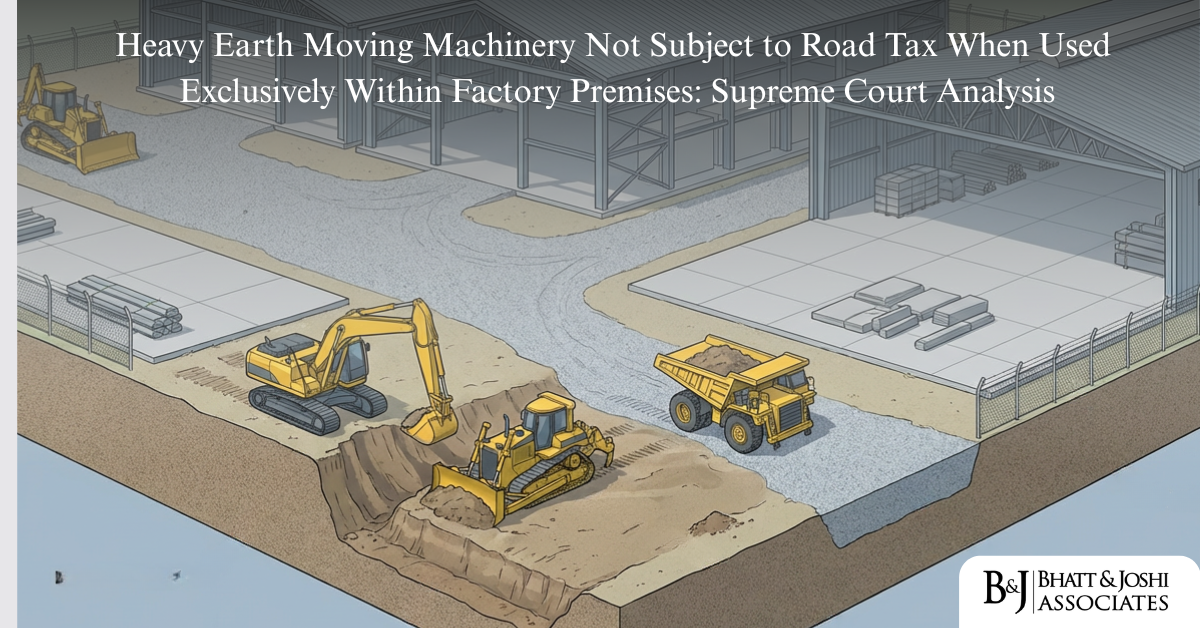
Heavy Earth Moving Machinery Not Subject to Road Tax When Used Exclusively Within Factory Premises: Supreme Court Analysis
Introduction
In a landmark judgment delivered on January 8, 2026, the Supreme Court of India in Ultratech Cement Limited vs. State of Gujarat clarified a longstanding debate on the taxation of heavy earth moving machinery and construction equipment. The Supreme Court bench, comprising Justice Pankaj Mithal and Justice Prasanna B. Varale, held that heavy earth moving machinery such as excavators, dumpers, loaders, dozers, surface miners, drills, and rock breakers, when used exclusively within factory premises or enclosed industrial areas, does not qualify as a motor vehicle under the Motor Vehicles Act, 1988 and is therefore not liable to road tax under state motor vehicle laws.
This judgment provides much-needed clarity to industrial sectors relying heavily on such machinery, including cement manufacturing, mining, steel production, and construction. The decision reinforces the constitutional principle that taxation must be founded on the actual use of public infrastructure and cannot be imposed arbitrarily on equipment confined to private premises.
Background of the Case
Ultratech Cement Limited operates multiple cement manufacturing plants in Gujarat, including facilities at Gujarat Cement Works and Narmada Cement Works in Kutch and Rajkot districts. The company utilizes various heavy earth moving machinery for mining limestone and conducting captive operations within its enclosed plant premises. The machinery in question included dumpers, loaders, excavators, surface miners, and rock breakers, which were transported to the factory sites in a dismantled condition on trailers and assembled within the premises. These machines were never driven on public roads and were designed specifically for off-road industrial operations.
Initially, in 1996, the Regional Transport Officer at Bhuj acknowledged that dumpers used within private premises did not require registration under the Motor Vehicles Act, 1988. However, in November 1999, following a press advertisement issued by the Gujarat Transport Commissioner, authorities directed Ultratech to register all special service vehicles and demanded payment of road tax under the Gujarat Motor Vehicles Tax Act, 1958. The total demand, inclusive of interest and penalties, amounted to approximately Rs. 1.36 crores for periods starting from 1999 onwards [2].
Ultratech contested these demands, arguing that the machinery was never used on public roads and manufacturers like Bharat Earth Movers Limited and the Automotive Research Association of India had certified that these vehicles were off-road equipment for which no road-worthiness certificate was even issued. The Gujarat High Court, in 2011, dismissed Ultratech’s challenge and held that the machinery fell within the definition of motor vehicles and was therefore taxable. Aggrieved by this decision, Ultratech approached the Supreme Court.
Legal Framework
Constitutional Provisions
The constitutional foundation for motor vehicle taxation lies in Entry 57 of List II of the Seventh Schedule to the Constitution of India, which empowers state legislatures to levy taxes on vehicles suitable for use on roads. Entry 57 specifically states: “Taxes on vehicles, whether mechanically propelled or not, suitable for use on roads, including tramcars subject to the provisions of entry 35 of List III” [3].
This constitutional provision clearly limits the taxing power of states to vehicles that are suitable for use on roads. The Supreme Court emphasized that this qualification cannot be overlooked or bypassed by state legislation. Article 265 of the Constitution further mandates that no tax shall be levied or collected except by authority of law, requiring strict interpretation of taxation statutes.
Motor Vehicles Act, 1988
Section 2(28) of the Motor Vehicles Act, 1988 defines a motor vehicle as “any mechanically propelled vehicle adapted for use upon roads whether the power of propulsion is transmitted thereto from an external or internal source and includes a chassis to which a body has not been attached and a trailer; but does not include a vehicle running upon fixed rails or a vehicle of a special type adapted for use only in a factory or in any other enclosed premises or a vehicle having less than four wheels fitted with engine capacity of not exceeding twenty-five cubic centimetres” [4].
The exclusionary clause in this definition is particularly significant. It explicitly states that vehicles of a special type adapted for use only in a factory or in any other enclosed premises are not motor vehicles for the purposes of the Act. This exclusion formed the cornerstone of the Supreme Court’s reasoning in the Ultratech case.
Gujarat Motor Vehicles Tax Act, 1958
Section 3 of the Gujarat Motor Vehicles Tax Act, 1958 is the charging provision that levies tax on all motor vehicles used or kept for use in the state. The court noted that while this provision appears broad, it cannot travel beyond the constitutional limitation imposed by Entry 57 of List II. Furthermore, Schedule I to Section 3(1) of the Gujarat Act does not prescribe any tax rate for construction equipment vehicles, making them non-chargeable to road tax [5].
Supreme Court’s Reasoning and Analysis
Interpretation of “Motor Vehicle”
The Supreme Court began its analysis by examining the scope and meaning of motor vehicle under Section 2(28) of the Motor Vehicles Act, 1988. The bench observed that the vehicles used by Ultratech are special-purpose construction equipment designed specifically for operation within industrial areas, factory premises, or other defined enclosed spaces. The court held: “We are of the conclusive opinion that the vehicles used by the appellants are vehicles of special types, precisely construction equipment vehicles which are suitable and are meant for use for operation and use within the industrial area/factory premises/defined enclosed premises and are not meant for use on roads or public roads” [1].
The judgment emphasized that these machines are off-road equipment and, as such, are excluded not only from the definition of motor vehicles under Section 2(28) of the Act but also from taxation, since Entry 57 of List II of the Constitution allows tax only on vehicles suitable for roads. By this decision, the Supreme Court clarified that heavy machinery used within industrial premises is not liable for road tax, providing clear guidance for industries operating such equipment.
Compensatory Nature of Motor Vehicle Tax
Building upon its recent decision in M/s. Tarachand Logistic Solutions Limited vs. State of Andhra Pradesh [6], the Supreme Court reiterated the fundamental principle that motor vehicle tax is compensatory in nature. The rationale for levying motor vehicle tax is that a person using public infrastructure such as roads and highways must pay for such usage. The court stated: “If a motor vehicle is not used in a public place or is not kept for use in a public place and the person concerned is not deriving any benefit from the public infrastructure, he should not be burdened with the motor vehicle tax” [6].
This principle established in Tarachand Logistic Solutions was directly applicable to the Ultratech case. Since the heavy earth moving machinery was confined to enclosed factory premises and derived no benefit from public roads, imposing motor vehicle tax would be fundamentally unjustified and contrary to the very purpose of such taxation.
Precedent Analysis: Bolani Ores Case
The Supreme Court relied heavily on its earlier landmark judgment in Bolani Ores Ltd. vs. State of Orissa [7], which established the interpretation that adapted for use upon roads means suitable for plying on roads. In that 1974 case, the Supreme Court court had examined whether heavy earth moving machinery like dumpers, rockers, and tractors used exclusively within mining premises constituted motor vehicles liable for road tax. The Bolani Ores judgment held that if a vehicle does not use public roads, it cannot be subjected to motor vehicle tax.
The Ultratech bench reaffirmed this principle and applied it to modern construction equipment vehicles. The court distinguished the present case from conflicting precedents by noting that earlier judgments had not specifically considered the exclusion clause contained in the second part of Section 2(28) of the Motor Vehicles Act, 1988.
Rejecting the State’s Arguments
The State of Gujarat, represented by Senior Advocate K. Parameshwar, argued that Section 3(1) of the Gujarat Tax Act is the charging provision which levies tax on all motor vehicles used or kept for use in the state. The State contended that no distinction could be made based on whether the vehicle is used on-road or off-road, as the statute does not use the words public place or public road. The State further submitted that a Ministry of Road Transport and Highways circular could not override express statutory provisions.
The Supreme Court rejected these arguments comprehensively. The bench observed that accepting the State’s interpretation would lead to absurd consequences. The court noted: “It may be noted that aircrafts specially those belonging to Air Force are capable of landing on the highways and other roads but the same cannot be brought within the fold of motor vehicle much less such aircrafts can be subjected to tax as motor vehicle” [5].
The court held that the conspicuous absence of the qualification suitable for use on roads in the Gujarat Tax Act cannot be used to circumvent the constitutional limitation imposed by Entry 57. The charging provision of state taxation law must conform to the constitutional entry that empowers such legislation.
Ministry Circular and Off-Road Equipment Classification
The Supreme Court gave significant weight to the Ministry of Road Transport and Highways circular dated July 13, 2020, which categorized such vehicles as off-road equipment. Senior Advocate P. Chidambaram, appearing for Ultratech, emphasized that this official classification supported the company’s position that the machinery falls outside the ambit of motor vehicles requiring registration and taxation.
The court agreed that this circular represented the official policy understanding of the central government regarding the classification of heavy earth moving machinery. While acknowledging that circulars cannot override statutory provisions, the bench found that the MoRTH circular correctly interpreted the existing legal framework and supported the exclusion of off-road equipment from motor vehicle taxation.
Implications and Practical Impact
Industrial Sector Relief
The Supreme Court’s ruling on heavy machinery road tax offers significant relief to industries that operate equipment solely within their premises. Companies in cement, steel, coal mining, construction, and similar sectors will no longer face retrospective tax demands, alleviating years of financial and regulatory uncertainty.
This decision particularly benefits organizations like Coal India Limited, Steel Authority of India Limited, Tata Steel, and various cement manufacturers with extensive mining and processing facilities. By confirming that off-road machinery is not liable for road tax, the Supreme Court has also simplified compliance, removing the need to register equipment designed exclusively for industrial use.
Caveat: Actual Road Usage Triggers Liability
The Supreme Court was careful to include an important caveat in its judgment. While exempting off-road equipment used exclusively within factory premises, the bench clarified that if any such vehicles are found actually using public roads, they would immediately lose their immunity. The court stated: “If any such kind of vehicles are found using roads, they would not be free from the rigors of Section 2(28) of the Act and Section 3 of the Gujarat Tax Act and may also be subject to proceedings for seizure and penalty in accordance with the law” [1].
This caveat means that companies must maintain strict discipline in ensuring that construction equipment vehicles remain confined to factory premises. Any movement on public roads, even incidental or temporary, could trigger registration requirements, taxation liability, and potential penalties. Companies may need to continue using trailers for transporting such equipment between facilities or to ensure compliance.
Reduction in Compliance Burden
For industries operating equipment within factories, mines, and enclosed sites, this ruling significantly reduces routine registration requirements, road tax demands, and coercive enforcement actions. Companies will no longer need to maintain elaborate documentation proving non-use on public roads or filing periodic intimations with transport authorities. This streamlining of compliance requirements allows companies to focus resources on core operations rather than navigating bureaucratic complexities.
Potential Grey Areas
Legal experts have noted that the court’s clarification on liability arising from actual road use leaves a potential grey area. Equipment that intermittently crosses public roads between sites could become the next axis of dispute unless usage patterns are clearly regulated and demonstrably incidental. Companies would be well-advised to maintain detailed records of equipment location and movement to demonstrate continuous use within enclosed premises.
Broader Legal Significance
Strict Construction of Taxation Statutes
The Ultratech judgment reinforces the established principle that taxation statutes must be strictly construed. Courts cannot expand the scope of taxation beyond what is clearly authorized by the constitutional entry and the charging provision. The Supreme Court’s reliance on Article 265 underscores that implied taxation is impermissible, and any ambiguity must be resolved in favor of the taxpayer.
This principle has broader implications for tax disputes across various domains. Revenue authorities cannot rely on loose interpretations or expansive readings of charging provisions to impose taxes. The constitutional framework and legislative intent must guide tax administration, preventing arbitrary or excessive demands.
End-Use Principle in Taxation
The judgment establishes that motor vehicle taxation is intrinsically linked to end use, specifically the use of public infrastructure. This compensatory model means that taxation cannot be imposed merely because a vehicle is capable of movement or has mechanical propulsion. The actual or intended use on public roads is the determining factor for taxation liability.
This principle distinguishes industrial equipment from transport vehicles. Even if heavy earth moving machinery possesses wheels, engines, and mobility, its designed purpose and actual deployment within private premises place it outside the taxation net. The end-use principle prevents governments from treating all mechanically propelled equipment as revenue sources regardless of their operational context.
Legislative Clarity
The judgment highlights the importance of legislative clarity in defining taxable subjects. The absence of any prescribed tax rate for construction equipment vehicles in Schedule I of the Gujarat Motor Vehicles Tax Act was viewed by the court as indicative of legislative intent not to tax such vehicles. This underscores that taxation requires explicit legislative mandate, and silence or ambiguity cannot be construed against taxpayers.
State legislatures must carefully draft taxation laws to align with constitutional entries and clearly define the scope of taxable subjects. Vague or overbroad provisions inviting judicial intervention and prolonged litigation are counterproductive for both taxpayers and revenue administration.
Conclusion
The Supreme Court of India, in Ultratech Cement Limited vs. State of Gujarat, delivered a landmark judgment benefiting industrial enterprises. By holding that heavy earth moving machinery used exclusively within factory premises does not qualify as motor vehicles subject to road tax, the Supreme Court has lifted a major financial and compliance burden from industries while reaffirming fundamental constitutional principles.
The judgment’s emphasis on the compensatory nature of motor vehicle tax, the requirement for vehicles to be suitable for use on roads, and the importance of actual use of public infrastructure provides a clear framework for future disputes. Companies can now confidently deploy off-road equipment within enclosed premises without fear of retrospective tax demands, provided they maintain strict discipline in preventing any use of such equipment on public roads.
This decision reflects the judiciary’s commitment to purposive interpretation of taxation laws, ensuring that the constitutional framework is respected and that taxation is imposed only where the underlying justification exists. The principles established in this judgment will guide industrial policy, tax administration, and compliance strategies for years to come.
References
[1] Ultratech Cement Limited vs. The State of Gujarat, Civil Appeal Nos. 3352-3353 of 2017, Supreme Court of India, January 8, 2026. Available at: https://www.livelaw.in/supreme-court/supreme-court-excavators-dumpers-no-road-tax-if-used-inside-factory-518323
[2] Bar and Bench. “Mining, construction vehicles not liable for motor vehicle tax if not used on public roads: Supreme Court.” Available at: https://www.barandbench.com/news/litigation/mining-construction-vehicles-not-liable-for-motor-vehicle-tax-if-not-used-on-public-roads-supreme-court
[3] Constitution of India, Seventh Schedule, List II – State List, Entry 57. Available at: https://www.constitutionofindia.net/schedules/list-ii-state-list/
[4] The Motor Vehicles Act, 1988, Section 2(28). Available at: https://indiankanoon.org/doc/1873380/
[5] Law Trend. “Heavy Earth Moving Machinery Used Exclusively Within Enclosed Premises Not Taxable as Motor Vehicles: Supreme Court.” Available at: https://lawtrend.in/heavy-earth-moving-machinery-used-exclusively-within-enclosed-premises-not-taxable-as-motor-vehicles-supreme-court/
[6] M/s. Tarachand Logistic Solutions Limited vs. State of Andhra Pradesh, 2025 INSC 1052, Supreme Court of India. Available at: https://www.verdictum.in/court-updates/supreme-court/ms-tarachand-logistic-solutions-limited-v-state-of-andhra-pradesh-2025-insc-1052-motor-vehicle-public-place-kept-for-use-motor-vehicle-tax-1589669
[7] Bolani Ores Ltd. vs. State of Orissa, 1975 AIR 17, 1975 SCR (2) 138, 1974 SCC (2) 777, Supreme Court of India. Available at: https://indiankanoon.org/doc/1370552/
Published and Authorized by Prapti Bhatt
