 Whatsapp

Registration of a Public Limited Company in India
Introduction
In the landscape of Indian corporate law, the registration of a public limited company represents a critical gateway for enterprises seeking to raise capital from the general public and expand their business operations. The Companies Act, 2013, which received presidential assent on August 29, 2013, serves as the principal legislation governing the incorporation and regulation of companies in India [1]. Unlike private limited companies, public limited companies possess the unique ability to invite public subscription for their securities, thereby accessing broader capital markets and facilitating large-scale business ventures. The registration process for such companies involves strict compliance with statutory requirements, ensuring transparency and accountability to protect the interests of potential investors and stakeholders. The Ministry of Corporate Affairs administers this regulatory framework through the Registrar of Companies, maintaining a balance between enabling business growth and safeguarding public interest.
Legal Framework Governing Public Limited Company
Definition and Characteristics
A public limited company under the Companies Act, 2013, is defined under Section 2(71) as a company which is not a private company [1]. The Act distinguishes public companies from private companies based on several fundamental characteristics. A public limited company can invite subscriptions from the general public for its securities, has no restriction on the maximum number of members, and must have a minimum of seven shareholders at the time of incorporation. The company must add the word “Limited” after its name, signifying its public status. Furthermore, such companies face more rigorous regulatory oversight and disclosure requirements compared to their private counterparts, reflecting their accountability to a wider body of stakeholders including public investors.
Constitutional Requirements
The constitutional framework for establishing a public limited company mandates specific minimum requirements that distinguish it from other corporate forms. According to the provisions of Section 3 of the Companies Act, 2013, a public company must have a minimum of seven persons subscribing to its memorandum of association [1]. The directorial structure requires at least three directors on the board, as stipulated under Section 149 of the Act, ensuring adequate governance and oversight mechanisms. Each director must obtain a Director Identification Number, a unique identification allotted by the Central Government through the Registrar of Companies. The company must establish and maintain a registered office within India from the date of incorporation, serving as the official address for all legal communications and statutory filings.
Incorporation Process Under the Companies Act, 2013
Pre-Incorporation Requirements
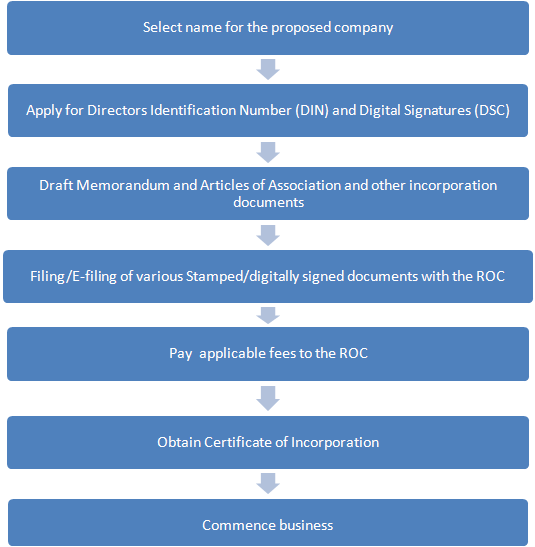
Before commencing the formal public limited company registration process, promoters must undertake several preparatory steps to ensure compliance with statutory requirements. The first critical step involves obtaining Digital Signature Certificates for all proposed directors and subscribers to the memorandum and articles of association. These digital signatures authenticate electronic filings with the Ministry of Corporate Affairs portal. Subsequently, proposed directors must apply for Director Identification Numbers using the relevant forms prescribed under the Companies (Appointment and Qualification of Directors) Rules, 2014. The promoters must also conduct thorough name availability checks through the Ministry of Corporate Affairs portal to ensure the proposed name does not violate the naming guidelines specified under Rule 8 of the Companies (Incorporation) Rules, 2014, and does not resemble existing registered companies.
SPICe+ Form Filing Procedure
The Ministry of Corporate Affairs introduced the SPICe+ (Simplified Proforma for Incorporating Company electronically Plus) form in February 2020, revolutionizing the company incorporation process by integrating multiple registrations into a single window system [2]. This web-based form replaced the earlier SPICe form and Part A of SPICe+ facilitates name reservation for the proposed company for a period of twenty days upon approval. Part B of the form encompasses the comprehensive incorporation application, including allotment of Director Identification Numbers for new directors, mandatory issuance of Permanent Account Number and Tax Deduction and Collection Account Number, and optional registration for Goods and Services Tax Identification Number. The form also provides for mandatory registration with the Employees’ Provident Fund Organisation and Employees’ State Insurance Corporation, streamlining compliance for new companies. Applicants must attach essential documents including the Memorandum of Association, Articles of Association, declarations from subscribers and first directors, proof of registered office, and identity and address proofs of all directors and subscribers.
Section 7 Incorporation Framework
Section 7 of the Companies Act, 2013, establishes the fundamental framework for company incorporation, prescribing mandatory documents and information that must be filed with the Registrar of Companies [1]. The Registrar, upon receiving the SPICe+ form along with requisite attachments, examines the completeness and accuracy of information provided. The memorandum and articles must be duly signed by all subscribers in the prescribed manner, accompanied by a declaration from a practicing professional such as a chartered accountant, company secretary, or cost accountant, certifying compliance with all statutory requirements. Additionally, each subscriber and proposed director must furnish a declaration stating they have not been convicted of any offense related to company promotion or management in the preceding five years, and confirming the accuracy and completeness of all filed documents. Upon satisfaction that all requirements have been met, the Registrar registers the documents and issues a Certificate of Incorporation in Form INC-11, which includes a unique Corporate Identity Number serving as the permanent identification for the company.
Regulatory Compliance and Listing Requirements
Securities and Exchange Board of India Regulations
Public limited companies intending to list their securities on recognized stock exchanges must comply with the Securities and Exchange Board of India (Listing Obligations and Disclosure Requirements) Regulations, 2015 [3]. These regulations mandate stringent disclosure norms to protect investor interests and ensure market transparency. Companies must maintain a minimum public shareholding as prescribed under the Securities Contracts (Regulation) Rules, 1957. The current framework requires that at least twenty-five percent of the paid-up equity share capital be offered to the public for subscription in the case of companies seeking listing. Listed companies must establish various committees including Audit Committee, Nomination and Remuneration Committee, and Stakeholders Relationship Committee as mandated under the regulations. Continuous disclosure obligations require listed entities to inform stock exchanges of all material events and price-sensitive information within thirty minutes of conclusion of board meetings.
Prospectus Requirements
When a public limited company seeks to raise capital through public subscription, it must issue a prospectus in accordance with Section 26 of the Companies Act, 2013 [1]. The prospectus constitutes a detailed document containing comprehensive information about the company’s business, financial position, risk factors, management, and the terms of the securities being offered. It must disclose all material facts and information necessary for investors to make informed investment decisions. The document undergoes scrutiny by merchant bankers registered with the Securities and Exchange Board of India, ensuring compliance with disclosure norms. Section 34 of the Act provides for criminal liability in cases where the prospectus contains any untrue statement or conceals material facts, thereby deterring misrepresentation and protecting investor interests. The prospectus must be filed with the Registrar of Companies and the Securities and Exchange Board of India before its issuance to the public.
Post-Incorporation Compliance Framework
Statutory Meetings and Returns
Following incorporation, public limited companies must comply with various ongoing statutory obligations to maintain their corporate status. Section 96 of the Companies Act, 2013, mandates that every company must hold an Annual General Meeting within six months from the close of the financial year [1]. The first Annual General Meeting must be held within nine months from the date of closing of the first financial year, and subsequently, not more than fifteen months shall elapse between two consecutive Annual General Meetings. Companies must file Annual Returns in Form MGT-7 with the Registrar within sixty days from the date of the Annual General Meeting, containing particulars of registered office, principal business activities, shareholding pattern, and details of directors and key managerial personnel. The Board of Directors must meet at least four times a year, with a maximum gap of one hundred twenty days between two consecutive meetings, ensuring regular oversight and strategic direction.
Financial Reporting and Audit Requirements
Public limited companies face stringent financial reporting obligations designed to ensure transparency and accountability to shareholders and stakeholders. Section 129 of the Companies Act, 2013, requires companies to prepare financial statements comprising balance sheet, profit and loss account, cash flow statement, and statement of changes in equity [1]. These statements must comply with accounting standards prescribed under Section 133 of the Act, which mandates adherence to Indian Accounting Standards for specified classes of companies. Section 139 requires appointment of statutory auditors within thirty days of incorporation, who shall hold office for a term of five consecutive years subject to ratification by members at every Annual General Meeting. The audited financial statements must be filed with the Registrar of Companies within thirty days of the Annual General Meeting along with the Board’s Report and Auditor’s Report, ensuring public availability of financial information for investor protection and market transparency.
Judicial Interpretation and Landmark Cases
Doctrine of Separate Legal Entity
Indian courts have consistently upheld the principle of separate legal personality of companies established through proper incorporation procedures. The landmark case of State Trading Corporation of India v. Commercial Tax Officer established that a company, once incorporated, becomes a distinct legal entity separate from its members, capable of owning property, entering into contracts, and suing or being sued in its own name [4]. This fundamental principle, originating from the English case of Salomon v. Salomon & Co Ltd, has been recognized and applied by Indian courts in numerous judgments. However, courts have also recognized circumstances where the corporate veil may be lifted to prevent fraud or improper conduct. The doctrine ensures that shareholders enjoy limited liability, with their personal assets protected from corporate debts and obligations, thereby encouraging entrepreneurship and investment in corporate ventures.
Oppression and Mismanagement Jurisprudence
The National Company Law Tribunal and appellate authorities have developed substantial jurisprudence concerning oppression and mismanagement in public companies. The case of Tata Sons Limited v. Cyrus Investments Private Limited examined the scope of Sections 241 and 242 of the Companies Act, 2013, which provide remedies for minority shareholders facing oppression or mismanagement [4]. The Supreme Court held that removal of a director does not constitute oppression unless proven to be prejudicial to the company’s interests or shareholders’ rights. The judgment clarified that tribunals cannot intervene in management decisions unless such decisions amount to oppression or mismanagement harmful to the company or public interest. This judicial interpretation balances management autonomy with minority shareholder protection, ensuring that legitimate business decisions are not unduly interfered with while providing recourse against actual misconduct.
Penalties and Enforcement Mechanisms
Criminal Liability for Fraud
Section 447 of the Companies Act, 2013, establishes severe penalties for fraudulent conduct in the registration of a public limited company and company management [1]. If any person furnishes false or incorrect information or suppresses material facts during the registration process, they become liable for imprisonment extending up to ten years and fines which may extend to ten lakh rupees or three times the amount involved in the fraud, whichever is higher. Section 7(6) specifically holds promoters, persons named as first directors, and persons making declarations liable for action under Section 447 if incorporation is obtained through fraudulent means. The National Company Law Tribunal possesses powers under Section 7(7) to pass various orders including directing unlimited liability of members, removal of company name from the register, or ordering winding up of the company where incorporation has been fraudulently obtained. These stringent provisions deter fraudulent incorporations and ensure integrity in the corporate registration system.
Administrative Actions by Registrar
The Registrar of Companies possesses extensive administrative powers to ensure compliance with statutory requirements and maintain the integrity of corporate records. Under Section 248 of the Companies Act, 2013, the Registrar may strike off the name of a company from the register if it fails to commence business within one year of incorporation or if subscribers do not pay subscription amounts within one hundred eighty days of incorporation [1]. The Registrar can also initiate action for removal of names of companies that are not carrying on business or operations. Before striking off a company’s name, the Registrar must issue a notice to the company and all directors providing an opportunity to submit representations. Such administrative actions protect the credibility of the corporate register and prevent inactive companies from remaining on official records indefinitely, thereby maintaining the reliability of public information about companies.
Comparative Analysis with Other Corporate Forms
Distinction from Private Limited Companies
The Companies Act, 2013, creates clear demarcations between public and private limited companies based on their structure, capital requirements, and regulatory obligations. Private limited companies, defined under Section 2(68), restrict the right to transfer shares, limit membership to two hundred persons excluding employees and former employees who continue as members, and prohibit invitations to the public for subscribing to securities [1]. While private companies require only two members and two directors at incorporation, public companies need seven members and three directors, reflecting their broader stakeholder base. Private companies enjoy certain exemptions from provisions applicable to public companies, such as relaxed requirements for board meetings and annual general meetings. However, public companies possess advantages in terms of capital mobilization through public offerings and enhanced credibility due to stringent regulatory oversight, making them suitable for large-scale business operations.
One Person Company and Producer Company Structures
The Companies Act, 2013, introduced innovative corporate structures including One Person Companies and Producer Companies to cater to diverse entrepreneurial needs. One Person Companies, defined under Section 2(62), allow single individuals to incorporate companies with limited liability, combining the benefits of corporate structure with ease of sole proprietorship [1]. However, One Person Companies cannot be converted into public companies directly and face restrictions on certain business activities. Producer Companies, governed by Chapter XXIA of the Act, are specifically designed for agricultural producers to collectively carry on activities relating to production, harvesting, procurement, grading, pooling, handling, marketing, selling, and export of primary produce. These specialized structures reflect the legislative intent to provide appropriate corporate frameworks for different types of business activities while maintaining the public limited company as the primary vehicle for large-scale capital mobilization and public investment.
Conclusion
The registration of a public limited company in India operates within a sophisticated legal framework designed to balance entrepreneurial freedom with investor protection and public interest. The Companies Act, 2013, along with rules framed thereunder and regulations issued by the Securities and Exchange Board of India, creates a structured pathway for incorporating companies capable of accessing public capital markets. The digitalization of incorporation processes through the SPICe+ form has significantly streamlined registration procedures, reducing time and complexity while maintaining rigorous compliance standards. Judicial interpretations have clarified the scope and application of various provisions, ensuring that the law evolves to address contemporary corporate governance challenges. The regulatory framework imposes strict disclosure requirements, ongoing compliance obligations, and severe penalties for fraudulent conduct, thereby maintaining the integrity of the corporate system. As India continues to develop as a major economy, the public limited company structure remains fundamental to facilitating large-scale business ventures, promoting economic growth, and providing investment opportunities to the public while ensuring adequate safeguards through comprehensive legal and regulatory mechanisms. The interplay between statutory provisions, regulatory requirements, and judicial oversight creates a robust ecosystem that supports legitimate business activities while deterring misconduct and protecting stakeholder interests.
References
[1] The Companies Act, 2013 (No. 18 of 2013). Ministry of Corporate Affairs, Government of India. Available at: https://www.mca.gov.in/content/mca/global/en/acts-rules/companies-act/companies-act-2013.html
[2] Ministry of Corporate Affairs. (2020). SPICe+ Forms – FAQs. Available at: https://www.mca.gov.in/MinistryV2/spiceplusfaqs.html
[3] Securities and Exchange Board of India (Listing Obligations and Disclosure Requirements) Regulations, 2015. Securities and Exchange Board of India. Available at: https://www.sebi.gov.in/legal/regulations/feb-2023/securities-and-exchange-board-of-india-listing-obligations-and-disclosure-requirements-regulations-2015-last-amended-on-february-07-2023-_69224.html
[4] Legal Service India. Famous Cases under Company Law. Available at: https://www.legalserviceindia.com/legal/article-8705-famous-cases-under-company-law.html
