Whatsapp

Restorative Justice vs Retributive Justice in Indian Criminal Law
Introduction
The Indian criminal justice system has historically operated predominantly on the foundations of retributive justice, where punishment and deterrence form the core objectives of legal redressal. However, recent decades have witnessed a paradigm shift toward restorative justice principles that emphasize healing, reconciliation, and rehabilitation rather than mere punishment. This transformation reflects a broader recognition that justice should not solely focus on penalizing offenders but should also address the needs of victims, facilitate offender reformation, and promote social harmony. Understanding the interplay between restorative justice and retributive justice models and their regulation within India’s legal framework is crucial for grasping the evolution of criminal jurisprudence in the country.
Understanding Retributive Justice
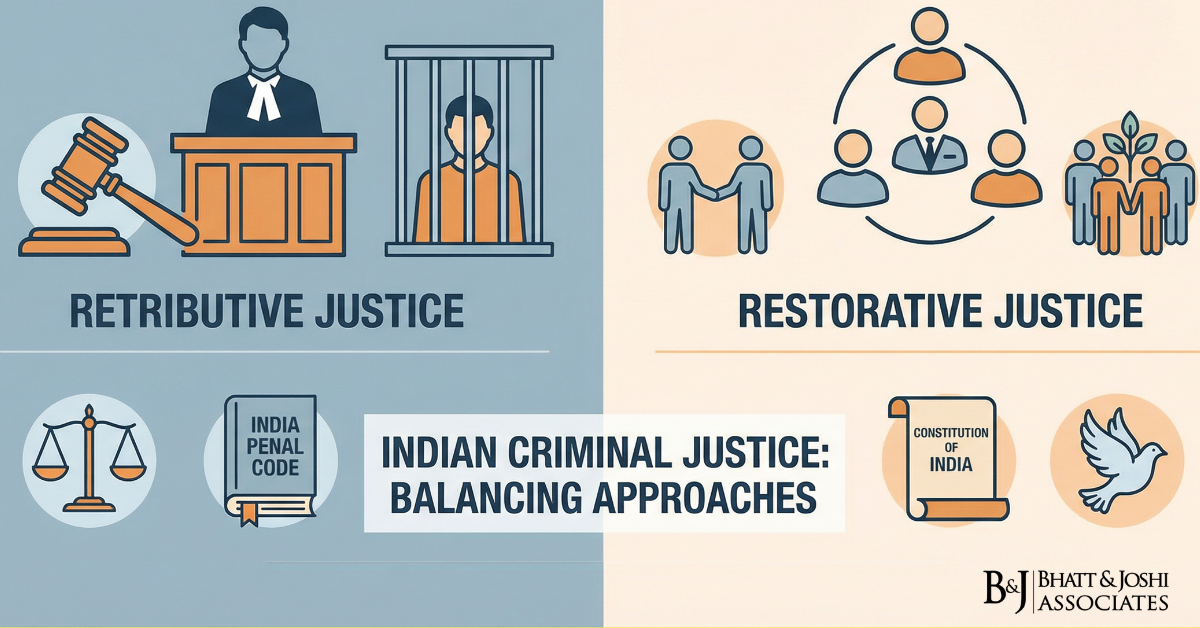
Retributive justice represents the traditional approach to criminal law, wherein the primary response to crime involves inflicting punishment proportionate to the offense committed. This model views crime as a violation against the state and society, necessitating punitive measures to restore social order and deter future criminality. The underlying philosophy rests on the principle that wrongdoers must suffer consequences for their actions, thereby vindicating the authority of law and satisfying societal demands for accountability.
Within the Indian context, retributive justice manifests through various provisions of the Indian Penal Code, 1860, which prescribes specific punishments ranging from fines to imprisonment and, in extreme cases, capital punishment. The adversarial nature of the Indian criminal justice system reinforces this approach, where the prosecution represents the state’s interests in securing conviction and appropriate sentencing. The presumption of innocence until proven guilty, the burden of proof on the prosecution, and the elaborate safeguards for the accused all operate within this retributive framework to ensure that punishment is meted out only after establishing guilt beyond reasonable doubt.
However, critics of purely retributive approaches argue that this model often fails to address the victim’s trauma or facilitate meaningful offender rehabilitation. The system becomes centered on determining guilt and imposing sanctions rather than healing relationships damaged by crime or preventing recidivism through transformative intervention.
Understanding Restorative Justice
Restorative justice emerged as an alternative paradigm that conceptualizes crime not merely as law-breaking but as harm inflicted upon individuals and communities. Rather than focusing exclusively on punishment, restorative justice seeks to repair the damage caused by criminal behavior through processes that involve active participation from victims, offenders, and affected community members. The fundamental premise holds that justice should restore victims to their pre-victimization state as far as possible, facilitate offender accountability and reformation, and rebuild fractured social relationships.
The restorative approach operates through various mechanisms including victim-offender mediation, family group conferencing, and community-based circles where stakeholders collectively address the crime’s impact and determine appropriate responses. These processes prioritize dialogue over adversarial confrontation, encouraging offenders to understand the consequences of their actions while providing victims opportunities to express their suffering and participate meaningfully in the justice process [1].
Unlike retribution which looks backward to assign blame and punishment, restorative justice adopts a forward-looking orientation concerned with resolving problems created by criminal conduct and preventing future harm. This paradigm shift acknowledges that victims require recognition of their suffering and meaningful participation in justice proceedings, while offenders need opportunities for rehabilitation and social reintegration rather than mere punitive isolation [2].
Constitutional and Statutory Framework for Restorative Justice
The Indian Constitution provides foundational support for restorative justice principles through several provisions. Article 39A mandates the state to ensure that the operation of the legal system promotes justice on the basis of equal opportunity and provides free legal aid to ensure access to justice for economically disadvantaged persons. This constitutional directive recognizes that genuine justice requires accessibility and inclusivity beyond mere procedural formality.
Furthermore, the Directive Principles of State Policy embedded in Articles 39(e), 39(f), 45, and 47 impose upon the state the responsibility to safeguard children’s interests, ensure their healthy development, and protect their basic human rights. These constitutional commitments have significantly influenced the adoption of restorative approaches, particularly in juvenile justice.
The Juvenile Justice (Care and Protection of Children) Act, 2015
The Juvenile Justice (Care and Protection of Children) Act, 2015 represents perhaps the most explicit statutory embodiment of restorative justice principles in Indian law. This legislation governs matters concerning children in conflict with law and children requiring care and protection, mandating a child-friendly approach that prioritizes rehabilitation over punishment [3].
The Act establishes Juvenile Justice Boards with powers to adjudicate matters involving child offenders through procedures emphasizing reformation and social reintegration. Section 3 of the Act enunciates fundamental principles including the principle of diversion, which promotes dealing with children in conflict with law without resorting to judicial proceedings unless necessary, and the principle of fresh start, which mandates erasure of past records to facilitate the child’s reintegration into society.
Rather than exposing children to the rigors of adult criminal trials, the JJ Act provides for specialized mechanisms that recognize children’s developmental vulnerabilities and greater capacity for rehabilitation. The maximum punishment under this Act is three years, reflecting the legislative commitment to reformative rather than purely punitive approaches. This framework aligns with India’s obligations under the United Nations Convention on the Rights of the Child, which prohibits life imprisonment and capital punishment for persons below eighteen years.
Compounding of Offences under the Code of Criminal Procedure
The Code of Criminal Procedure, 1973 (CrPC) incorporates restorative elements through its provisions on compounding of offences contained in Section 320. This section identifies specific offenses that can be resolved through mutual settlement between victims and offenders, either with or without court permission, depending on the offense’s nature.
Section 320(1) lists offenses compoundable without court intervention, while Section 320(2) specifies offenses requiring judicial approval for compounding. This mechanism allows parties to resolve disputes without protracted criminal proceedings, particularly in matters with predominantly civil character or arising from personal disputes. However, the provision carefully balances restorative possibilities against public interest by designating certain serious offenses as non-compoundable, thereby preventing private settlements that might compromise societal justice concerns [4].
The Supreme Court in Gian Singh v. State of Punjab (2012) established comprehensive guidelines governing the exercise of judicial power to quash criminal proceedings based on settlement between parties. The Court recognized that while heinous offenses involving serious crimes like murder, rape, or dacoity should not be quashed despite settlement, proceedings in matters with predominantly civil nature—such as commercial disputes, matrimonial conflicts, or family matters where the wrong is primarily private—may be terminated if parties have genuinely resolved their dispute and continuing prosecution would cause extreme injustice to the accused [5].
Plea Bargaining Provisions
The Criminal Law (Amendment) Act, 2005 introduced plea bargaining into Indian criminal procedure through Chapter XXIA of the CrPC, comprising Sections 265A to 265L. This mechanism allows accused persons to negotiate mutually acceptable dispositions with prosecutors, subject to court approval, thereby facilitating expeditious case resolution while reducing the burden on an overburdened judicial system.
Plea bargaining applies to offenses punishable with imprisonment up to seven years, excluding crimes against women, children below fourteen years, and socio-economic offenses affecting national interests. The process requires the accused to voluntarily file an application accompanied by an affidavit affirming that the plea is made without coercion or undue influence. Courts conduct in-camera examinations to verify voluntariness before facilitating mutually satisfactory dispositions between parties [6].
This restorative mechanism serves multiple objectives: reducing case pendency, decreasing the population of undertrial prisoners, providing compensation to crime victims, and acknowledging the reformative dimensions of criminal justice. However, judgments rendered through plea bargaining are final except for special leave petitions under Article 136 or writ petitions under Articles 226 and 227 of the Constitution.
The Gram Nyayalayas Act, 2008
The Gram Nyayalayas Act, 2008 establishes village courts at the grassroots level to provide accessible and affordable justice to rural populations. These mobile courts, presided over by judicial officers with powers equivalent to Judicial Magistrates of the First Class, handle criminal and civil matters specified in the Act’s schedules.
Significantly, Gram Nyayalayas are mandated to attempt dispute settlement through conciliation, utilizing appointed conciliators to facilitate agreements between parties before proceeding to formal adjudication. The Act permits these courts to accept evidence that might otherwise be inadmissible under the Indian Evidence Act, 1872, guided instead by principles of natural justice. This flexibility reflects recognition that justice delivery in rural contexts may require adaptability to local circumstances while maintaining fundamental fairness [7].
Judicial Recognition of Restorative Justice
Indian judiciary has progressively embraced restorative justice principles through landmark judgments that balance retributive and reformative considerations. The Supreme Court in Mohd. Firoz v. State of Madhya Pradesh (2022) exemplified this balanced approach while addressing sentencing in a grave case involving sexual assault and murder of a minor. Although the Court upheld the conviction based on overwhelming evidence, it reduced the sentence from life imprisonment to twenty years, emphasizing that maximum punishment does not always facilitate repairing the offender’s psyche.
The Court observed that restorative justice principles advocate allowing offenders opportunities to repair damage caused and become socially useful individuals upon release from incarceration. Quoting Oscar Wilde’s statement that “every saint has a past and every sinner has a future,” the judgment recognized the reformative potential even in serious offenses, while carefully balancing this against retributive justice demands and societal protection needs [8].
This judicial philosophy reflects growing recognition that sentencing should serve multiple purposes: acknowledging the gravity of offenses and criminal records, ensuring proportionate punishment, but also considering rehabilitation possibilities and the offender’s capacity for transformation. The Court stressed that prescribing maximum punishment may not always prove determinative for repairing offenders’ damaged psyche, thereby necessitating individualized justice that considers specific circumstances.
Victim-Centric Restorative Mechanisms
Restorative justice in India increasingly emphasizes victim participation and rehabilitation. The Code of Criminal Procedure amendments have progressively enhanced victim rights, including provisions for victim compensation, participation in proceedings, and appeal rights in specific circumstances. However, gaps remain in fully operationalizing victim-centric approaches.
The victim’s role traditionally remained peripheral in adversarial criminal proceedings focused on state prosecution versus accused defense. Restorative justice challenges this marginalization by centering victims’ experiences, needs, and preferences. Victim-offender mediation programs, though still developing in India, create spaces where victims can articulate the crime’s impact, receive answers to troubling questions, and participate in determining appropriate remedial measures. Meanwhile, offenders confront the human consequences of their actions beyond abstract legal violations, potentially fostering genuine remorse and behavioral transformation.
Nevertheless, implementing restorative approaches requires careful attention to power dynamics, ensuring that victims are not pressured into settlements that inadequately address their harm or compromise their safety. Particularly in cases involving gender-based violence or crimes against vulnerable populations, restorative processes must incorporate stringent safeguards against coercion or revictimization.
Challenges and Limitations of Restorative Justice and Retributive Justice
Despite growing recognition, restorative justice implementation in India faces significant challenges. The deeply entrenched adversarial system, cultural emphasis on punishment as justice, limited institutional infrastructure for restorative programs, and inadequate training for justice system actors all impede comprehensive adoption.
Moreover, determining appropriate boundaries for restorative approaches remains contentious. While restorative justice may suit minor offenses, property crimes, or disputes with civil dimensions, its applicability to serious violent crimes generates substantial debate. Critics argue that allowing settlement or mediation in heinous offenses trivializes the crimes’ gravity and potentially compromises public safety and deterrence objectives.
The Indian Penal Code criminalizes offenses like rape under Section 375 with punishments ranging from ten years rigorous imprisonment to life imprisonment under Section 376, classifying these as non-compoundable under the CrPC. Courts have consistently refused to permit compromise or mediation in such cases, recognizing that sexual violence constitutes not merely individual wrong but profound violation of equality and dignity impacting societal values fundamentally [9].
Additionally, concerns exist regarding potential manipulation of restorative processes by powerful offenders to escape accountability or by families to suppress crimes against vulnerable members. Ensuring genuine voluntariness, preventing coercion, and maintaining appropriate oversight mechanisms become crucial for restorative justice integrity.
Comparative Insights and Future Directions: Restorative vs Retributive Justice
India’s restorative justice evolution mirrors global trends while retaining distinctive features shaped by its constitutional commitments, cultural traditions, and legal history. Countries like New Zealand have extensively integrated restorative practices into mainstream criminal justice, particularly for youth offenders, while South Africa’s Truth and Reconciliation Commission demonstrated restorative principles’ potential for addressing mass atrocities and facilitating societal healing after systemic violence.
For India, the path forward in restorative justice and retributive justice in Indian criminal law involves carefully calibrating these approaches based on the nature of the offence, the parties’ circumstances, and broader societal interests. Expanding restorative programs for appropriate categories of offences, strengthening victim support services, enhancing training for judicial officers and court personnel, and developing robust monitoring mechanisms can facilitate effective implementation while safeguarding against abuse.
The Panchayati Raj system, with its decentralized governance structure and community involvement traditions, offers potential foundations for expanding restorative justice at grassroots levels. However, this must be accompanied by clear legal frameworks, capacity building, and safeguards against local power hierarchies that might compromise fairness.
Conclusion
The relationship between restorative justice and retributive justice in Indian criminal law reflects an ongoing evolution rather than a binary choice. While retributive principles continue dominating formal criminal justice processes, restorative elements have gained increasing recognition through statutory provisions, judicial pronouncements, and pilot programs addressing specific offense categories or populations.
This integration acknowledges that effective justice requires multiple approaches responsive to crime’s diverse manifestations and justice stakeholders’ varying needs. Retributive justice serves essential functions in vindicating legal authority, ensuring proportionate accountability, and deterring serious criminality. Simultaneously, restorative justice offers pathways for victim healing, offender rehabilitation, and community restoration that purely punitive approaches cannot achieve.
As India continues developing its criminal justice system, the challenge lies in thoughtfully incorporating restorative principles where appropriate while maintaining robust protections against serious crimes and safeguarding vulnerable populations. This balanced approach, grounded in constitutional values and responsive to contemporary justice needs, holds promise for creating a more humane, effective, and inclusive criminal justice framework that serves all stakeholders—victims, offenders, and society—in meaningful ways.
References
[1] R. Thilagaraj and Jianhong Liu, Restorative Justice in India (Springer 2017). Available at: https://www.researchgate.net/publication/316159579_Restorative_Justice_in_India_Traditional_Practice_and_Contemporary_Applications
[2] Akanksha Marwah, ‘Restorative Justice and Reformation of Offenders’ (2020) ILI Law Review 165. Available at: https://ili.ac.in/pdf/amar.pdf
[3] The Juvenile Justice (Care and Protection of Children) Act, 2015 (Act No. 2 of 2016). Available at: https://www.indiacode.nic.in/bitstream/123456789/2148/1/a2016-2.pdf
[4] The Code of Criminal Procedure, 1973, Section 320. Available at: https://blog.ipleaders.in/section-320-crpc/
[5] Gian Singh v. State of Punjab & Anr., (2012) 10 SCC 303. Available at: https://indiankanoon.org/doc/69949024/
[6] The Criminal Law (Amendment) Act, 2005, Chapter XXIA (Sections 265A-265L). Available at: https://www.drishtijudiciary.com/to-the-point/bharatiya-nagarik-suraksha-sanhita-&-code-of-criminal-procedure/plea-bargaining
[7] The Gram Nyayalayas Act, 2008 (Act No. 4 of 2009). Available at: https://www.indiacode.nic.in/bitstream/123456789/19258/1/gram_nyayalay_act_2008.pdf
[8] Mohd. Firoz v. State of Madhya Pradesh, (2022) 7 SCC 443. Available at: https://indiankanoon.org/doc/133779136/
[9] Vibha Rana, ‘Restorative Justice in Indian Rape Trials: Can Community Mediation Be Ethical?’ India Legal (26 August 2025). Available at: https://indialegallive.com/laws-research-indepth/restorative-justice-in-indian-rape-trials-can-community-mediation-be-ethical/