 Whatsapp

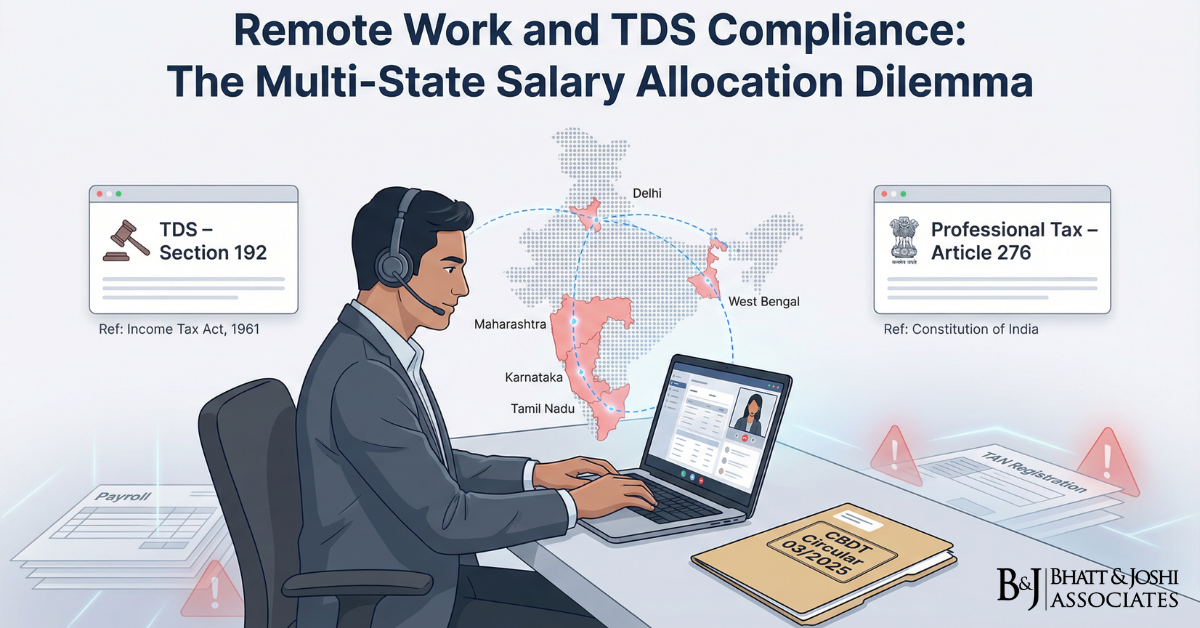
TDS on Salary for Remote Employees Across Multiple Indian States Under Section 192: Compliance Challenges”
Introduction
The rise of remote work in post-pandemic India has created a TDS on salary compliance challenge that neither the Income Tax Act, 1961 nor the CBDT has clearly addressed. Employers face uncertainty when an employee’s physical location differs from the registered office or when employees split their work across multiple states in a financial year. While Section 192 of the Income Tax Act mandates that employers deduct TDS on salary at the time of payment and deposit it with the central government, distributed workforces have exposed ambiguities in jurisdiction, professional tax obligations, and proper allocation of salary income. Errors in compliance can result in penalties, interest, or even criminal liability for employers.
Section 192 Explained: TDS on Salary Compliance for Employers
Section 192 of the Income Tax Act, 1961 is the primary charging mechanism for TDS on salary. It mandates that “any person responsible for paying any income chargeable under the head ‘Salaries’ shall, at the time of payment, deduct income-tax on the amount payable at the average rate of income-tax computed on the basis of the rates in force for the financial year in which the payment is made.” [1] The critical phrase is “at the time of payment” — unlike most other TDS provisions, Section 192 does not require deduction at accrual. The deduction obligation crystallises the moment salary is actually disbursed.
The section is deliberately employer-agnostic. It applies to individuals, Hindu Undivided Families, companies, trusts, partnership firms, government bodies, and cooperative societies. Under Section 204 of the Act, in cases of salary other than those paid by the Central or State Government, the “person responsible for paying” is the employer itself, or in the case of a company, the company including its Principal Officer. [1]
CBDT issues annual circulars consolidating rates and procedures for TDS on salary. The most recent for FY 2024-25 is Circular No. 03/2025 dated February 20, 2025, which consolidates amendments from the Finance Act, 2023, Finance (No. 1) Act, 2024, and Finance (No. 2) Act, 2024. [2] In areas where no new amendments apply, the provisions of Circular No. 24/2022 dated December 7, 2022 continue to operate. [3] These circulars govern how employers compute TDS, handle perquisites, report in Form 24Q, and issue Form 16 — but neither circular addresses what an employer must do when an employee’s state of physical work changes mid-year or spans multiple states simultaneously.
The Multi-State Problem: Where It Gets Complicated
When an employee works from the same location every day, the employer’s payroll compliance is relatively contained. TDS goes to the central government regardless, and professional tax — a state-level levy — is deducted and deposited with the state in which the employee works. The moment that employee begins working from a different state, even temporarily, the compliance picture becomes murky on two fronts: professional tax registration and the question of which state’s rules govern the deduction.
Professional tax is a creature of state law, authorised by Article 276 of the Constitution of India, which provides for the levy of “a tax on professions, trades, callings and employments” not exceeding Rs. 2,500 per annum. [4] Each state that levies professional tax — currently Karnataka, Maharashtra, West Bengal, Andhra Pradesh, Telangana, Tamil Nadu, Gujarat, Kerala, Assam, Odisha, Jharkhand, Sikkim, Meghalaya, Tripura, Madhya Pradesh, Mizoram, and Bihar — establishes its own slab rates, payment cycles, and registration requirements. An employer must register separately in each state where it has a place of work. [4]
When an employee works from home in a different state from the employer’s registered office, the question of whether the employee’s home constitutes the employer’s “place of work” in that state does not have a definitive statutory answer. The employer arguably has a professional tax compliance obligation in the state where the employee is physically performing services, but without a formal office or registration there, this obligation exists in a practical and legal grey zone.
Section 9(1)(ii) and the Territorial Connection of Salary Income
Any analysis of TDS jurisdictional issues must begin with Section 9(1)(ii) of the Income Tax Act, 1961, which deems salary income to “accrue or arise in India” if it is earned in India. The Explanation to this clause, inserted by the Finance Act, 1983 with retrospective effect from April 1, 1979, clarifies that income under the head Salaries “payable for service rendered in India” shall be regarded as income earned in India. [5]
The operational significance of Section 9(1)(ii) cannot be understated for the multi-state scenario. If an employee’s work is geographically diffuse, the “place of rendering service” becomes the determinant of where salary income arises. For a remote worker alternating between Maharashtra and Goa, it is theoretically possible that salary accrues partly in both states. The Income Tax Act, at the central government level, does not make this distinction practically meaningful since all TDS ultimately flows to the Union, but it creates a valid conceptual problem for state-level professional tax compliance.
Landmark Case Law: CIT v. Eli Lilly and Co. (India) Pvt. Ltd. (2009)
The foundational judicial authority on the territorial reach of Section 192 is the Supreme Court’s judgment in Commissioner of Income Tax, New Delhi v. M/s Eli Lilly and Co. (India) Pvt. Ltd. and Others, decided on March 25, 2009, reported at (2009) 312 ITR 225 (SC). [5] The case arose from a batch of 104 appeals across various High Courts and tribunals on whether Indian joint venture companies were obligated to deduct TDS under Section 192(1) on “home salary” paid by foreign parent companies to expatriate employees outside India.
The Supreme Court held that Section 192 and Section 9(1)(ii), read together, form an “integrated code.” The Court ruled that if the payments of home salary abroad have “any connection or nexus with his rendition of service in India, then such payment would constitute income which is deemed to accrue or arise to the recipient in India as salary earned in India in terms of Section 9(1)(ii).” The Court further held that TDS provisions under Chapter XVII-B are not purely mechanical provisions operating in isolation from the charging provisions; they form part of a coherent legislative scheme that must be read purposively. [5]
The ratio firmly establishes that “territorial connection” — not just the place of payment — determines TDS liability. The physical location where services are rendered anchors the salary income to a jurisdiction. For domestic remote workers moving between states, this principle raises questions that the Supreme Court has not yet been asked to answer directly. If a software engineer renders services from Hyderabad for eight months and from Chandigarh for four months within a single financial year, under the Eli Lilly principle her salary income arguably has a territorial connection to both Telangana and Punjab/Haryana — but professional tax treatment of this scenario remains unarticulated in any binding authority. [9]
The Form 24Q Problem and the Employer’s TAN
Every employer deducting TDS under Section 192 must file quarterly TDS returns in Form 24Q with the Income Tax Department and issue Form 16 annually to employees. CBDT Circular No. 03/2025 introduced a new Column No. 388A in Form 24Q to capture TDS deducted under additional sections, ensuring complete reporting. [2] Employers file under a single Tax Deduction Account Number (TAN), registered at a fixed address. This creates a structural problem: the TAN does not track the employee’s shifting physical location, and Form 24Q does not require disclosure of the state(s) from which work was performed.
The practical result is that an employee who works from Maharashtra for six months and from Karnataka for six months in the same financial year has her entire TDS credited under the employer’s single central filing. The employer’s professional tax registration — and hence the state’s ability to collect professional tax — may be confined to Maharashtra, leaving Karnataka with no collection mechanism and no awareness of the liability. CBDT Notification No. 112/2024 dated October 15, 2024 introduced Form 12BAA, requiring employees to disclose TDS and TCS deducted on non-salary income to their employer, and expanded the scope of Section 192(2B) to allow employers to adjust salary TDS by taking into account TCS credits. [6] But even this notification is silent on the multi-state professional tax issue.
Professional Tax Across Multiple States: The Registration Trap
For employers with pan-India distributed workforces, professional tax registration is arguably the most under-addressed compliance risk. The applicable state professional tax legislation mandates that “application for the Registration Certificate has to be done separately to each authority with respect to the place of work coming under the jurisdiction of that authority.” [4] A Bengaluru-headquartered IT company whose engineering team suddenly works from their homes in Hyderabad, Pune, Chennai, and Bhubaneswar has, in theory, triggered registration obligations in Telangana, Maharashtra, Tamil Nadu, and Odisha simultaneously.
The slab rates differ significantly: Maharashtra charges Rs. 200 per month for employees earning above Rs. 10,000 per month, while Telangana operates different income bands. The maximum professional tax is constitutionally capped at Rs. 2,500 per annum per person, but non-registration and non-deduction attract penalties under each state’s statute. An employer using Maharashtra’s slabs for an employee working from Hyderabad is technically non-compliant in Telangana even if the quantum of deduction happens to be similar. The additional compliance burden for employers managing employees across multiple locations has been widely identified as a significant practical challenge — applying the wrong state’s rules is described by payroll practitioners as a common mistake particularly for employers managing employees across multiple locations. [4]
Section 192(2) and the Multiple Employer Rule: A Partial Analogy
Section 192(2) of the Income Tax Act, 1961 provides a partial mechanism for employees who have more than one employer. Where an employee is employed with more than one employer, she may furnish particulars of salary income from the other employer(s) in Form 12B, and the primary employer then deducts TDS on the aggregate income. This provision was designed for job-changers rather than multi-location workers, but it offers an indirect analogy: the Act does contemplate salary income arising from multiple sources and has a mechanism for aggregation before deduction.
The analogy breaks down for the multi-state problem because the issue there is not multiple employers but a single employer with a mobile employee. There is no corresponding provision requiring the employee or employer to declare or track states of physical work throughout the year. CBDT Circular No. 24/2022 notes that where an employee has more than one employer, each employer issues Part A of Form 16 for the period of employment with that employer. [3] This approach of apportioning Form 16 is not available for multi-state work within a single employment because TDS remains a single stream under one TAN.
Assessee-in-Default Risk: TDS on Salary Penalties Under Sections 201, 271C & 276B
An employer who fails to deduct TDS or deducts an incorrect amount becomes an “assessee in default” under Section 201 of the Income Tax Act, 1961. Section 201(1A) mandates interest at 1.5% per month from the date on which TDS should have been deducted to the date of actual deposit. Section 271C imposes a penalty equal to the amount of TDS that was not deducted. Section 276B provides for rigorous imprisonment of between three months and seven years and a fine for failure to deposit deducted TDS with the government. [2]
ITAT Patna’s ruling in the matter of Ashish Ranjan, affirmed by the Delhi High Court’s decisions in Sanjay Sudan and Chintan Bindra, clarified that Section 205 bars the tax department from recovering TDS from the employee if TDS was actually deducted by the employer — the liability for non-deposit remains squarely with the employer. [7] This creates an asymmetric risk for the multi-state scenario: the employee is protected if TDS was deducted, but the employer bears full default liability under both central and state law regardless of how genuinely ambiguous the jurisdictional question was.
The BDO India analysis of the Delhi ITAT’s ruling in a secondment context further makes clear that CBDT Circular 720, dated August 30, 1995, establishes that salary payments can be liable for TDS under only one section — i.e., the same salary cannot be subjected to TDS twice, once under Section 192 and again under Section 195. [8] While that principle addresses a cross-border rather than cross-state scenario, it reinforces the idea that the Indian TDS regime assumes a single point of withholding per payment, without mechanisms to apportion across multiple jurisdictions.
What Employers Are Actually Doing
In the absence of clear guidance, most large employers have adopted pragmatic positions. The dominant approach is to tie professional tax registration and deduction to the employer’s registered or principal office location, irrespective of where the employee physically works. A second common approach is to deduct professional tax based on the employee’s state of residence at onboarding, making no adjustments when the employee relocates. A third, more cautious approach — used by multinationals with large distributed teams — is to obtain professional tax registrations in every state where significant numbers of employees are resident, treating employees’ homes as places of work. None of these approaches is formally endorsed by any CBDT circular or state professional tax authority, and the compliance gap is systematically embedded in payroll systems used by millions of Indian employers.
Conclusion
TDS on salary under Section 192 of the Income Tax Act, 1961 is built on the assumption that an employee works from a fixed location. The Supreme Court in CIT v. Eli Lilly (2009) established that territorial connection — specifically the place of rendition of services — determines where salary income accrues and hence where TDS obligations arise. [5] CBDT’s Circular No. 03/2025 for FY 2024-25 has refined TDS computation mechanics but has not addressed the multi-state remote work scenario. [2] Professional tax, governed by Article 276 of the Constitution and individual state statutes, explicitly requires state-specific registration when a place of work spans multiple states. [4] These obligations carry the full weight of Sections 201, 271C, and 276B penalties irrespective of the amounts involved. Until India’s tax administration produces coherent guidance for the distributed workforce, employers are making risk-weighted decisions in a legal vacuum — and that problem will only grow as remote work becomes a permanent feature of Indian employment.
References
[1] CBDT / Income Tax India – TDS on Salaries (Official Booklet): https://incometaxindia.gov.in/booklets%20%20pamphlets/tds-on-salaries.pdf
[2] ASC Group – CBDT Circular No. 03/2025: TDS from Salaries for FY 2024-25: https://www.ascgroup.in/comprehensive-updates-on-tds-from-salaries-for-fy-2024-2025/
[3] Taxmann – CBDT Circular No. 24/2022 on Salary TDS for FY 2022-23: https://www.taxmann.com/post/blog/cbdt-issues-circular-on-tds-from-salaries-for-financial-year-2022-23/
[4] Tally Solutions – Professional Tax Calculation: State-wise Guide India 2025: https://tallysolutions.com/accounting/professional-tax-calculation-state-wise-india/
[5] Indian Kanoon – CIT v. Eli Lilly & Co. (India) Pvt. Ltd., (2009) 312 ITR 225 (SC): https://indiankanoon.org/doc/1160384/
[6] Tax at Hand (KPMG) – CBDT Notification No. 112/2024: Form 12BAA and TDS/TCS Credit on Salary: https://www.taxathand.com/article/38230/India/2024/CBDT-notification-updates-process-and-forms-for-claiming-TDSTCS-credit-on-salary-
[7] Ahuja & Ahuja – ITAT Patna: Employee Not Liable for Employer’s TDS Default under Section 205: https://www.ahujaandahuja.in/itat-patna-employee-not-liable-for-employers-tds-default-under-section-205/
[8] BDO India – Delhi ITAT Rules on Withholding Tax for Salary Reimbursement in Secondment Cases: https://www.bdo.in/en-gb/insights/alerts-updates/direct-tax-alert-delhi-tax-tribunal-gives-ruling-on-applicability-of-withholding-tax-provision-on
[9] itatonline.org – CIT v. Eli Lilly (Supreme Court): Case Summary and Ratio: https://itatonline.org/archives/cit-vs-eli-lilly-supreme-court/
