 Whatsapp

The Competition Commission of India: Regulatory Framework and Legal Landscape
Introduction
The Competition Commission of India (CCI) stands as India’s premier competition regulatory authority, established as a statutory body under the Competition Act, 2002. Following the economic liberalization of 1991, India recognized the urgent need for a robust competition framework to prevent monopolistic practices and ensure fair market competition. The CCI became fully operational in May 2009, marking a significant milestone in India’s economic regulatory landscape [1].
The establishment of the CCI represented a paradigm shift from the earlier Monopolies and Restrictive Trade Practices Act, 1969, which had become inadequate in addressing the complexities of modern market dynamics. The Competition Act, 2002, was subsequently amended by the Competition (Amendment) Act, 2007, and later by the Competition (Amendment) Act, 2009, to strengthen the regulatory framework and enhance the CCI’s operational effectiveness [2].
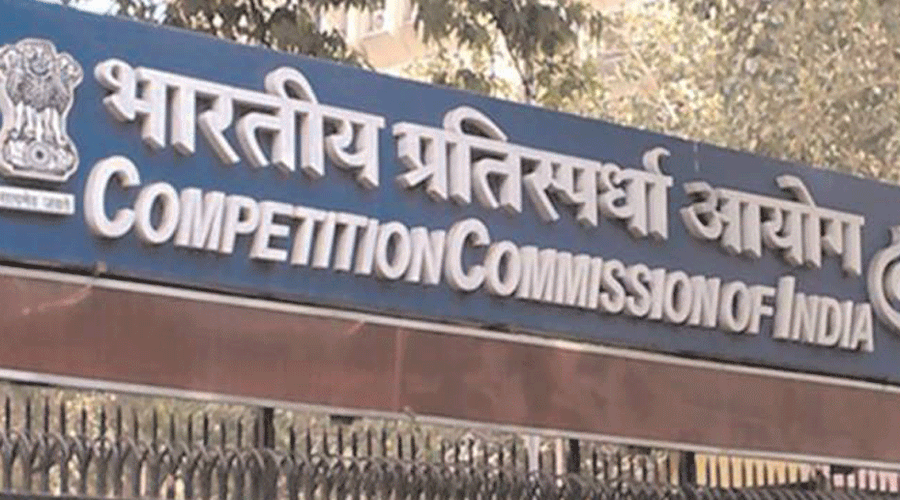
Legislative Framework and Legal Foundation
The Competition Act, 2002, serves as the cornerstone legislation governing competition law in India. The Act was conceived to prevent practices having adverse effects on competition, promote and sustain competition in markets, protect consumer interests, and ensure freedom of trade carried on by other participants in markets of India. The Act has undergone significant amendments, with the most recent being the Competition (Amendment) Act, 2023, which introduced crucial changes including deal value thresholds and enhanced powers for the CCI [3].
Under Section 7 of the Competition Act, 2002, the CCI was established as a statutory body corporate, having perpetual succession and a common seal. The Act empowers the CCI with extensive jurisdiction over all matters relating to competition, including anti-competitive agreements, abuse of dominant position, and combinations such as mergers and acquisitions. The legislative intent behind the Act was to create a modern competition law regime that could effectively address the challenges of a liberalized economy while ensuring consumer welfare and market efficiency.
The Competition (Amendment) Act, 2023, introduced transformative changes to the regulatory landscape. The amendment established deal value thresholds, requiring transactions exceeding INR 2,000 crore to seek prior CCI approval, regardless of traditional asset and turnover thresholds. This change addresses the regulatory gaps in digital economy transactions where asset-light business models were previously escaping competition scrutiny.
Composition and Structure of CCI
The Competition Commission of India comprises a Chairperson and not less than two and not more than six members, as stipulated under Section 8 of the Competition Act, 2002. Currently, the CCI operates with a full complement of seven members, including the Chairperson, all appointed by the Central Government [4]. The current Chairperson is Ravneet Kaur, who leads the Commission with extensive experience in competition matters.
The appointment process for CCI members follows a structured selection mechanism involving a Selection Committee. As per Section 9 of the Act, the Chairperson and every member of the Commission must be persons of ability, integrity, and standing who have been or are qualified to be judges of High Courts, or who have special knowledge of and professional experience of not less than fifteen years in international trade, economics, business, commerce, law, finance, accountancy, management, industry, public affairs, or administration.
The tenure of the Chairperson and members is five years from the date of assumption of office, or until they attain the age of sixty-five years, whichever is earlier. This structure ensures continuity in decision-making while preventing potential conflicts of interest through defined tenure periods. The Commission operates as a quasi-judicial body, possessing powers similar to civil courts in certain procedural matters, including the power to summon and enforce attendance of witnesses, require discovery and production of documents, and receive evidence on affidavits.
Functions and Powers of CCI
The CCI’s mandate encompasses three primary functions: eliminating anti-competitive practices, regulating combinations, and promoting competition advocacy. Under Section 18 of the Competition Act, the CCI is duty-bound to eliminate practices having adverse effects on competition, promote and sustain competition, protect consumer interests, and ensure freedom of trade in Indian markets.
The Commission’s investigative powers are substantial and carefully defined under the Act. Section 26 empowers the CCI to inquire into anti-competitive agreements and abuse of dominant position upon receiving information from any person, consumer, or trade association. The investigation process involves the Director General, who conducts detailed investigations and submits reports to the Commission. The CCI can impose penalties up to ten percent of the average turnover of the enterprise for the last three preceding financial years for anti-competitive practices.
In matters of combinations, the CCI exercises jurisdiction over mergers, acquisitions, and amalgamations that meet specified thresholds. The recent amendments have expanded this jurisdiction significantly. Previously, combinations were assessed based on asset and turnover thresholds. The 2023 amendment introduced deal value thresholds, bringing transactions valued above INR 2,000 crore under CCI scrutiny, provided the target entity has substantial business operations in India.
The CCI’s regulatory approach emphasizes market efficiency and consumer welfare. The Commission analyzes market dynamics, competitive landscape, and potential impacts on consumers before making determinations. This economic approach ensures that regulatory interventions are justified and proportionate to market realities.
Anti-Competitive Practices and Regulatory Response
The Competition Act identifies two primary categories of anti-competitive practices: anti-competitive agreements under Section 3 and abuse of dominant position under Section 4. Anti-competitive agreements include horizontal agreements such as cartels involving price-fixing, market sharing, and output restrictions, as well as vertical agreements that may cause appreciable adverse effects on competition.
The CCI has developed sophisticated analytical frameworks for assessing anti-competitive practices. In cartel investigations, the Commission employs economic analysis to determine market allocation, price coordination, and other restrictive practices. The leniency provisions under the Competition Commission of India (Lesser Penalty) Regulations, 2009, provide incentives for enterprises to voluntarily disclose cartel activities in exchange for reduced penalties.
Recent enforcement actions demonstrate the CCI’s evolving approach to competition violations. The Commission has been particularly active in addressing digital market challenges, where traditional competition analysis requires adaptation to new business models. Platform markets, data-driven business strategies, and network effects present unique analytical challenges that the CCI has been addressing through specialized expertise and international best practices.
The abuse of dominant position provisions require careful market definition and dominance assessment. The CCI analyzes market share, barriers to entry, buyer power, and other relevant factors to determine dominance. Once dominance is established, the Commission examines whether the entity has abused its position through predatory pricing, exclusive dealing, tying arrangements, or other restrictive practices.
Merger Control and Combination Regulation
Merger control represents a significant aspect of CCI’s jurisdiction, designed to prevent combinations that may cause appreciable adverse effects on competition. The regulatory framework requires mandatory notification for combinations exceeding specified thresholds, enabling the CCI to review transactions before implementation.
The traditional thresholds under Section 5 of the Act include asset-based criteria (assets worth INR 1,000 crore or more for acquiring entities, and INR 350 crore for target entities) and turnover-based criteria (turnover of INR 3,000 crore or more for acquiring entities, and INR 1,000 crore for target entities). The 2023 amendment introduced deal value thresholds, capturing transactions worth INR 2,000 crore or more where the target has substantial business operations in India [5].
The CCI’s merger review process involves detailed economic analysis of market concentration, competitive effects, efficiency considerations, and consumer welfare implications. The Commission applies the Substantial Lessening of Competition (SLC) test, examining whether a proposed combination is likely to cause or likely to cause appreciable adverse effect on competition within the relevant market in India.
The regulatory review timeline provides certainty to businesses while ensuring thorough analysis. The CCI must form a prima facie opinion within thirty working days of receiving complete information. If detailed investigation is required, the Commission has an additional ninety working days to make its final determination, extendable by a maximum of thirty days in exceptional circumstances.
Competition Advocacy and Market Development
Beyond enforcement activities, the CCI plays a crucial role in competition advocacy, promoting competitive markets through policy recommendations, market studies, and stakeholder engagement. Section 49 of the Competition Act empowers the CCI to provide opinions to statutory authorities on competition issues, contributing to broader economic policy formulation.
The Commission regularly conducts market studies to understand competitive dynamics in various sectors. These studies inform policy recommendations and help identify potential competition concerns before they crystallize into violations. Recent market studies have covered sectors such as e-commerce, telecommunications, pharmaceuticals, and financial services, providing valuable insights for policymakers and market participants.
The CCI’s advocacy efforts extend to capacity building and awareness creation. The Commission organizes training programs for government officials, judicial officers, and legal practitioners to enhance understanding of competition principles. International cooperation through bilateral agreements and multilateral forums helps align Indian competition law with global best practices while addressing cross-border competition issues.
Judicial Review and Appellate Mechanism
The competition law framework includes robust judicial review mechanisms to ensure accountability and legal certainty. The National Company Law Appellate Tribunal (NCLAT) serves as the appellate authority for CCI decisions under Section 53A of the Competition Act. This appellate mechanism provides an essential check on CCI’s exercise of power while ensuring specialized expertise in competition matters.
The Supreme Court of India exercises ultimate appellate jurisdiction over competition matters through appeals from NCLAT decisions. This hierarchical review structure ensures that competition law develops consistently with broader legal principles while maintaining specialized expertise at the tribunal level.
Recent judicial decisions have clarified important aspects of competition law interpretation and application. Courts have addressed issues such as the scope of CCI’s jurisdiction, the standard of evidence required for competition violations, and the relationship between competition law and sectoral regulations. These precedents contribute to the evolution of Indian competition jurisprudence and provide guidance for future cases.
Contemporary Challenges and Digital Economy
The digital economy presents unprecedented challenges for competition regulation worldwide, and India is no exception. Platform markets, data advantages, network effects, and algorithmic decision-making require sophisticated analytical approaches that go beyond traditional competition analysis. The CCI has been adapting its enforcement approach to address these challenges effectively.
Digital market investigations have revealed complex competitive dynamics where traditional market definition and dominance assessment may require modification. Multi-sided platforms, zero-price markets, and data-driven business models challenge conventional economic analysis. The CCI has been developing expertise in these areas while engaging with international competition authorities to share experiences and best practices.
The 2023 amendments partially address digital economy challenges through deal value thresholds, capturing asset-light digital transactions that previously escaped merger review. However, ongoing challenges include addressing data monopolization, algorithmic coordination, and platform self-preferencing, which require continued regulatory evolution.
International Cooperation and Best Practices
The CCI actively engages in international cooperation to enhance its enforcement capabilities and align with global competition law developments. Bilateral cooperation agreements with competition authorities facilitate information sharing, technical assistance, and coordinated enforcement actions in cross-border cases.
Participation in multilateral forums such as the International Competition Network (ICN), Organisation for Economic Co-operation and Development (OECD), and United Nations Conference on Trade and Development (UNCTAD) enables knowledge sharing and policy coordination. These engagements help Indian competition law evolve in line with international best practices while addressing domestic market specificities.
The CCI has been particularly active in developing country cooperation, sharing its experiences in competition law implementation and learning from other emerging economy challenges. This South-South cooperation contributes to global competition law development while addressing common challenges faced by developing economies.
Future Prospects and Regulatory Evolution
Looking forward, the CCI faces several challenges and opportunities in maintaining effective competition regulation. The continuing digital transformation of the economy requires ongoing regulatory adaptation and analytical sophistication. Emerging technologies such as artificial intelligence, blockchain, and Internet of Things present new competitive dynamics that competition law must address.
The regulatory framework may require further amendments to address contemporary challenges effectively. Areas for potential development include enhanced powers for market investigations, improved coordination with sectoral regulators, and strengthened international cooperation mechanisms. The CCI’s institutional capacity building remains crucial for meeting these evolving challenges [6].
The Commission’s role in promoting economic development through competitive markets continues to evolve. As India pursues ambitious economic growth targets, effective competition regulation becomes increasingly important for ensuring market efficiency, innovation incentives, and consumer welfare. The CCI’s contribution to this broader economic agenda requires continued institutional strengthening and stakeholder engagement.
Conclusion
The Competition Commission of India has established itself as a credible and effective competition authority since its inception. The legislative framework provided by the Competition Act, 2002, and its subsequent amendments creates a robust foundation for competition regulation in India’s evolving economy. The Commission’s enforcement record, advocacy efforts, and institutional development demonstrate its commitment to promoting competitive markets and protecting consumer interests.
The recent amendments to the Competition Act reflect the dynamic nature of competition law and the need for continuous adaptation to market realities. The introduction of deal value thresholds, enhanced investigative powers, and streamlined procedures position the CCI to address contemporary competition challenges effectively.
As India continues its economic transformation, the CCI’s role becomes increasingly significant in ensuring that markets work efficiently and competitively. The Commission’s success in balancing enforcement rigor with business certainty, while promoting innovation and economic growth, will determine its effectiveness in achieving the Competition Act’s objectives of protecting competition, consumers, and trade freedom in Indian markets.
The future of competition regulation in India depends on the CCI’s ability to evolve with changing market dynamics while maintaining its commitment to evidence-based decision-making and stakeholder engagement. Through continued institutional development, international cooperation, and regulatory innovation, the CCI can contribute significantly to India’s economic development goals while ensuring fair and competitive markets for all participants.
References
[1] Competition Commission of India. (2024). About CCI.
[2] Ministry of Corporate Affairs. (2007). Competition (Amendment) Act, 2007.
[3] Government of India. (2023). Competition (Amendment) Act, 2023. Retrieved from https://www.investindia.gov.in/team-india-blogs/competition-amendment-act-2023-significance-and-implications-competition
[4] Competition Commission of India. (2025). Organization Structure.
[5] S&R Law. (2023). Changes to the Competition Act, 2002. Retrieved from https://www.snrlaw.in/changes-to-the-competition-act-2002/
[6] Cyril Amarchand Mangaldas. (2021). Competition Law Developments in India. Retrieved from https://competition.cyrilamarchandblogs.com/
