 Whatsapp

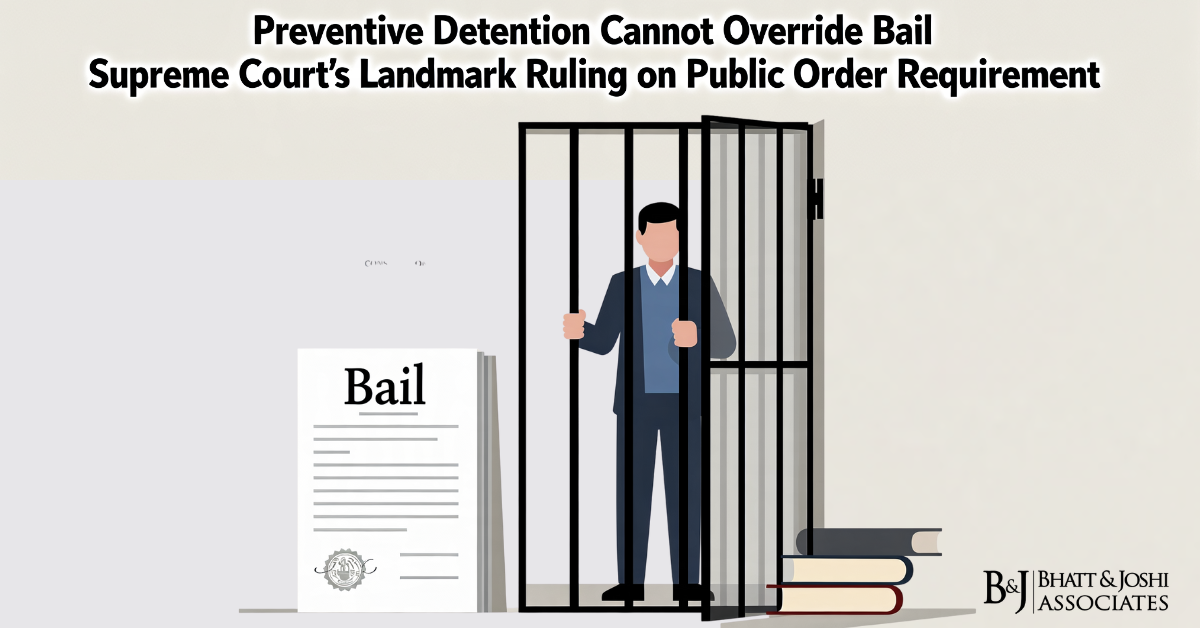
Preventive Detention Cannot Override Bail: Supreme Court’s Landmark Ruling on Public Order Requirement
Introduction
The Supreme Court of India recently delivered a significant judgment reaffirming that preventive detention laws cannot be used as instruments to bypass bail orders granted by courts of competent jurisdiction. In its June 2025 ruling in Dhanya M v. State of Kerala [1], the Supreme Court emphasized that authorities must demonstrate a genuine threat to public order rather than merely addressing law and order situations when invoking preventive detention powers. This judgment underscores the constitutional protections afforded under Article 21 and Article 22 of the Constitution of India, which safeguard personal liberty against arbitrary state action.
The case involved Rajesh, a registered moneylender operating under the name Rithika Finance in Kerala, who was detained under the Kerala Anti-Social Activities (Prevention) Act, 2007, despite being on bail in all pending criminal cases against him. The Supreme Court, in a judgment authored by Justice Sanjay Karol and Justice Manmohan, quashed the preventive detention order, holding that such extraordinary powers must be exercised sparingly and cannot substitute for ordinary criminal law remedies such as bail cancellation applications.
Constitutional Framework of Preventive Detention
Preventive detention represents one of the most stringent powers available to the state, allowing authorities to detain individuals not for crimes committed but for anticipated future actions that might threaten national security or public order. The constitutional validity of preventive detention stems from Article 22 of the Constitution of India, which provides both the authorization for such detention and the safeguards that must accompany its exercise.
Article 22(3)(b) of the Constitution permits preventive detention by carving out exceptions to the fundamental protections against arrest and detention provided in clauses (1) and (2). However, this provision does not grant unlimited power to the executive. The Constitution mandates specific procedural safeguards that must be scrupulously followed. Article 22(4) stipulates that no law providing for preventive detention shall authorize detention beyond three months unless an Advisory Board consisting of persons who are or have been judges of a High Court reports before the expiration of three months that there is sufficient cause for such detention.
Furthermore, Article 22(5) requires that when any person is detained pursuant to an order made under any law providing for preventive detention, the authority making the order shall, as soon as may be, communicate to such person the grounds on which the order has been made and shall afford him the earliest opportunity of making a representation against the order. These constitutional safeguards reflect the framers’ recognition that preventive detention represents a drastic encroachment upon personal liberty and must therefore be subject to stringent checks and balances.
The National Security Act, 1980 and State-Level Preventive Detention Laws
The primary legislation governing preventive detention at the national level is the National Security Act, 1980 [2]. Section 3(2) of this Act empowers the Central Government or the State Government to detain a person if satisfied that such detention is necessary to prevent him from acting in any manner prejudicial to the security of the State, from acting in any manner prejudicial to the maintenance of public order, or from acting in any manner prejudicial to the maintenance of supplies and services essential to the community.
The Act provides that both the Central Government and State Governments may exercise these powers, though Section 3(3) permits certain district-level officers to make detention orders that must subsequently be approved by the State Government within twelve days. The maximum period of detention under ordinary circumstances is twelve months, though this can vary based on the specific grounds and statutory provisions applicable.
Beyond the National Security Act, various states have enacted their own preventive detention legislation targeting specific categories of anti-social activities. The Kerala Anti-Social Activities (Prevention) Act, 2007, under which the detention in Dhanya M was ordered, represents one such state-level statute. These laws typically target individuals deemed to be habitual offenders or those engaged in activities considered prejudicial to public order, though the Supreme Court has repeatedly cautioned against their misuse.
The Critical Distinction Between Law and Order and Public Order
One of the most significant aspects of the Supreme Court’s jurisprudence on preventive detention concerns the distinction between matters of law and order and those of public order. This distinction determines whether preventive detention can be lawfully invoked. In Dhanya M v. State of Kerala, the Supreme Court relied heavily on earlier precedents, including SK Nazneen v. State of Telangana [3] and Ameena Begum v. State of Telangana [4], to emphasize that preventive detention is justified only when there exists a threat to public order, not merely a law and order problem.
The Court in SK Nazneen explained that the difference between law and order and public order is one of degree and extent of the reach of the act in question upon society. Public order concerns the general tranquility and orderly state of the community at large. When an act has the potentiality to disturb the even tempo of life of the community and affects the public at large rather than just a few individuals, it raises a question of public order. Conversely, if a contravention in its effect is confined only to a few individuals directly involved as distinct from affecting a wide spectrum of the public, it could raise a problem of law and order only.
This distinction is not merely academic but has profound practical implications. Preventive detention laws typically authorize detention only when there exists a threat to public order. If authorities invoke these laws in situations that constitute only law and order problems, such detention orders become vulnerable to judicial scrutiny and potential invalidation. In the Dhanya M case, the Supreme Court found that the detaining authority had characterized the situation as involving merely law and order, which was insufficient to justify the invocation of preventive detention powers.
The Dhanya M Judgment: Facts and Legal Analysis
The facts of Dhanya M v. State of Kerala present a clear illustration of the potential for misuse of preventive detention powers. Rajesh, the detenu, operated a registered lending business and faced criminal charges in several cases involving alleged violations of the Kerala Money Lenders Act, the Kerala Prohibition of Charging Exorbitant Interest Act, and provisions of the Indian Penal Code. Critically, Rajesh had been granted bail in all pending cases and was complying with the conditions imposed by the courts.
Despite this, on June 20, 2024, the District Magistrate of Palakkad issued an order under Section 3(1) of the Kerala Anti-Social Activities (Prevention) Act, 2007, directing that Rajesh be detained on the grounds that he was a notorious goonda and a threat to society at large. The detention order was based on a recommendation from the District Police Head, which characterized Rajesh as engaging in activities harmful to the maintenance of public order.
Dhanya M, the wife of the detenu, challenged this detention order before the Kerala High Court through a writ petition seeking a writ of habeas corpus. The High Court, in its judgment dated September 4, 2024, dismissed the petition, holding that procedural safeguards had been complied with and that the detaining authority’s subjective satisfaction could not be questioned in judicial review. The High Court reasoned that it could not sit in appeal over the decision of the detaining authority based on the materials placed before it.
Aggrieved by the High Court’s decision, Dhanya M appealed to the Supreme Court. The Supreme Court granted leave and proceeded to examine whether the preventive detention was justified under law. The Court noted that by December 10, 2024, the maximum period of detention under the Act had been completed, and the detenu was released. However, the Court proceeded to examine the case on merits given its significance for the proper application of preventive detention laws.
Supreme Court’s Reasoning and Legal Principles
The Supreme Court’s reasoning in Dhanya M rests on several fundamental legal principles that have evolved through decades of jurisprudence on preventive detention. First, the Court reiterated that preventive detention is an extraordinary and draconian power that must be used sparingly and only in rare cases where an individual’s activities pose a threat to public order. Citing Rekha v. State of Tamil Nadu [5], the Court emphasized that preventive detention is an exception to Article 21 of the Constitution, which protects the right to life and personal liberty, and therefore must be applied as such an exception.
The Court observed that in the present case, the detenu was already on bail in all the criminal cases cited as grounds for detention. This fact was of critical importance because it indicated that the regular criminal justice system had already examined the allegations and determined that the detenu could be released on bail subject to appropriate conditions. The detaining authority’s decision to invoke preventive detention despite the grant of bail raised serious questions about whether this was an attempt to circumvent the ordinary criminal law process.
Drawing on its earlier decision in SK Nazneen v. State of Telangana, the Court stated that when a person has been granted bail, the State should move for cancellation of bail rather than placing him under preventive detention, which is not the appropriate remedy. This principle reflects the constitutional hierarchy of remedies, wherein ordinary criminal law procedures should be exhausted before resorting to extraordinary measures like preventive detention. The Court also relied on Ameena Begum v. State of Telangana, which held that there may have existed sufficient grounds to appeal against bail orders, but circumstances did not warrant the circumvention of ordinary criminal procedure to resort to an extraordinary measure of preventive detention.
The Supreme Court further examined the distinction between law and order and public order in the context of the present case. The Court noted that the characterization of the detenu’s activities in the detention order suggested that the authorities were concerned primarily with law and order rather than genuine threats to public order affecting the community at large. The Court cited Nenavath Bujji v. State of Telangana [6], which explained that if a contravention in its effect is confined only to a few individuals directly involved as distinct from a wide spectrum of public, it could raise a problem of law and order only.
The Doctrine Against Using Preventive Detention to Clip Wings
A particularly significant aspect of the Supreme Court’s judgment was its reliance on the principle articulated in Vijay Narain Singh v. State of Bihar [7], which held that the law of preventive detention is a hard law and therefore should be strictly construed. The Court quoted from this judgment stating that care should be taken that the liberty of a person is not jeopardized unless his case falls squarely within the four corners of the relevant law. Most importantly, the Court emphasized the holding that the law of preventive detention should not be used merely to clip the wings of an accused who is involved in a criminal prosecution.
This principle serves as a vital safeguard against the misuse of preventive detention powers. When an individual is already facing criminal charges and is either in judicial custody or has been granted bail, the ordinary criminal justice system is functioning as designed. The prosecution has the opportunity to present evidence, seek conviction, and if bail has been granted, move for its cancellation if circumstances warrant. Using preventive detention in such situations effectively bypasses this entire process and substitutes executive discretion for judicial determination.
The Supreme Court’s reasoning reflects a deep concern about maintaining the integrity of the criminal justice system. If preventive detention could be routinely invoked whenever authorities disagreed with bail decisions or feared that prosecutions might fail, it would render meaningless the constitutional and statutory protections that govern criminal proceedings. The Court’s judgment thus serves as a reminder that preventive detention must remain what it was intended to be an exceptional measure for exceptional circumstances, not a routine tool of law enforcement.
Procedural Safeguards and Their Importance
Beyond the substantive question of when preventive detention can be invoked, the Supreme Court’s jurisprudence has also emphasized the critical importance of procedural safeguards. These safeguards serve multiple purposes including ensuring that detention orders are not made arbitrarily, providing detenues with opportunities to challenge their detention, and enabling judicial oversight of executive action.
The Constitution itself mandates several procedural requirements. Article 22(5) requires that the detaining authority communicate to the detenu the grounds on which the detention order has been made and afford him the earliest opportunity of making a representation against the order. While Article 22(6) permits the authority to withhold facts considered against the public interest to disclose, this exception must be applied narrowly and cannot be used to deny the detenu any meaningful opportunity to contest the detention.
Furthermore, the statutory framework under laws like the National Security Act provides additional procedural protections. These include requirements that detention orders be approved by higher authorities within specified time periods, that cases be referred to Advisory Boards within stipulated timeframes, and that detenues be provided with materials necessary to make effective representations. The Supreme Court has consistently held that these procedural safeguards are not mere technicalities but represent substantive protections of fundamental rights.
In cases where procedural safeguards have been violated, courts have not hesitated to quash detention orders even if there might otherwise have been grounds for detention. This strict approach reflects the understanding that when liberty is at stake, procedural protections assume paramount importance. The Court has recognized that the power of preventive detention is so drastic that any failure to comply with prescribed procedures vitiates the entire detention.
Implications for Law Enforcement and Judicial Practice
The Supreme Court’s judgment in Dhanya M v. State of Kerala has significant implications for how law enforcement authorities and judicial officers approach cases involving preventive detention. For law enforcement, the judgment serves as a clear directive that preventive detention cannot be used as a substitute for bail cancellation or as a means to keep individuals in custody when regular criminal proceedings are ongoing. Authorities must carefully assess whether a genuine threat to public order exists before invoking these powers, and mere repetition of criminal conduct or allegations of habitual offending do not automatically justify preventive detention.
The judgment also emphasizes the importance of proper documentation and reasoning in detention orders. Detaining authorities must clearly articulate how the detenu’s activities threaten public order as distinguished from merely creating law and order problems. Vague or conclusory statements will not suffice. The materials relied upon must demonstrate a potentiality to disturb the even tempo of community life, affecting the public at large rather than just individuals directly involved in specific disputes or transactions.
For judicial officers reviewing detention orders, the judgment reinforces the need for careful scrutiny of whether procedural safeguards have been followed and whether the grounds articulated truly justify the invocation of preventive detention powers. While courts have traditionally been reluctant to substitute their judgment for that of detaining authorities on questions of subjective satisfaction, they retain the power and indeed the duty to examine whether the materials before the detaining authority could reasonably support the satisfaction recorded. Courts must also be vigilant to ensure that preventive detention is not being misused to circumvent ordinary criminal law processes.
The Balance Between State Security and Individual Liberty
At its core, the law of preventive detention represents an attempt to balance two competing imperatives: the state’s legitimate interest in maintaining public order and national security, and the individual’s fundamental right to personal liberty. This balance has been the subject of vigorous debate since the inception of the Constitution. While the framers recognized the necessity of providing for preventive detention given the security challenges facing a newly independent nation, they also built in substantial safeguards to prevent abuse.
The Supreme Court’s evolving jurisprudence on preventive detention reflects an ongoing effort to maintain this balance in light of changing circumstances and emerging challenges. Early cases like A.K. Gopalan v. State of Madras took a relatively narrow view of judicial review of detention orders, focusing primarily on procedural compliance. Over time, however, the Court has adopted a more expansive approach, examining not just whether procedures were followed but whether the invocation of preventive detention was justified in the circumstances of each case.
The Dhanya M judgment represents a continuation and refinement of this approach. By holding that preventive detention cannot be used to override bail orders and must be reserved for genuine threats to public order, the Court has reinforced the exceptional nature of these powers. The judgment acknowledges that while preventive detention has a place in India’s legal framework, that place is limited and must be carefully circumscribed to protect individual liberty.
Conclusion and the Path Forward
The Supreme Court’s ruling in Dhanya M v. State of Kerala stands as a significant reaffirmation of constitutional values and the primacy of individual liberty in a democratic society. By holding that preventive detention cannot be used to override bail orders granted by competent courts and emphasizing the necessity of demonstrating genuine threats to public order, the Court has provided crucial guidance for the proper application of these extraordinary powers.
The judgment serves multiple purposes. For detenues and their families, it offers hope that courts will carefully scrutinize detention orders and will not hesitate to intervene when preventive detention is misused. For law enforcement authorities, it provides clear parameters within which preventive detention powers must be exercised, emphasizing that these powers are not routine tools but exceptional measures to be invoked sparingly. For the judiciary, it reinforces the critical role courts play in protecting fundamental rights and ensuring that executive actions comply with constitutional requirements.
Looking forward, the principles articulated in Dhanya M are likely to influence how preventive detention cases are approached across India. The judgment’s emphasis on the distinction between law and order and public order, its insistence that preventive detention not be used to circumvent ordinary criminal law processes, and its recognition that bail decisions must be respected unless appropriate procedures for cancellation are followed all contribute to a framework that better protects individual liberty while still permitting the state to address genuine security threats when necessary.
The challenge that remains is ensuring that these principles are consistently applied across different jurisdictions and under varying factual circumstances. Preventive detention laws continue to exist in the statute books and will continue to be invoked by authorities. Whether the promise of Dhanya M is fully realized will depend on the vigilance of courts, the restraint of executive authorities, and the commitment of all stakeholders to upholding constitutional values in practice and not merely in theory.
References
[1] Dhanya M v. State of Kerala & Ors., Criminal Appeal No. 2897/2025, Supreme Court of India (June 6, 2025). Available at: https://www.livelaw.in/top-stories/supreme-court-quashes-preventive-detention-order-kerala-anti-social-activities-prevention-act-294760
[2] The National Security Act, 1980, Act No. 65 of 1980. Available at: https://indiankanoon.org/doc/190229/
[3] SK Nazneen v. State of Telangana, (2023) 9 SCC 633, Supreme Court of India. Referenced in: https://www.scobserver.in/supreme-court-observer-law-reports-scolr/dhanya-m-v-state-of-kerala-preventive-detention-not-an-alternative-for-cancellation-of-bail/
[4] Ameena Begum v. State of Telangana, (2023) 9 SCC 587, Supreme Court of India (September 4, 2023). Available at: https://indiankanoon.org/doc/29917711/
[5] Rekha v. State of Tamil Nadu, (2011) 5 SCC 244, Supreme Court of India. Referenced in official Supreme Court judgment at: https://api.sci.gov.in/supremecourt/2024/47305/47305_2024_3_1501_62170_Judgement_06-Jun-2025.pdf
[6] Nenavath Bujji v. State of Telangana, 2024 LiveLaw (SC) 253, Supreme Court of India. Referenced in: https://www.livelaw.in/top-stories/supreme-court-quashes-preventive-detention-order-kerala-anti-social-activities-prevention-act-294760
[7] Vijay Narain Singh v. State of Bihar, (1984) 3 SCC 14, Supreme Court of India. Referenced in: https://www.livelaw.in/top-stories/supreme-court-quashes-preventive-detention-order-kerala-anti-social-activities-prevention-act-294760
[8] Article 22, Constitution of India. Available at: https://indiankanoon.org/doc/581566/
[9] Supreme Court Observer, “Preventive Detention Not an Alternative for Seeking Cancellation of Bail” (June 10, 2025). Available at: https://www.scobserver.in/supreme-court-observer-law-reports-scolr/dhanya-m-v-state-of-kerala-preventive-detention-not-an-alternative-for-cancellation-of-bail/
Published and Authorized by Sneh Purohit
