 Whatsapp

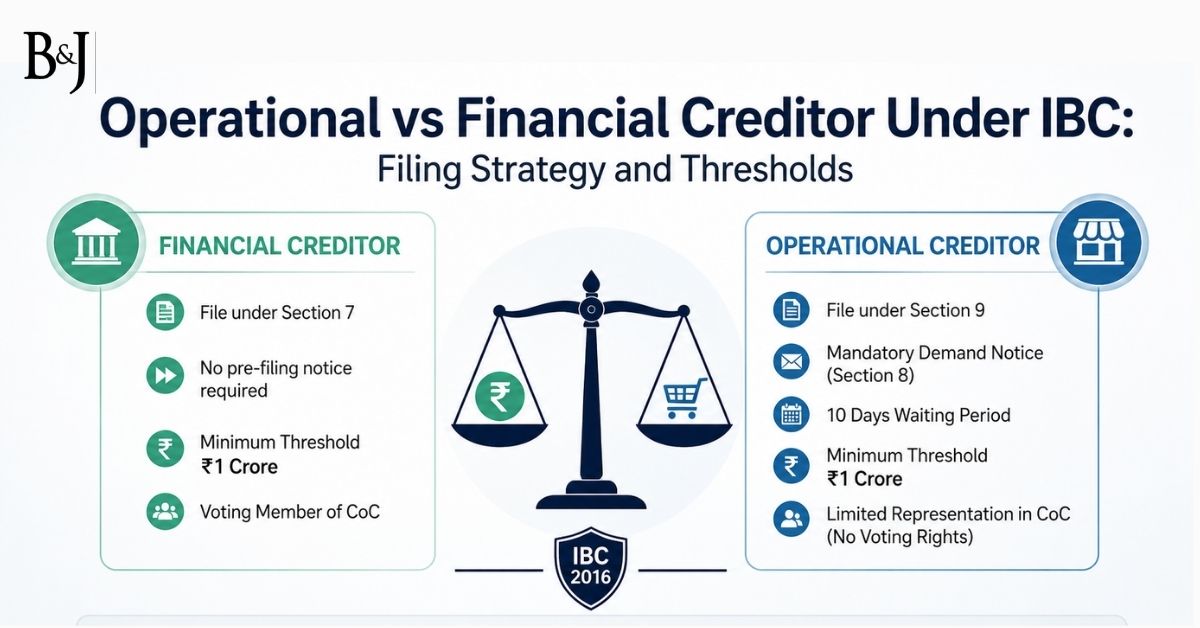
Operational vs Financial Creditor Under IBC: Filing Strategy and Thresholds
Executive Summary The distinction between an operational creditor and a financial creditor under the Insolvency and Bankruptcy Code, 2016 (“IBC” or “the Code̶
What “Time Value of Money” Means for Financial Debt under the IBC
Whether a creditor is a “financial creditor” decides who controls an insolvency: only financial creditors sit on the committee of creditors and vote on a resolution pla
Are Interest-Free Loans “Financial Debt” under the IBC? The Supreme Court’s Answer and Its Limits
Money often moves between group companies, from promoters into their businesses, or from friendly investors, without any stipulated interest. When the recipient later enters
Is a Profit-Sharing Investment a Financial Debt under the IBC? Joint Ventures, Section 5(8) and the Realpro Realty Decision
Two parties pool money to develop a property. One puts in seventy-five per cent, the other twenty-five. They share costs, profits and losses in the same ratio. The document calls t
Inter-Corporate Deposits as Financial Debt: NCLAT Position
An In-depth Analysis of the Case: Ansal Housing Ltd. vs. Samyak Projects Pvt. Ltd. Introduction The relationship between corporate entities often involves financial arrangements th
Personal Insolvency Consequences in India: IBC Section 100 & Discharge
Introduction The landscape of insolvency and bankruptcy law in India underwent a paradigmatic transformation with the enactment of the Insolvency and Bankruptcy Code, 2016 (hereina
Financial Debt and Time Value of Money: A Legal Analysis of Akzo Nobel India Ltd vs Stan Cars Pvt Ltd
Introduction The evolving jurisprudence surrounding financial debt under the Insolvency and Bankruptcy Code, 2016 continues to shape India’s corporate insolvency landscape. T